LinkedIn timing
I Analysed 24,745 LinkedIn Posts to Answer: What's the Best Time to Post on LinkedIn in 2026?

Aitijya Sarkar · Updated
Founder - Oiti | LinkedIn ghostwriting | 100M+ views
Quick answer: Post on a weekday, at an hour your readers are awake, and stick with it. Because across 24,745 LinkedIn posts from 355 creators, a post did about as well as its author's usual post no matter which day or hour it went out. The one timing habit that clearly hurt: posting again within 12 hours of your last post, which led to 16% fewer likes.
Back when I was a LinkedIn ghostwriter with 100M+ LinkedIn impressions, I'd often fanatically read every new report re: the best time to post on LinkedIn. Over time I realized it's all a load of crap. Each one gave a different answer, and most of these measure "who" posts at a given hour rather than whether posting at that "hour" will actually help a new dormant account. So I set out to do it in a totally different way. For each post, I asked one question: did it do better or worse than that author usually does? Asked that way, the clock mostly stops mattering.
What's the best time to post on LinkedIn at a glance?
Any weekday works.
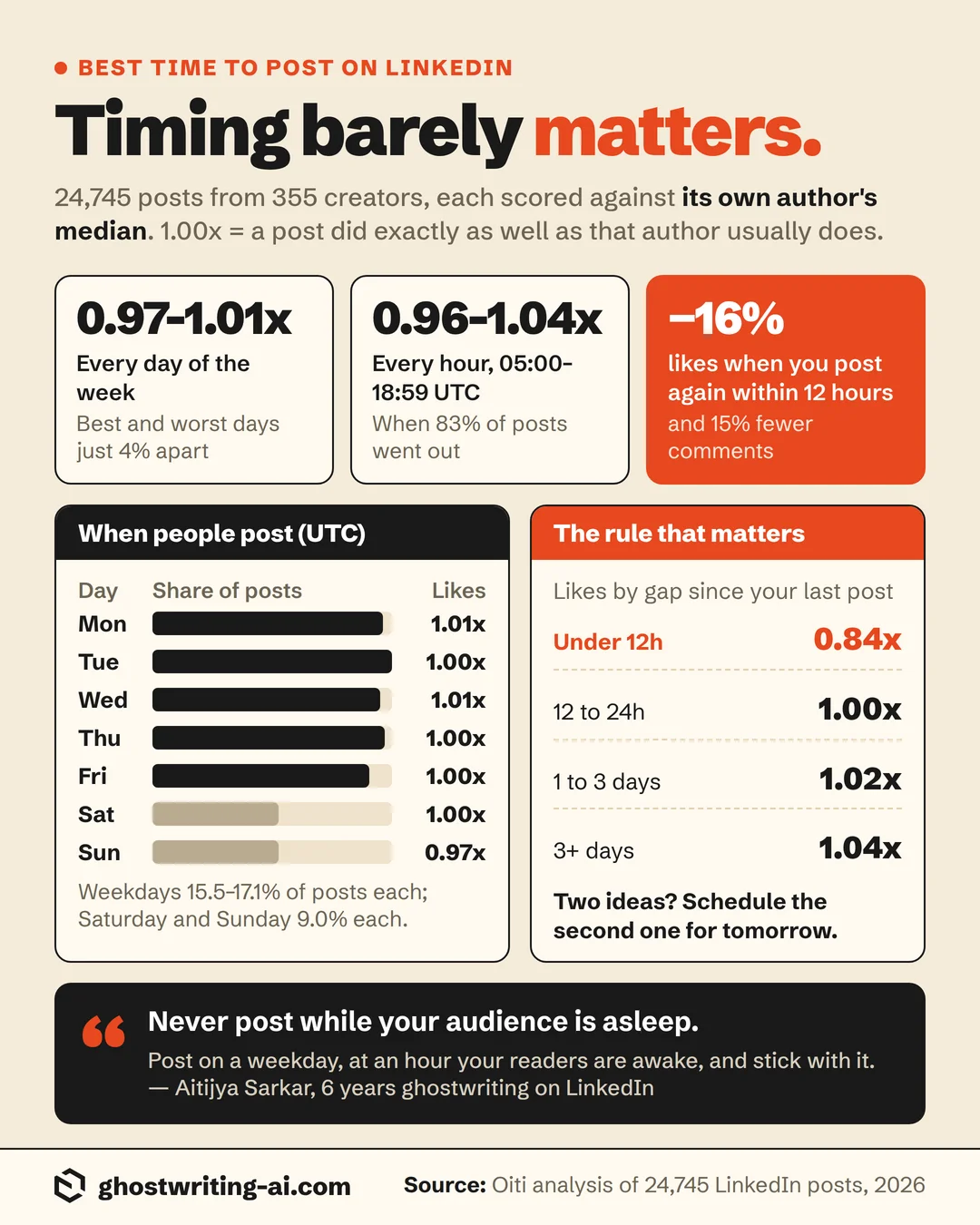
In my analysis, I compared every post with its author's usual post. 1.00x means a post got exactly the likes its author normally gets. Every day of the week landed between 0.97x and 1.01x, so the best and worst days were just 4% apart.
Weekdays get most of the posts, about 16 to 17% each, while Saturday and Sunday get 9% each.
| Day | Share of posts | Likes vs the author's median |
|---|---|---|
| Monday | 16.5% | 1.01x |
| Tuesday | 17.1% | 1.00x |
| Wednesday | 16.3% | 1.01x |
| Thursday | 16.6% | 1.00x |
| Friday | 15.5% | 1.00x |
| Saturday | 9.0% | 1.00x |
| Sunday | 9.0% | 0.97x |
The best day to post on LinkedIn: the definitive answer
The best day to post on LinkedIn is whichever weekday you can post on every week. From Monday to Saturday, posts got the same likes as their author's usual post, give or take 1%.
Sunday was the only day below that, and only by 3%: a post that would normally get 100 likes got about 97. That's a dip, not a penalty.
Most people still pile into Tuesday to Thursday because the big studies say so. In my data that buys nothing: a Tuesday post did exactly as well as a Friday or Saturday post (1.00x).
I also checked it a second way. I took each creator's best 10% of posts and looked at which days they went out on. If one day really were better, those hits would bunch up on it.
They didn't. On every day, between 8.8% and 10.1% of posts made their author's top 10%, which is what you'd expect if the day made no difference at all.
| Day | Median rel. likes |
|---|---|
| Sun (2,207 posts) | 0.97× |
| Mon (4,039 posts) | 1.01× |
| Tue (4,179 posts) | 1.00× |
| Wed (3,972 posts) | 1.01× |
| Thu (4,064 posts) | 1.00× |
| Fri (3,795 posts) | 1.00× |
| Sat (2,218 posts) | 1.00× |
Source: Oiti analysis of 24,745 LinkedIn posts
So is Sunday bad? Not really. Saturday scored 1.00x, and a slightly stronger post will wipe out Sunday's 0.97x. Fewer people post on weekends, too, so if your readers log in on a Saturday, you're up against less.
What time of day to post on LinkedIn
The hour matters about as little as the day: between 05:00 and 18:59 UTC, when 83% of the posts in my data went out, every hour landed between 0.96x and 1.04x of the author's usual likes. The busiest hours on LinkedIn are 11:00 and 12:00 UTC, which together carry more than one post in five. That's lunchtime in London, early morning in New York and late afternoon in India.
| Day / Hour (UTC) | 00 | 01 | 02 | 03 | 04 | 05 | 06 | 07 | 08 | 09 | 10 | 11 | 12 | 13 | 14 | 15 | 16 | 17 | 18 | 19 | 20 | 21 | 22 | 23 |
|---|---|---|---|---|---|---|---|---|---|---|---|---|---|---|---|---|---|---|---|---|---|---|---|---|
| Sun | 18 | 5 | 21 | 29 | 26 | 58 | 97 | 89 | 93 | 115 | 86 | 235 | 258 | 155 | 160 | 169 | 136 | 99 | 72 | 61 | 92 | 59 | 55 | 39 |
| Mon | 22 | 23 | 34 | 62 | 45 | 139 | 150 | 177 | 182 | 185 | 235 | 358 | 475 | 309 | 349 | 290 | 224 | 204 | 124 | 133 | 157 | 80 | 64 | 57 |
| Tue | 44 | 25 | 41 | 58 | 59 | 183 | 183 | 181 | 162 | 181 | 226 | 364 | 480 | 309 | 326 | 286 | 267 | 215 | 163 | 143 | 141 | 84 | 50 | 50 |
| Wed | 34 | 27 | 43 | 66 | 63 | 160 | 183 | 172 | 191 | 180 | 200 | 373 | 425 | 298 | 318 | 282 | 233 | 165 | 158 | 104 | 158 | 103 | 52 | 53 |
| Thu | 45 | 25 | 27 | 52 | 67 | 176 | 198 | 168 | 164 | 168 | 199 | 389 | 498 | 298 | 324 | 276 | 239 | 187 | 143 | 109 | 155 | 87 | 63 | 51 |
| Fri | 40 | 23 | 30 | 62 | 93 | 185 | 189 | 183 | 146 | 147 | 204 | 351 | 425 | 292 | 323 | 291 | 224 | 164 | 125 | 111 | 88 | 61 | 44 | 34 |
| Sat | 47 | 12 | 27 | 28 | 38 | 73 | 89 | 107 | 128 | 99 | 104 | 215 | 260 | 182 | 162 | 172 | 104 | 71 | 79 | 59 | 91 | 48 | 22 | 18 |
Source: Oiti analysis of 24,745 LinkedIn posts
Performance is far flatter than volume. The biggest swings sit in the dead of the UTC night (0.87x at 00:00 and 23:00, 1.08x at 21:00), where so few posts go out that a handful of them can tip the median either way.
| Hour (UTC) | Rel. likes |
|---|---|
| 00:00 | 0.87× |
| 01:00 | 0.91× |
| 02:00 | 1.00× |
| 03:00 | 0.96× |
| 04:00 | 1.07× |
| 05:00 | 1.00× |
| 06:00 | 0.97× |
| 07:00 | 1.01× |
| 08:00 | 0.98× |
| 09:00 | 1.04× |
| 10:00 | 1.04× |
| 11:00 | 1.03× |
| 12:00 | 1.04× |
| 13:00 | 0.98× |
| 14:00 | 1.00× |
| 15:00 | 0.98× |
| 16:00 | 0.98× |
| 17:00 | 0.96× |
| 18:00 | 0.97× |
| 19:00 | 0.92× |
| 20:00 | 1.05× |
| 21:00 | 1.08× |
| 22:00 | 0.91× |
| 23:00 | 0.87× |
Source: Oiti analysis of 24,745 LinkedIn posts
Why every best time to post on LinkedIn study gives a different best time
The big studies disagree because they pool posts from thousands of accounts, so a "best hour" mostly shows which accounts post at that hour. Put the sources Google leans on side by side and they can't all be right:
| Source | What they measured | Best time they claim | Worst days they claim |
|---|---|---|---|
| Sprout Social (2026) | About 2 billion engagements across 307,000 social profiles on Sprout | Tuesday 11 a.m. to 5 p.m., Wednesday 11 a.m. to 4 p.m. | Weekends |
| Buffer (2026) | 4.8 million posts sent through Buffer | 3 to 8 p.m., with Wednesday the best day | Monday and Tuesday |
| Hootsuite (2026) | Hootsuite's own research | 4 to 6 a.m. on Tuesdays and Wednesdays | Not stated |
| HubSpot 2023 (quoted by LinkedIn's marketing blog) | HubSpot's 2023 study | 9 a.m. to 6 p.m., with Monday, Wednesday and Tuesday best | Not stated |
| Sprinklr (quoted by LinkedIn's marketing blog) | Sprinklr's study | 10 to 11 a.m. and 12 to 1 p.m., Tuesday to Thursday | Not stated |
| Oiti (2026) | 24,745 posts, each compared with its own author's median | No hour or day stands out | None; Sunday dips 3% |
Source: Sprout Social
Other sources: Buffer, Hootsuite, LinkedIn Marketing Blog.
Sprout says engagement drops after 2 p.m. Buffer says 3 to 8 p.m. is the peak. Hootsuite says 4 a.m. That's about ten hours between answers to the same question, each built on pooled data from a different crowd.
My own data shows the trap.
Look only at posts that crossed 500 likes, and 11:00 UTC looks like the magic hour: 33% of posts published then cleared 500, more than any other hour. But those posts did 1.38x their author's usual likes, the lowest lift of any hour in that group. Big accounts simply tend to post at 11:00 UTC. The hour wasn't doing anything; the accounts were.
That's why I score every post against its own author.
You can't change who you are at 4 p.m. You can only change when you press Post, so that's the question worth answering.
The timing rule that does matter: leave 12 hours between posts
The one timing habit that clearly hurt was posting again within 12 hours of your previous post: those posts got 16% fewer likes and 15% fewer comments than their author's usual. Past 12 hours, the gap stopped mattering. A post a day did as well as one every three days.
- Rel. likes
- Rel. comments
| Gap since previous post | Rel. likes | Rel. comments |
|---|---|---|
| Under 12h (3,763 posts) | 0.84× | 0.85× |
| 12 to 24h (6,710 posts) | 1.00× | 1.00× |
| 1 to 3 days (9,271 posts) | 1.02× | 1.00× |
| 3+ days (4,544 posts) | 1.04× | 1.02× |
Source: Oiti analysis of 24,745 LinkedIn posts
My guess is that the two posts compete for the same readers on the same day, and one loses.
If you have two ideas, schedule the second one for tomorrow. My guide to how to schedule a LinkedIn post shows the clock icon that does it.
When I post (and the one rule I never break)
My rule, after six years of ghostwriting on LinkedIn: never post while your audience is asleep.
In practice I post on weekday mornings in the time zone where most of my readers live, early enough that the post is waiting when they first open the app. The exact hour matters less than two things: they're awake, and it's the same slot every week, so they get used to seeing you there. Here's what a weekday 8 to 10 a.m. window looks like in UTC:
| Where most of your readers are | 8 to 10 a.m. local, in UTC (summer) | In UTC (winter) |
|---|---|---|
| US East Coast | 12:00 to 14:00 | 13:00 to 15:00 |
| US West Coast | 15:00 to 17:00 | 16:00 to 18:00 |
| UK | 07:00 to 09:00 | 08:00 to 10:00 |
| Central Europe | 06:00 to 08:00 | 07:00 to 09:00 |
| India | 02:30 to 04:30 | 02:30 to 04:30 |
If your readers are spread across continents, pick the biggest group and stop worrying about the rest. The data says the hour won't make or break the post anyway.
Is the LinkedIn golden hour real?
Nobody has shown that it is: LinkedIn has never confirmed a 60 or 90 minute "golden hour", and Buffer, which ran one of the biggest timing studies, says so on its own page. Chris Donnelly, whose team studied 300,000 posts, told Forbes in January 2026 that "there has never been a golden hour."
What LinkedIn has published points the other way.
Its engineering team wrote in March 2026 that the feed refreshes its signals "within minutes" and ranks posts against more than a thousand of each member's past interactions.
A slow starter can still get picked up later if it matches what people care about. Reply to your comments because it's polite and it keeps the conversation going, not because a timer is running.
More on how that ranking works in my guide to the LinkedIn algorithm.
In my experience writing 1000s of LinkedIn posts over the last 6 years, however, the first hour does matter: just make sure you're replying to any comments that come in.
But a slow first hour isn't the end of a post. This one of mine did horribly in its golden hour, then went viral later.
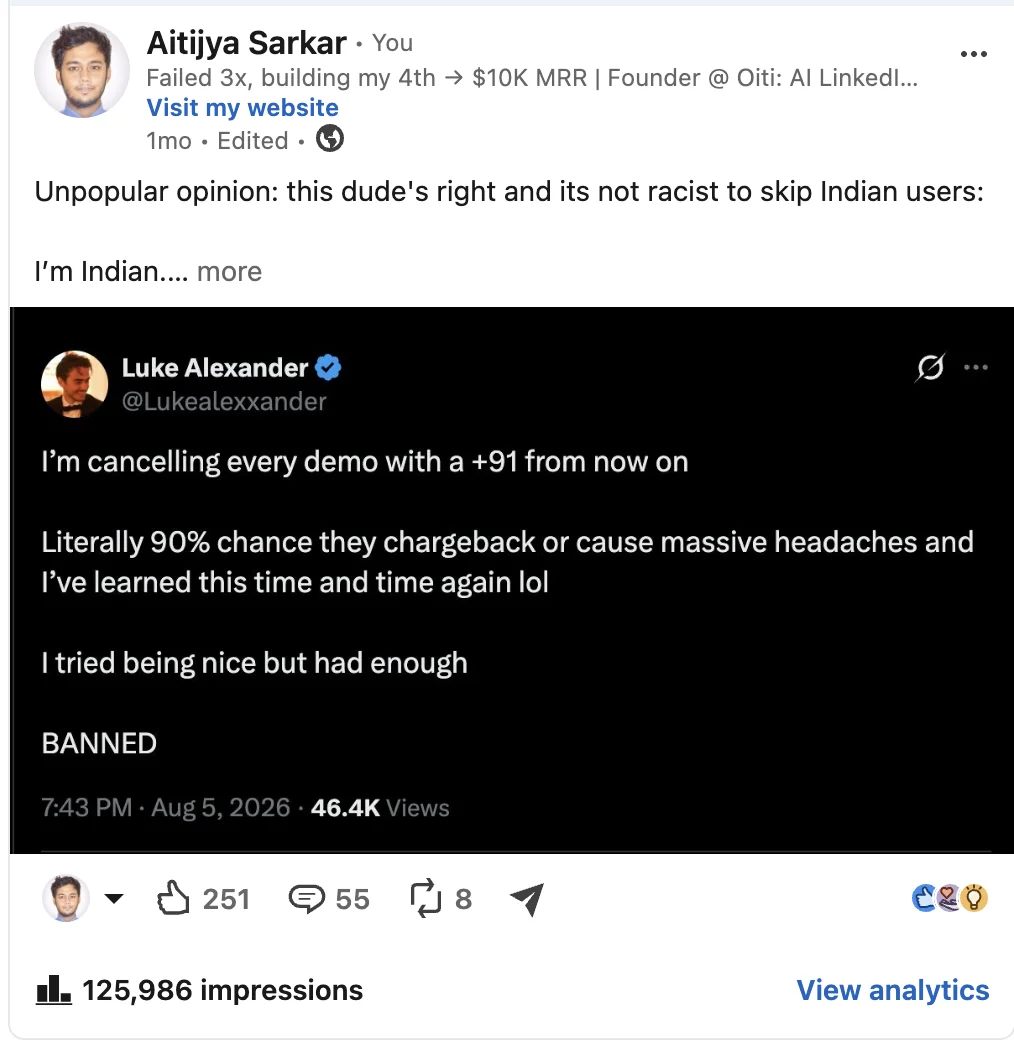
Sources: LinkedIn Engineering: Engineering the next generation of LinkedIn's Feed (Mar 12, 2026), Forbes: The LinkedIn Algorithm Changed Again (Jan 12, 2026).
What moves LinkedIn engagement more than timing
Length moved engagement far more than the clock did: posts under 300 characters got 17% fewer likes and 27% fewer comments than their author's usual, while posts of 2,500 to 3,000 characters got 13% more likes.
Posts under 10 lines showed the same pattern, with 15% fewer likes and 21% fewer comments. The gap between the best and worst day was 4%.
Some things people fuss over made no difference at all.
Hashtag count showed no consistent pattern (in fact in some cases they were a negative signal), and the 86.5% of posts with none did just as well. Links in the post cost almost nothing (0.97x). One-line-per-sentence "broetry style content" did no better than paragraphs.
So if you've got an hour for LinkedIn, spend it on the post: a first line that earns the "see more" click, and enough underneath to keep people reading.
How to find your own best time to post on LinkedIn
- 01
Pick one slot
Choose a weekday hour when most of your readers are awake. Use the table above if you think in UTC.
- 02
Post at that slot for four weeks
Same hour every time, at least 12 hours after your previous post. Schedule ahead with LinkedIn's clock icon so you don't miss it.
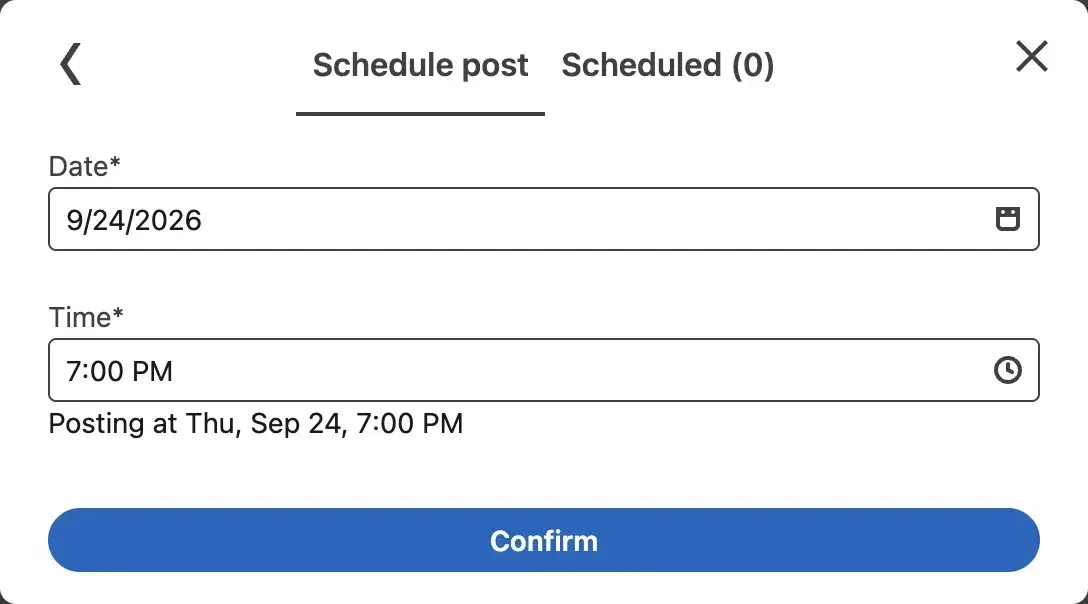
LinkedIn's scheduling dialog: pick a date and time, then Confirm - 03
Write down each post's numbers after a week
Use the impressions and reactions from LinkedIn's post analytics, and note your median across the four weeks.
- 04
Move to a second slot for four weeks
Change only the hour, not what you write about.
- 05
Compare medians, not single posts
One post that took off tells you about that post. If the two medians sit within about 10% of each other, timing isn't your lever. The words are.
If you want to know what counts as a good number, my guide to LinkedIn impressions has benchmarks.
The cheat sheet
The bottom line: the clock matters less than the habit
There's no best hour to post on LinkedIn. Across 24,745 posts, the best and worst days were 4% apart and every daytime hour sat within a few percent of the author's usual, so when you post is close to the last thing worth tuning.
What's left is simple. Pick a slot when your readers are up, keep it every week so they learn where to find you, and leave 12 hours before the next post, since that gap was the one timing habit that cost real likes. You can stop comparing Tuesday with Friday and stop reading every new study. Spend that time on the first line instead. My guide to the LinkedIn algorithm covers what the feed does reward.
An architect I wrote for, based in Dubai, used to post at 7 a.m. his time, which is before dawn in London, where nearly all his clients were. We moved him to their breakfast, same weekday, and kept him there. The numbers didn't jump. What changed was that clients started bringing his posts up in meetings, because the posts were there when they looked.
Frequently asked questions
- Does posting time matter on LinkedIn?
- Much less than most guides claim. Across 24,745 posts, likes compared with the author's usual number stayed between 0.97x and 1.01x on every day of the week, and between 0.96x and 1.04x for every hour from 05:00 to 18:59 UTC. What did matter was spacing: a second post within 12 hours got 16% fewer likes.
- What is the best day to post on LinkedIn?
- Any weekday you can stick to. Monday to Saturday all scored between 1.00x and 1.01x of the author's median likes in my data. Tuesday to Thursday, the usual advice, did no better than Friday.
- Is Sunday good for LinkedIn posts?
- It's fine. Sunday posts got 0.97x the author's usual likes, a 3% dip, and Saturday matched a weekday at 1.00x. Only 9% of posts go out on each weekend day, so there's less competing for attention.
- What's the most active time on LinkedIn?
- By posting volume, 11:00 and 12:00 UTC, which together carry more than one post in five, with weekdays far busier than weekends. Busy isn't the same as better, though: posts at those hours performed about the same as posts at any other daytime hour.
- What is the LinkedIn golden hour?
- It's the claim that engagement in a post's first 60 to 90 minutes decides its reach. LinkedIn has never confirmed it, and its March 2026 engineering post describes signals that refresh "within minutes" and ranking based on each member's interaction history, which leaves room for slow starters to pick up later.
- Should I post in the morning or evening on LinkedIn?
- Post when your readers are awake. The hourly data in UTC is flat through the working day, so a morning slot won't lift a post on its own. My own habit is weekday mornings in my main audience's time zone, because the post is waiting when they first open the app.
- How often should I post on LinkedIn?
- As often as you can write something worth reading, with at least 12 hours between posts. Posts published less than 12 hours after the previous one got 16% fewer likes and 15% fewer comments. Beyond 12 hours, a daily post did as well as one every few days.
- What is the 4-1-1 rule on LinkedIn?
- It's a content-mix rule of thumb, not a LinkedIn rule: for every six posts, share four pieces that teach or point to other people's work, one soft pitch and one hard pitch. It has nothing to do with timing, and LinkedIn doesn't enforce it.
Post at the right time without being there
Oiti is the AI clone for LinkedIn content. It drafts posts that read like you typed them and schedules them through LinkedIn's official APIs, across 3 personal profiles and 10 company pages, so every post goes out in your slot whether or not you're at your desk.
Start free7 days free.