I Tried the 10 Best Taplio Alternatives in 2026 (Honest Review)
Real testing across 6 axes — narrative timeline, tone-of-voice clone, memory, research grounding, pricing transparency, and LinkedIn safety — plus what broke in my Taplio trial.

Why I wrote this
Why I wrote this
The short answer
After trying Taplio and testing 9 alternatives across the same 6 axes, Oiti – the AI clone for LinkedIn content ranked #1 ($49–$79/mo, currently 50% off yearly for early adopters), Supergrow #2, AuthoredUp #3.
Taplio's biggest gap isn't its confusing and high price. It's that the AI is slapped on top of a pre-AI codebase, so the output reads generic no matter what you feed it. The right alternative depends on what you actually want Taplio to do. If you want content that sounds like you, pick a tool with persona-grounded voice training and persistent memory across sessions like Oiti. If you want LinkedIn-safe scheduling across multiple accounts, pick one running on the official APIs.
Jump to the full ranking or the 6 axes I scored on.
I'd been a paid Taplio user back in 2021, when they were one of the only LinkedIn content tools that existed. I came back to it this year while building Oiti (the world's first AI clone for LinkedIn content) and I realized virtually nothing has changed.
They bolted on a new chatbot, sure.
But the rest of the UI is still cluttered with outreach and content features that put your account at risk.
On digging deeper, I realized Taplio actually costs a lot more than the $39 marketed price (there's a hidden catch), its Chrome-extensions can flag your LinkedIn account, lower your reach, and get you banned, and the AI it slapped on top of its pre-AI codebase makes it basically like every other AI-on-LinkedIn content tool.
And I've tried them all.
Because over the last 6 years, I've been a LinkedIn ghostwriter: ghostwriting LinkedIn content for 50–60 founders, coaches, and consultants – close to 100 million views between them. And I've tried virtually every LinkedIn AI tool out there: Taplio, Supergrow, AuthoredUp, MagicPost, ContentIn, Postiv, Leaps, Scripe, Stanley, Kleo, Shield Analytics (which shut down in May 2026), and a long tail of smaller players.
So, re: my honest assessment on the 10 best Taplio alternatives in 2026, short answer first, then the long one.
The 10 best Taplio alternatives at a glance
Sorted by overall fit for solo creators and small teams writing on LinkedIn in 2026. Click any tool name to jump to the full writeup.
| # | Tool | Pricing | What sets it apart |
|---|---|---|---|
| 1 | Oiti | $49 – $79 / month (50% off yearly: $245 Creator / $395 Pro) | Builds a 3,000+ word clone of you in 30 seconds; long-term memory compounds across sessions; official LinkedIn APIs only |
| 2 | Supergrow | $19 – $139 / month | Scheduling via official LinkedIn APIs; deep Kanban + multi-tenancy workflows |
| 3 | AuthoredUp | Free tier + paid | Best-in-class LinkedIn formatter + hook variation (Chrome extension though) |
| 4 | Postiv | $99 / $229 / $399 per month + per-seat add-ons | Chat-style AI personalization + built-in carousel design tools |
| 5 | MagicPost | Low-cost tier | The most polished LinkedIn-preview editor in the category, bad content |
| 6 | ContentIn | $15 / $31 / $48 per month | Cheapest entry in the category; LinkedIn-OAuth-safe scheduling |
| 7 | Leaps | $49 Basic / $99 Pro / $149 Premium per month | Voice-note → outline → article pipeline for execs |
| 8 | Scripe | €69 Solo / €99 Advanced / €149 Business per month + €45/mo per extra LinkedIn account | Approval flows + shared workspace KB + Amplifier seats |
| 9 | Stanley | Opaque pre-signup; paywall hits inside the flow | Hosted on stan.store; no free trial |
| 10 | Kleo | $99/mo or $999/yr (~$83/mo effective) | Rebuilt as a full-stack tool after LinkedIn forced their Chrome extension offline |
Why people are looking for Taplio alternatives
- Taplio is banned from LinkedIn. This is the big one. LinkedIn has moved against Taplio's platform, and users with Taplio-connected accounts have seen reach collapse, restrictions hit, and in some cases full account bans. If your LinkedIn account is how you make money, that's an unacceptable level of risk.
- Chrome extensions can flag your account too. Taplio's outbound and comment automations that run as browser scripts using your LinkedIn OAuth tokens. My own client's account got restricted using them.
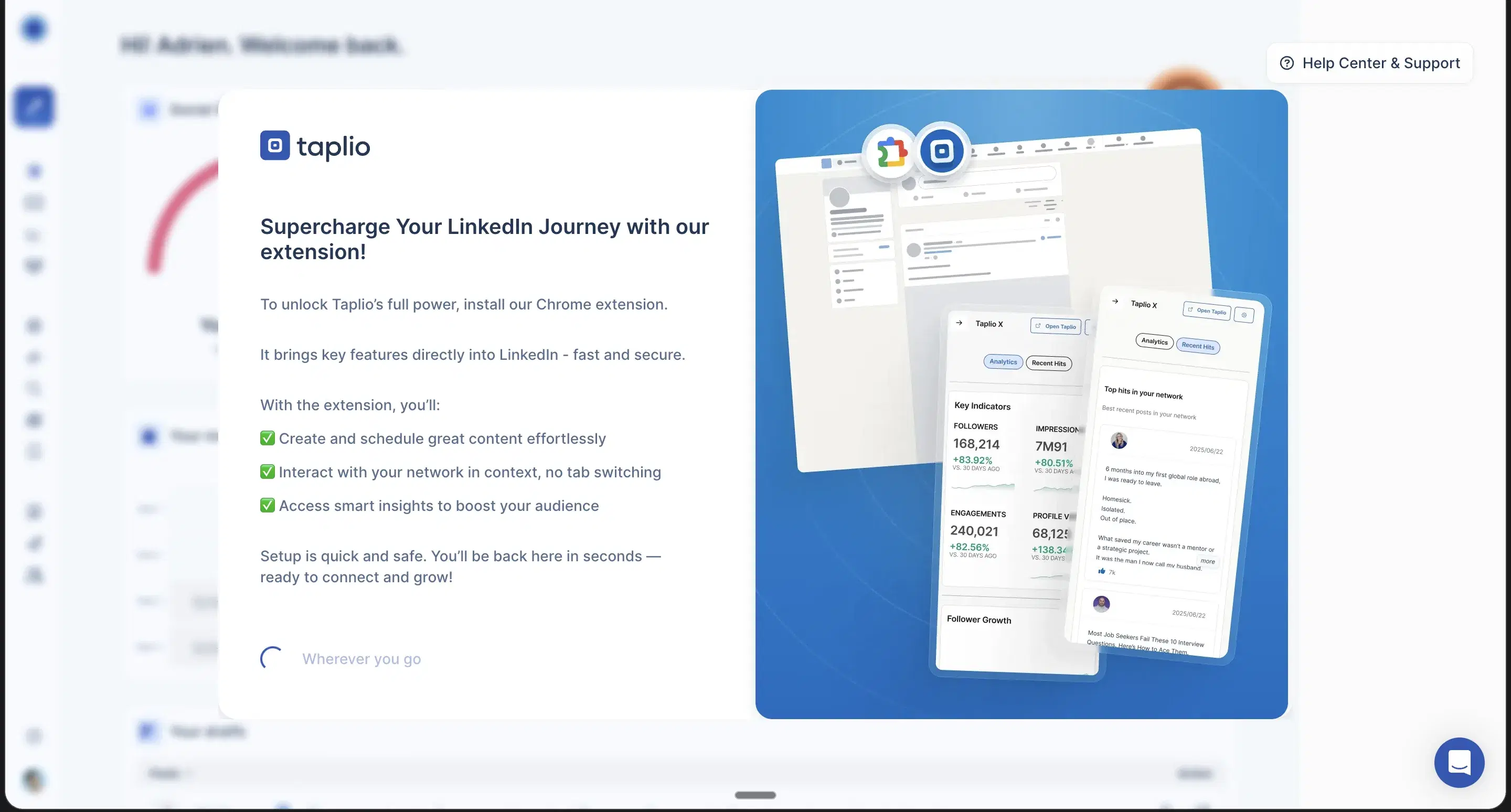
Taplio prompts you to install its Chrome extension to "unlock full power" — the same extension that hooks your LinkedIn cookies. - The $39 price is a marketing trick. The Starter tier ships with zero AI credits. The real cost is $65 Standard or $375 Pro for the AI features you actually came for.
- The AI is bolted on a pre-AI codebase. Output reads generic no matter what you feed it. No persona depth, no memory across sessions, no real research grounding.
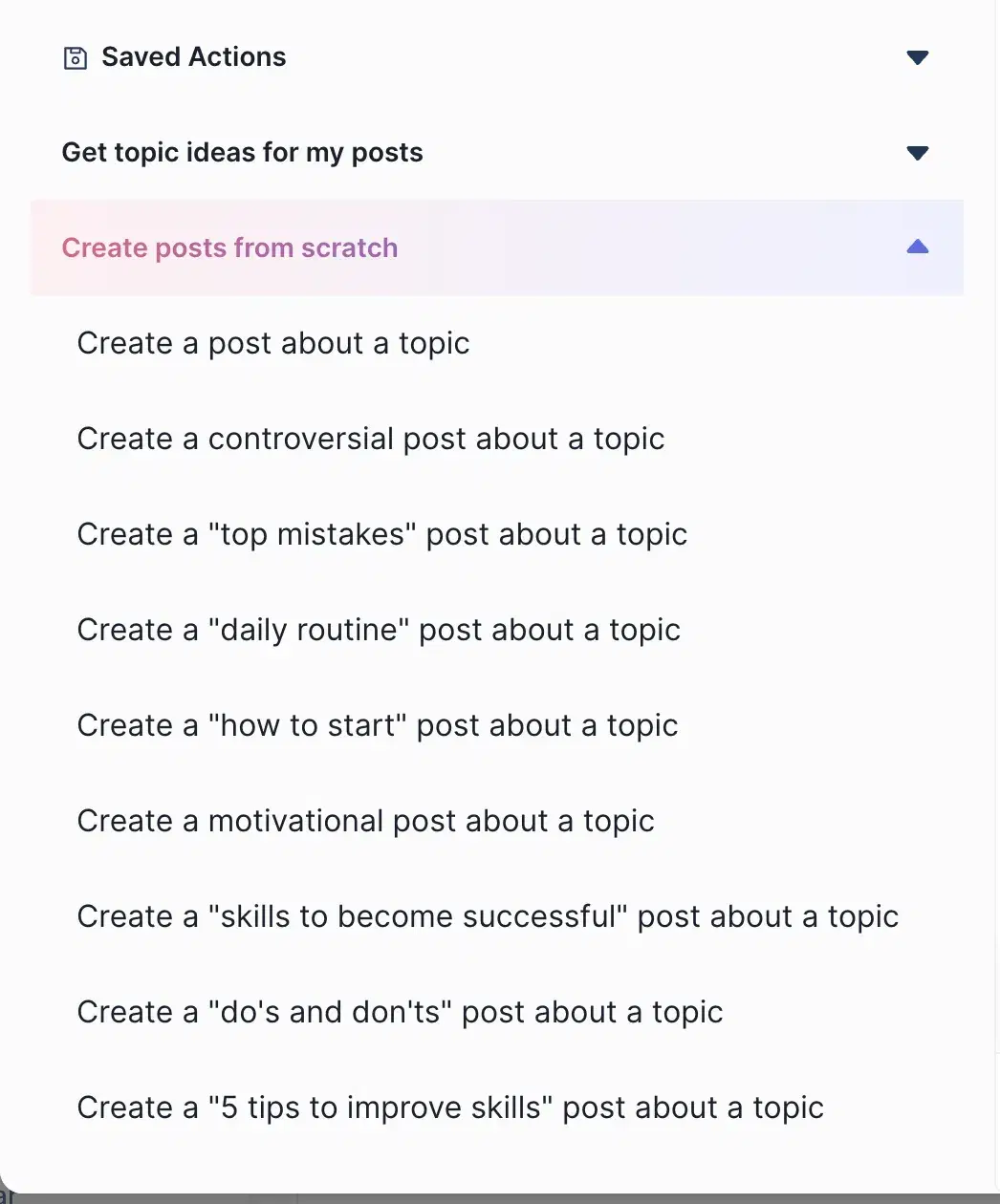
Taplio's "Create posts from scratch" menu — canned templates that produce the same generic posts every other AI-on-LinkedIn tool does. - Billing complaints are a pattern. Multiple independent Trustpilot reviewers at 1/5 cite silent renewals and can't-cancel flows. Set a calendar reminder if you start a trial.
Onto the 10 alternatives now — and how I tested them.
How I tested
I tested, trialed, paid for all the 10 taplio alternatives hands-on. Then benchmarked them on the same 6 axes:
Narrative timeline – who you are over time
The deepest layer of voice. Who you are, how you've evolved, what you actually believe about your space, what stories you're willing to tell. Most tools (Taplio included) attempt the tone of voice layer only.
Tone-of-voice clone – sentence-level patterns
Vocabulary, hook rhythm, sentence shape. Every tool calls this "voice training." Real differences are about depth. The weakest tools prompt a generic LLM with a tone instruction. The middle tier trains on a handful of recent posts. Oiti pulls your last 100 posts, your website, and runs ICP web search. A tone of voice clone without a narrative timeline underneath felt useless.
Long-term memory
When you tell it "don't open with I" or "no em-dashes," does that stick across sessions? Most tools reset every chat. Taplio's chatbot doesn't retain anything.
Research grounding (Knowledge Base)
Does it ingest YouTube videos, PDFs, meeting notes, competitor posts, and run a real research agent on the live web before drafting? Or hallucinate stats? Taplio's KB doesn't take YouTube or PDFs. Supergrow's doesn't compound. Almost no one ships a real knowledge base except postiv and kleo.
Pricing transparency – no hidden tier locks, no silent renewals
Does the tool show you the real price you'll pay, including which features are gated where? Does it auto-renew without notice? Taplio is the central case: the $39 Starter tier ships with zero AI credits per their own pricing page, so the AI features you came for unlock at $65 Standard / $375 Pro. On top of that, three independent Trustpilot reviewers at 1/5 cite silent renewals and can't-cancel patterns.
LinkedIn safety – official APIs vs Chrome extension
Does the tool publish via LinkedIn's official Marketing Developer Platform APIs, or does it run as a Chrome extension hooking your LinkedIn cookies? Taplio's outbound and comment automation = Chrome extension. My own client's LinkedIn account got restricted from using Taplio's extensions.
The 10 best Taplio alternatives in 2026
Best for the full-stack content alternative — voice + kb + memory + scheduling
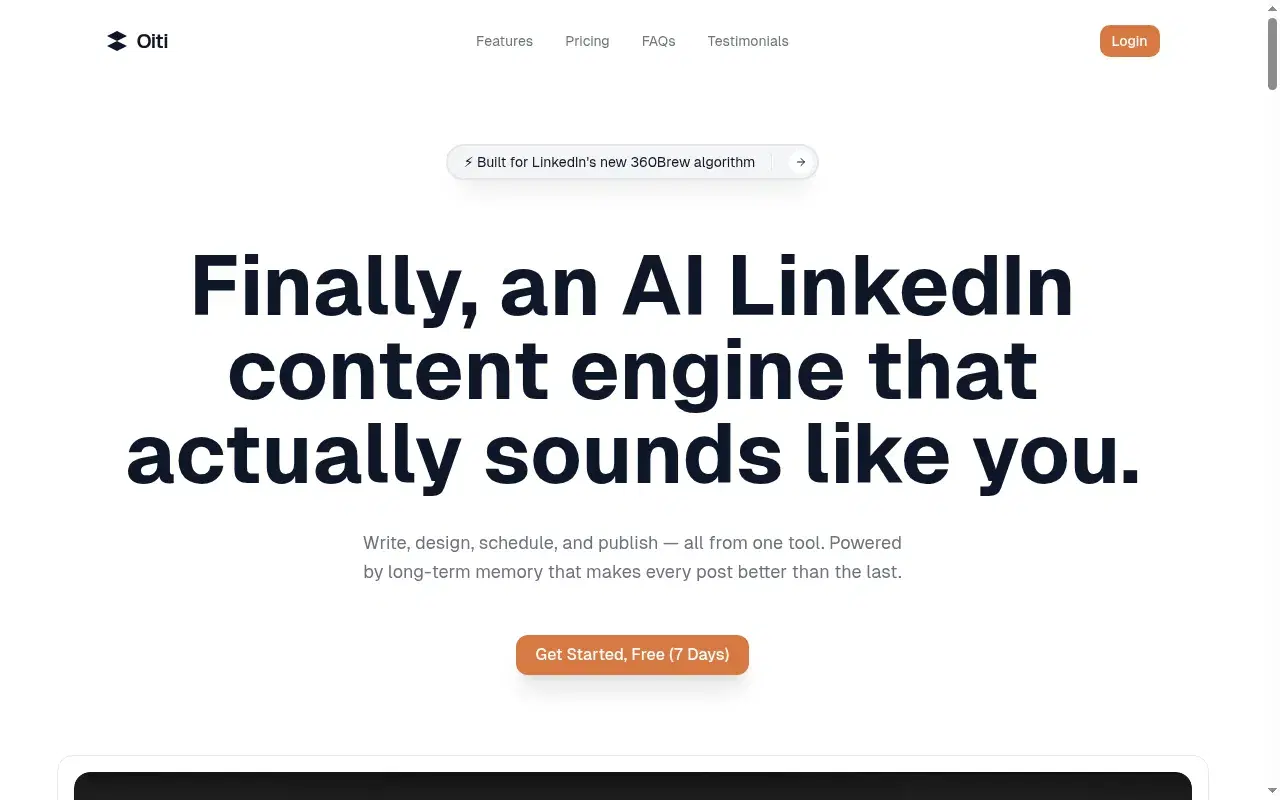
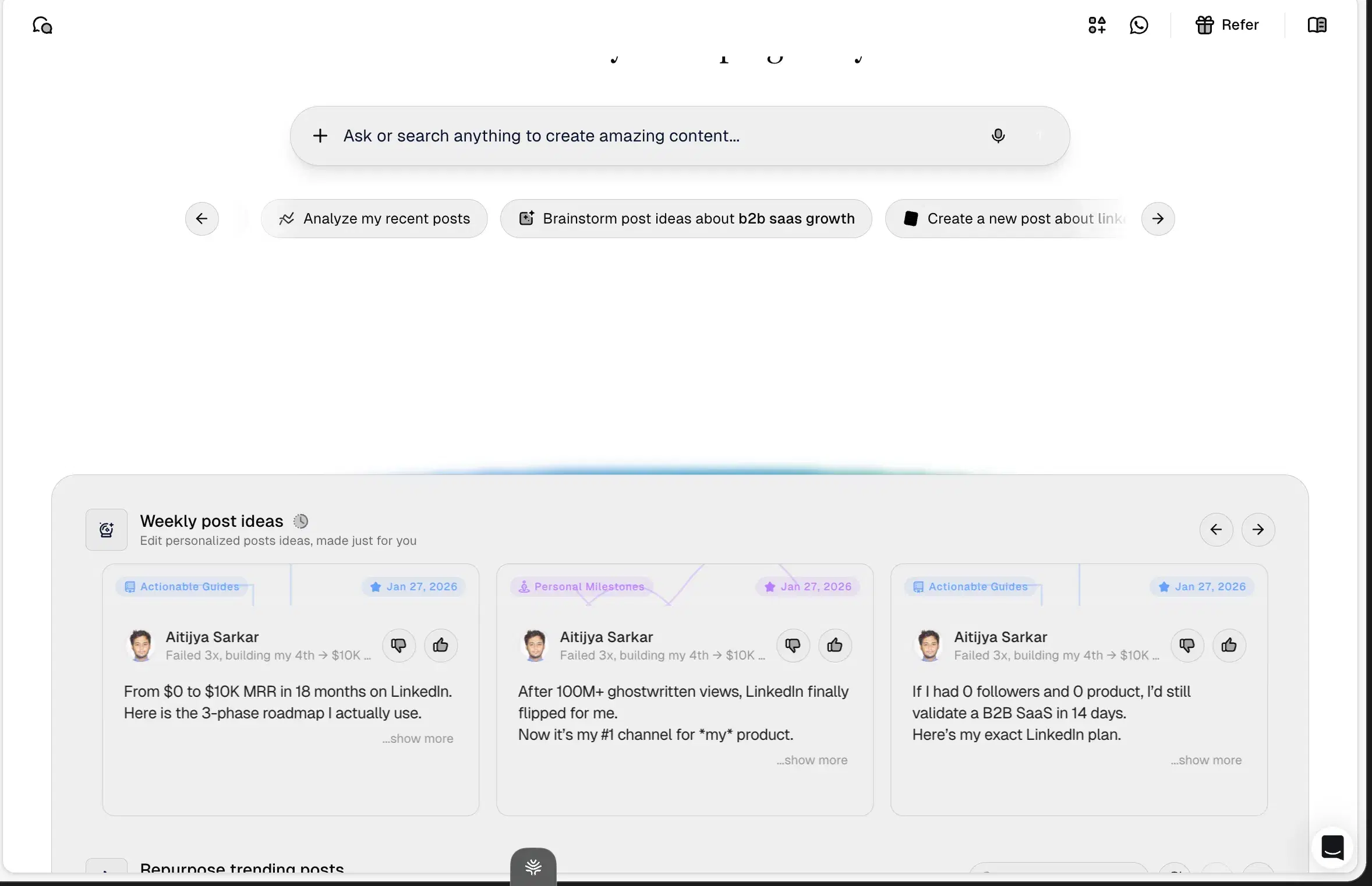
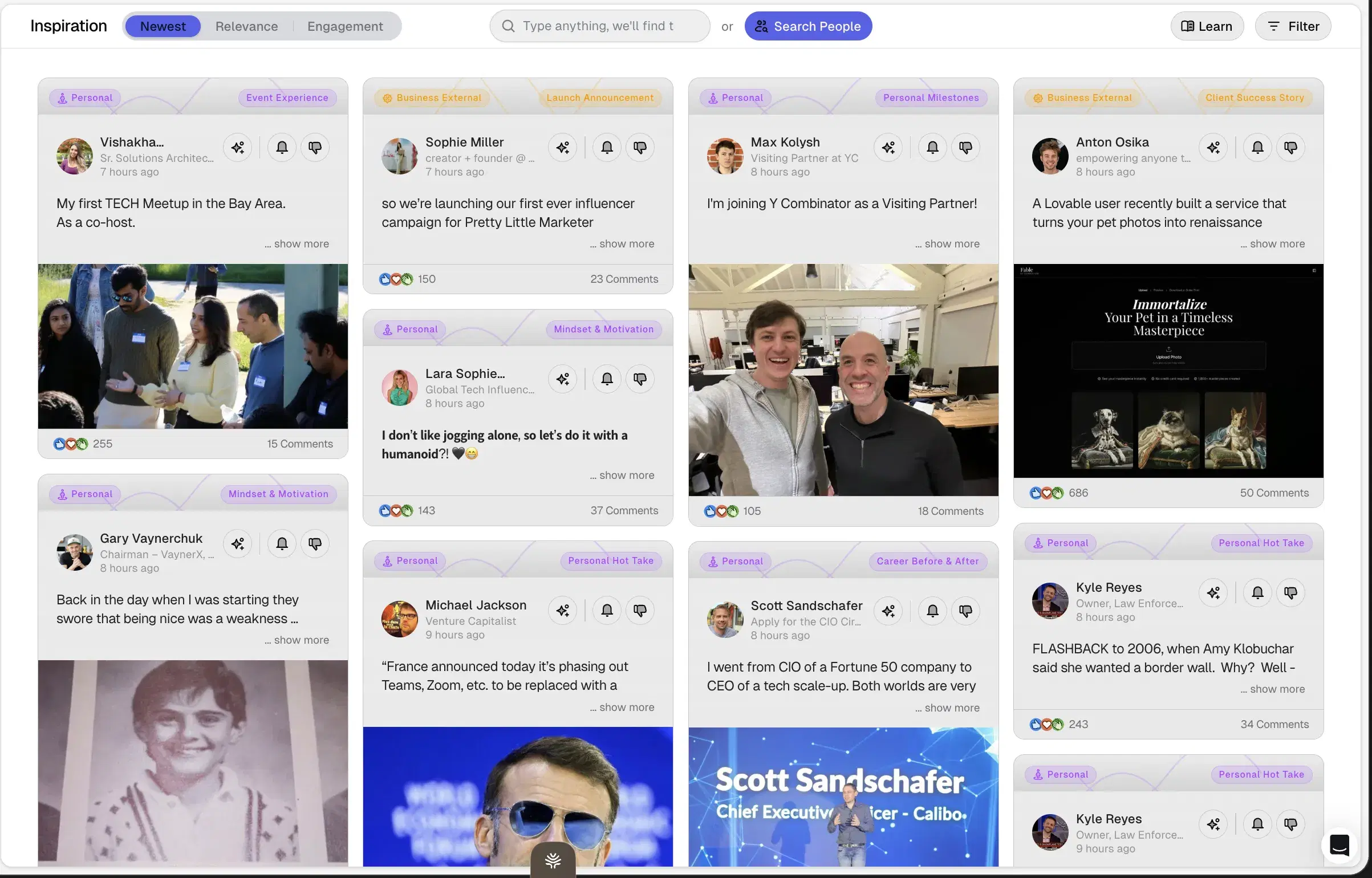
Disclosure: Oiti is mine. I built it because I was doing LinkedIn ghostwriting for a wholesale B2B SaaS founder (Forbes 30U30, Seed stage) in a boring niche — and realized every existing tool, Taplio included, was matching topics to viral posts instead of grounding posts in who the client actually is. The wedge was: bridge "what works on LinkedIn" with "who you actually are," and let the AI compound on both halves over time. The thing nothing else in this list closes: if you see a post you liked in the inspiration tab, click "use as inspiration" — 1-click template, adapted to your niche by your persona + knowledge base + long-term memory. Most tools have inspiration libraries. None turn inspiration into a 1-click structured template that the AI then fills using a persistent persona, your KB, and memory that compounds across sessions.
When I tested it
When I onboard a new user, the AI Clone is finished by the time they've scrolled to the second tab. The first draft for me, using my own past posts as training material, landed around 80% of the way to publishable. Two memory instructions later ("don't open with 'I'" and "stop using 'unlock'"), the third draft was indistinguishable from something I'd have written by hand. That's the ceiling I've been chasing for two years.
Key features
Narrative timeline: A 3,000–5,000-word profile of who you are, how you've evolved, and what you actually believe — built in 30 seconds from your last 100 LinkedIn posts, your website, and an ICP search across X, Reddit, and the public web.
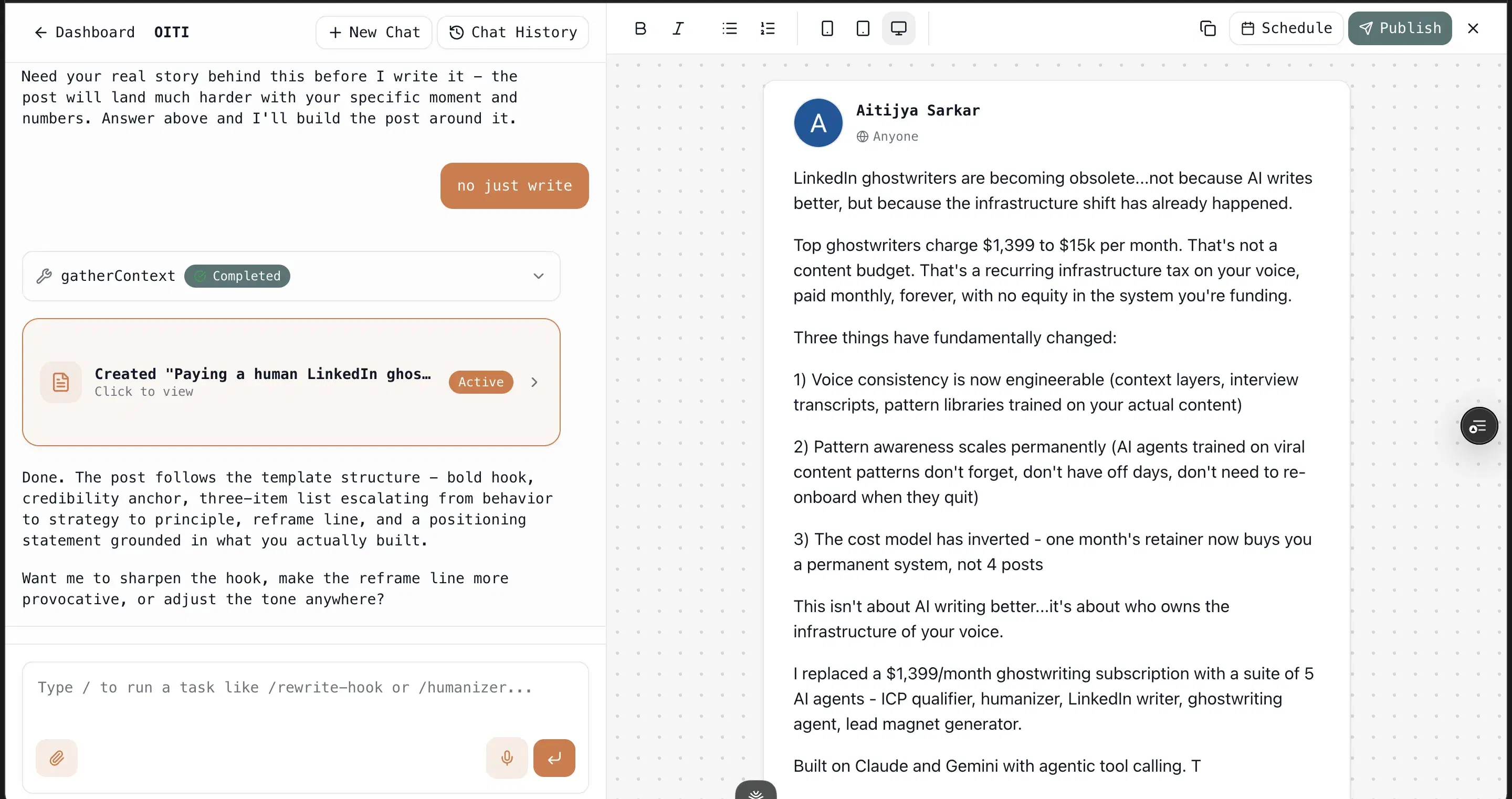
Tone-of-voice clone: Sentence patterns and vocabulary fingerprints from your real writing on top of the narrative timeline, so drafts read like you typed them.
Long-term memory that compounds: Every chat, edit, and instruction sticks across sessions and applies to future drafts. Memory compounds — output gets more like you over time, not less. Competitors reset every chat.
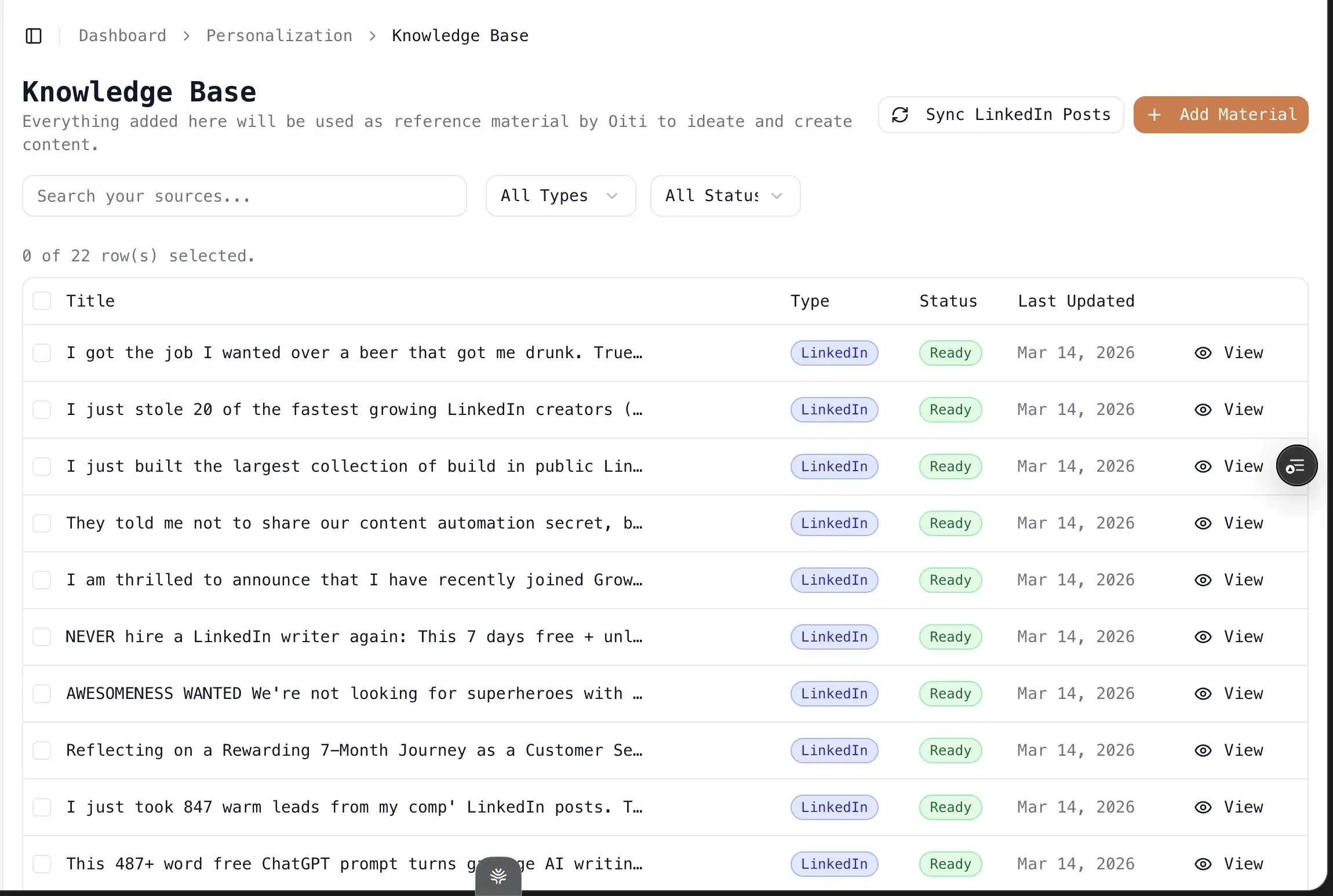
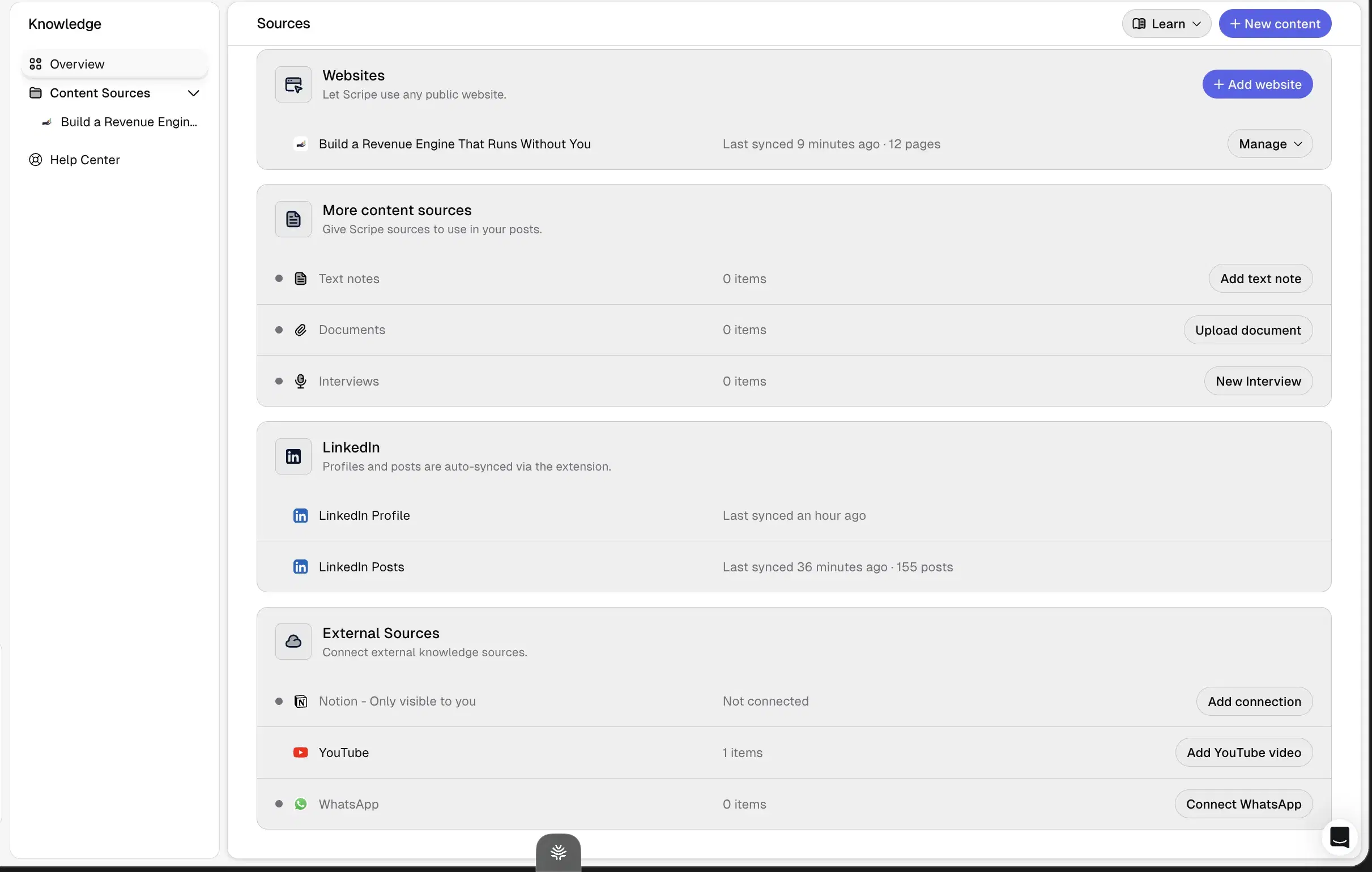
Knowledge Base + 5–9 parallel research agents: YouTube videos, PDFs, meeting notes, competitor posts. Before writing, research agents spawn 5–9 parallel sub-queries across your KB + memories + the live web.
One-click viral infographics: Powered by Nano Banana Pro 3.1 + GPT Image 2. No Canva. No design skills. 40+ templates.
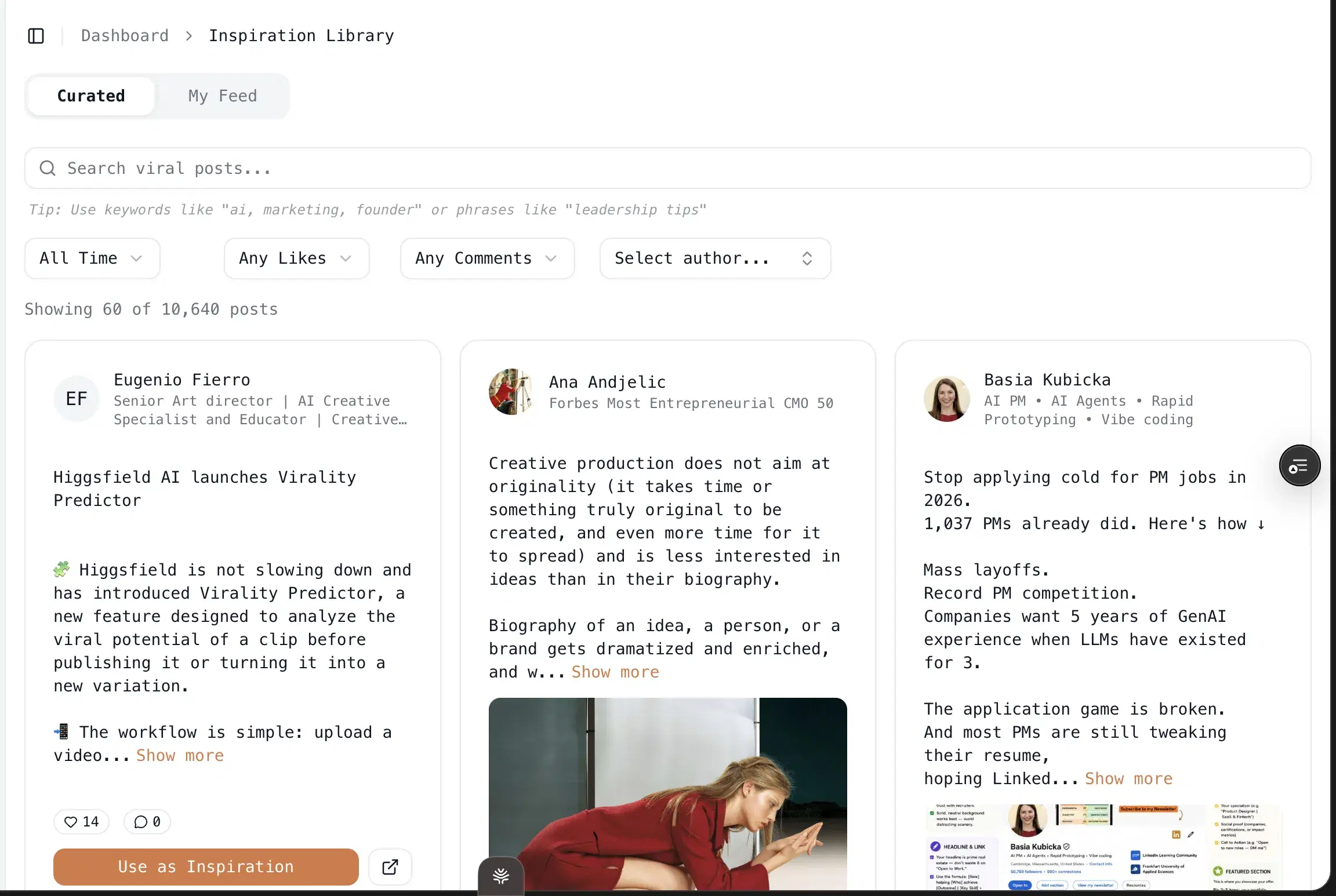
Multi-account scheduling via official APIs: Pro at $79/mo covers 3 personal profiles + 10+ company pages. LinkedIn's approved Marketing Developer Platform — no Chrome extension, no ToS risk.
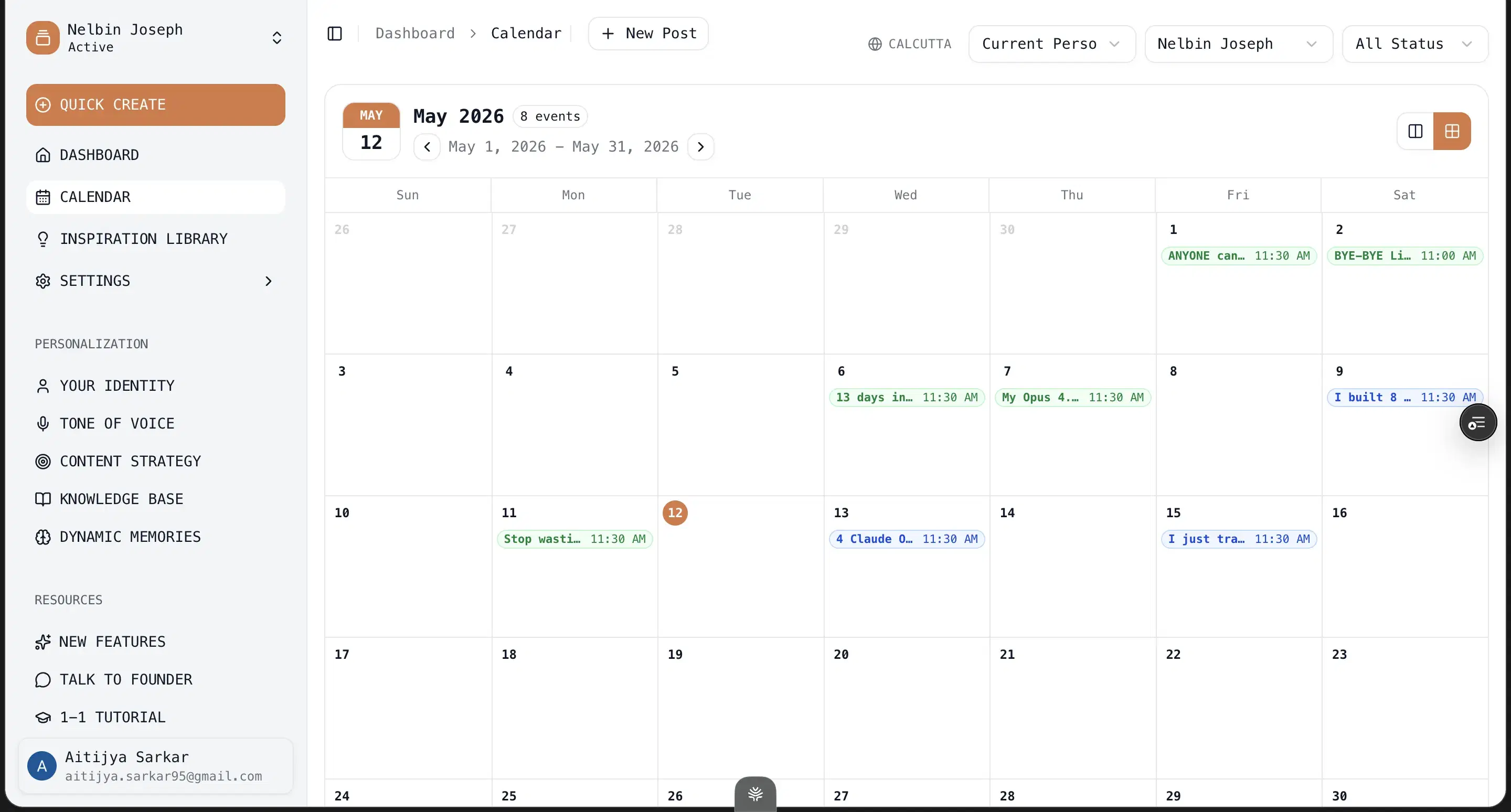
8,300+ viral outlier templates: Patterns drawn from 100M+ views and 1M+ organic engagement.
Best for
- Solo founders and creators in boring or technical niches (B2B SaaS infra, fintech, wholesale, dev tools, supply chain) where generic creator-economy AI content won't work.
- Ghostwriters and agencies running 3+ client voices — Pro is built for multi-Clone, multi-voice work, with unlimited rate limits.
- Consultants and IP-driven coaches with deep material — book authors, podcasters, YouTubers, PDF-playbook owners — because the KB ingests YouTube transcripts + PDFs.
Pricing
$49 – $79 / month (50% off yearly: $245 Creator / $395 Pro) · 7-day free trial, no usage caps
Pros
- Deep context engine is the real moat. The 3,000+ word persona profile is what makes drafts sound like you. Sentence patterns are just the surface. Most tools stop at the surface.
- Memory that compounds across sessions. Every edit and instruction sticks. Drafts get more like you over time, not less. Most tools reset every chat — Oiti gets sharper.
- Multi-account scheduling beats dedicated schedulers on price. Pro at $79/mo = 3 personal profiles + 10 company pages with full AI writing on top. Hootsuite and Buffer charge more for scheduling alone.
Cons
- No native iOS or Android app. Mobile is browser-only. The web app works fine on phones, but there's no App Store download. If you only ever post from your phone, that's worth knowing.
- No Chrome extension overlay into LinkedIn. Oiti lives in its own editor instead of injecting suggestions into linkedin.com. A deliberate choice — extensions break with every LinkedIn UI shuffle, and they're the category LinkedIn is actively clamping down on — but worth flagging if you specifically wanted the in-feed overlay experience.
- Doesn't generate Twitter/X or Instagram content. Oiti is a LinkedIn-first content engine. If you want one tool that also handles X threads or Instagram captions, you'd need a second tool for those.
- No carousels or slide decks (yet). Oiti is post-first — infographics yes (40+ templates, Nano Banana Pro 3.1), carousels no. If your primary LinkedIn medium is multi-slide carousels, Postiv (#4) genuinely beats Oiti on this specific axis.
Best for multi-account scheduling for teams
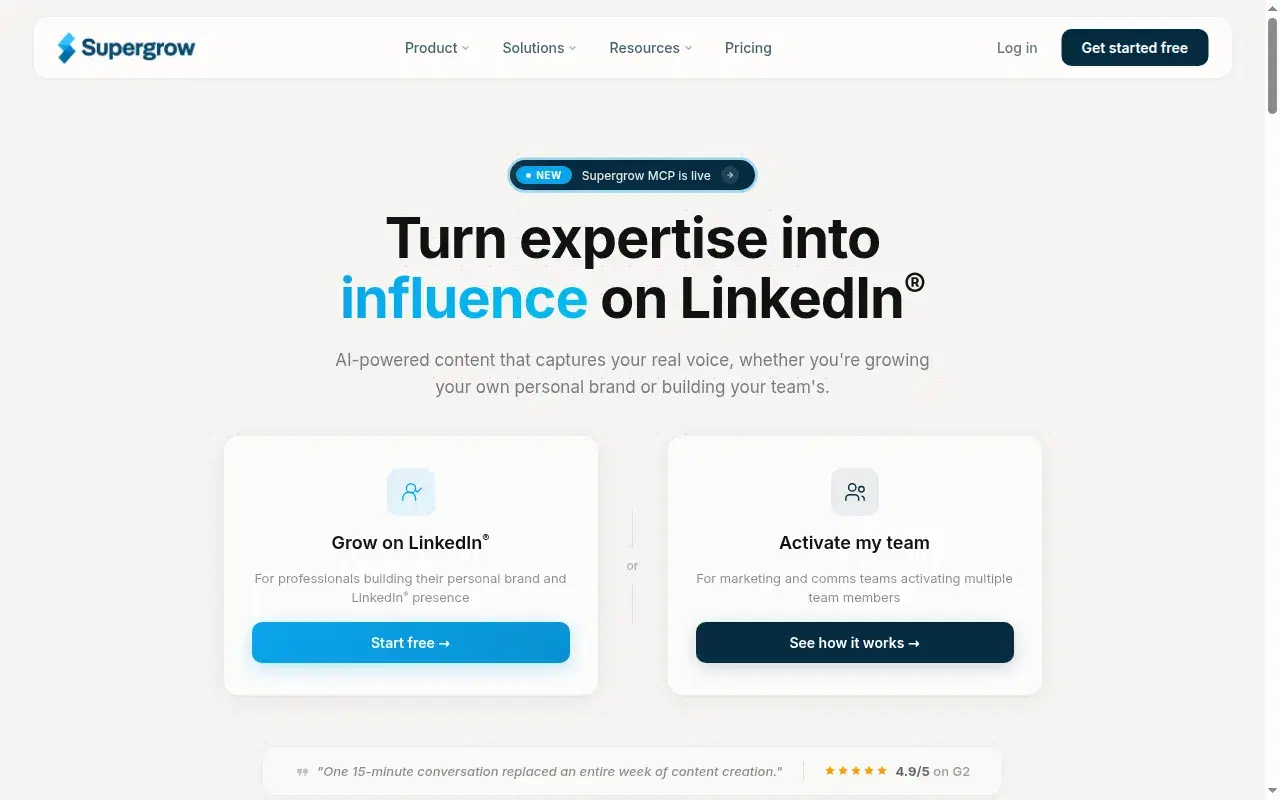
Supergrow is the closest to Oiti in the whole list. Same ToS-safe positioning (LinkedIn's official APIs, no Chrome extension), same multi-account scheduling, similar pitch on content. I heard of them the first time they offered a lifetime deal back in 2023 (if I remember), used them for content + scheduling for a stretch that year, and signed up and tried it again in 2026 for this article. The honest story: Supergrow has grown a lot on the team and scheduling side. The consumer/individual writing side hasn't kept pace. If you're managing 3+ LinkedIn accounts and you need a real scheduling backbone with approval flows, comment workflows, and a shared Kanban queue, Supergrow's structure is genuinely thoughtful. Indian founders, started in 2023, well-built for team-based workflows. They've really figured out multi-tenant workflows on LinkedIn.
When I tested it
Where it falls down — and this is the deal-breaker for solo creators — the content output reads generic. No persona depth. No voice fidelity. The chat is primitive — feedback I gave it in one session didn't carry over to the next. There's no long-running agent pattern. The interface felt clunky and slow when I tried it. G2 reviewers ding analytics depth as a recurring weakness. That aligns with where Supergrow's investment has gone — they've built deep on scheduling + multi-account workflows, lighter on the writing depth + persona seeding + analytics layer.
Key features
Scheduling via official LinkedIn APIs: ToS-safe. No Chrome-extension risk. Genuine peer to Oiti on safety.
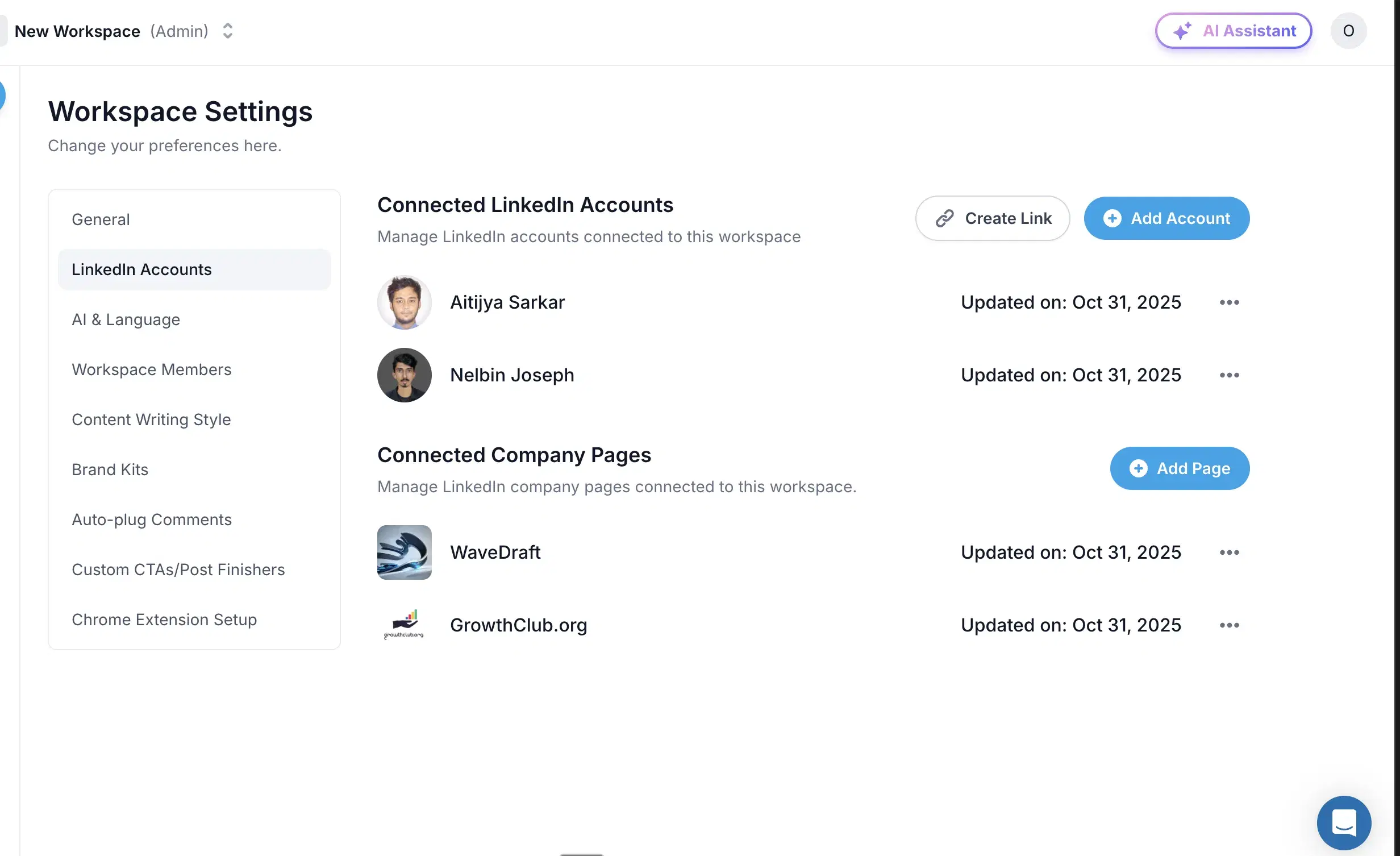
Multi-tenancy + Kanban queue: Built-in comment + change workflows, deep scheduling pipeline. If your job is to schedule across 3+ accounts with a team, this works.
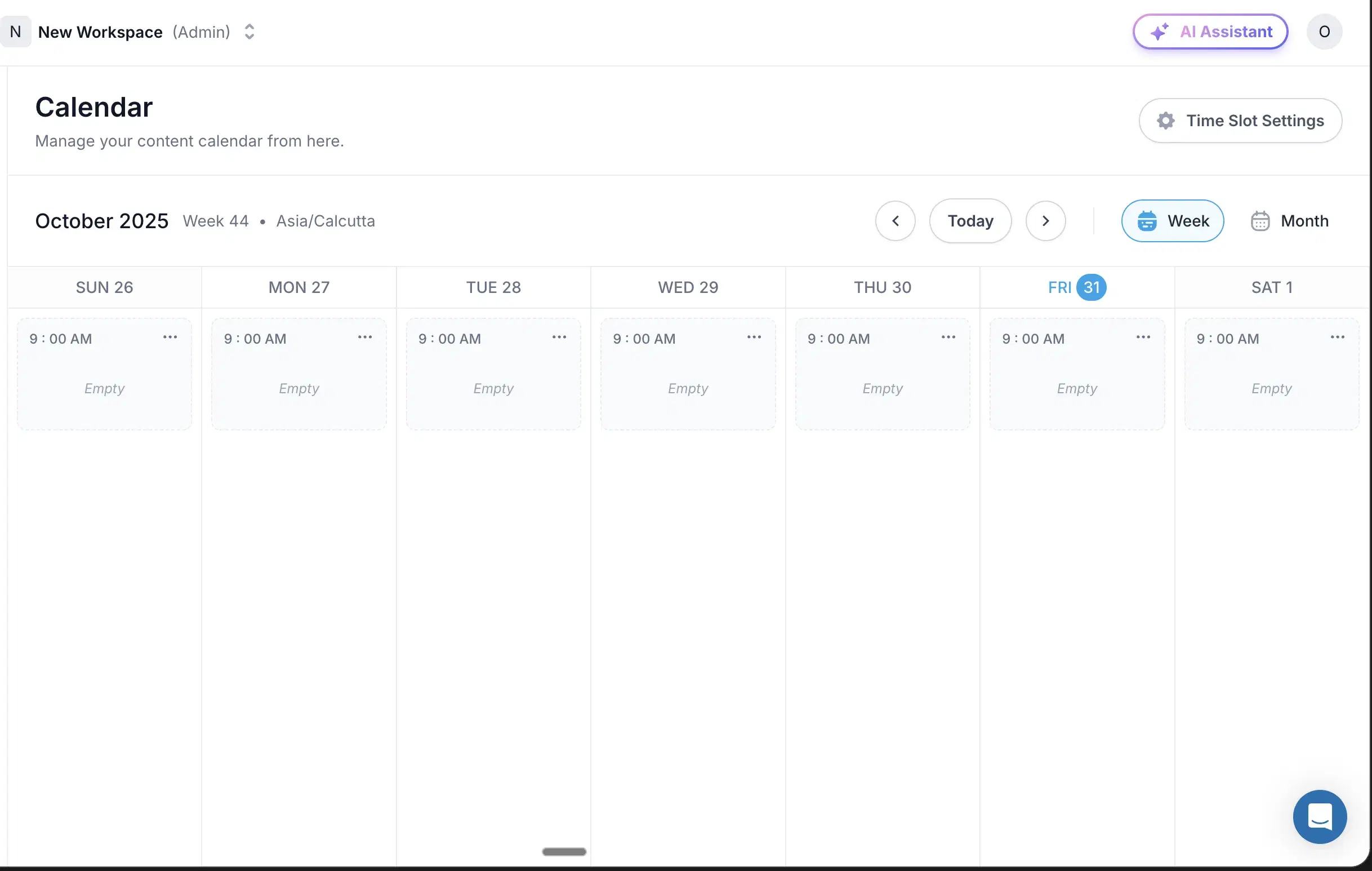
Carousel + post editor: Unified editor in one tab. UI optimized for team approval cycles.
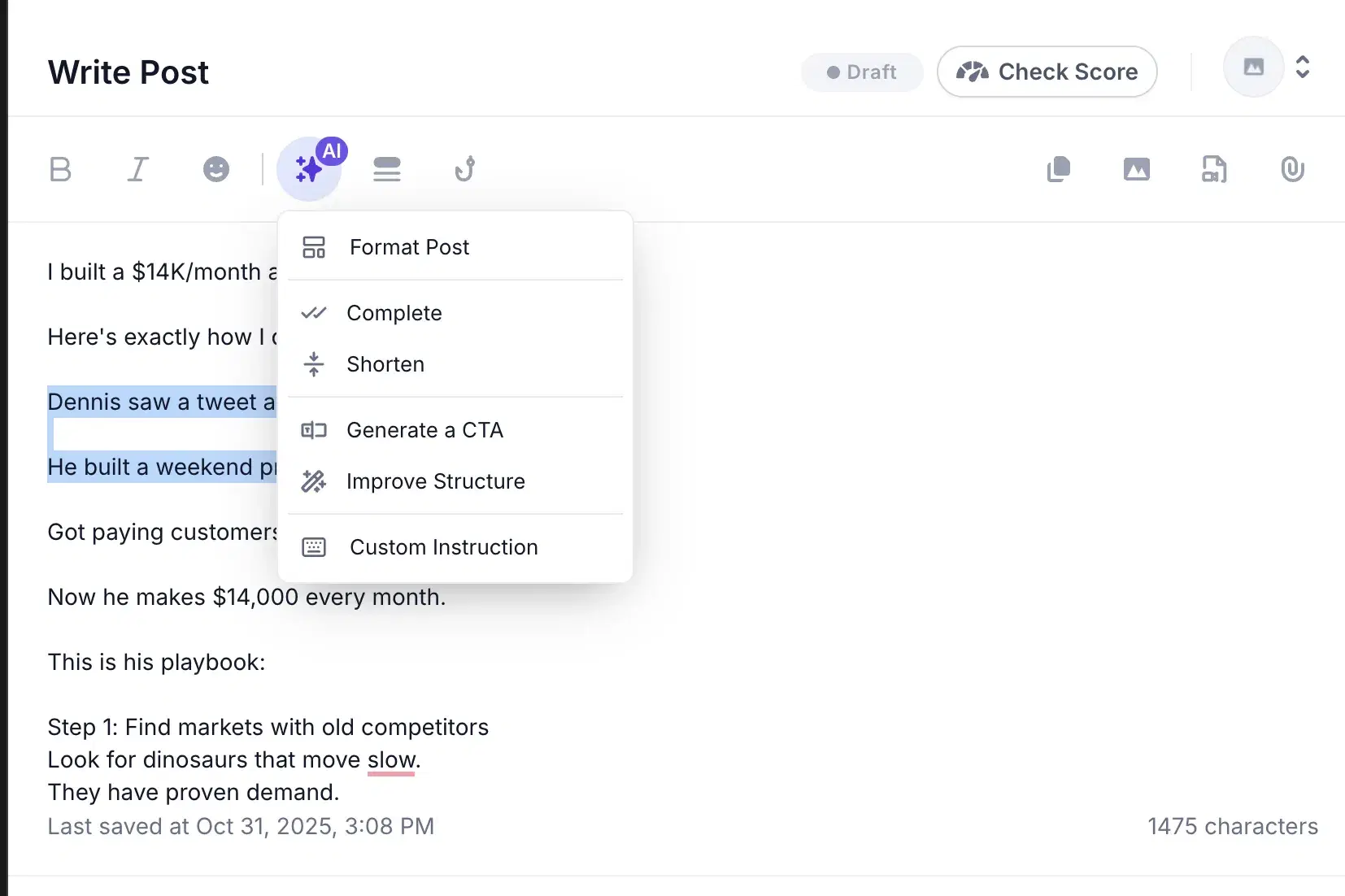
Approval workflows: Per-post approval routing for agencies managing client content.
Best for
- Teams or agencies managing 3+ LinkedIn accounts who genuinely need the deep scheduling backbone.
- Operators willing to use a separate tool (or Claude) for actual content creation while Supergrow handles distribution.
Pricing
$19 – $139 / month · Free trial
Pros
- Scheduling via official LinkedIn APIs. ToS-safe. No Chrome-extension risk. Genuine peer to Oiti on safety.
- Multi-account / multi-tenancy is genuinely well-built. Kanban queue, comment + change workflows, deep scheduling pipeline. Real wedge vs solo-focused tools.
- Honest indie-founder team. Well-built for what they've built for.
Cons
- Content output reads generic — no persona depth, no voice fidelity. Confirmed in my 2026 trial. The narrative-timeline + persona + KB-grounding layer that catches this exact failure mode isn't here — the AI doesn't know who you are before it writes a word.
- No retained memory across posts. Chat is primitive. Feedback doesn't carry over between sessions. Every chat is square one. Long-term memory persists every edit and instruction in Oiti; drafts get more like you over time.
- Analytics depth is weak. Recurring G2 reviewer complaint. If reporting depth is a top need, you'll feel the gap.(source)
Best for formatting-only power users
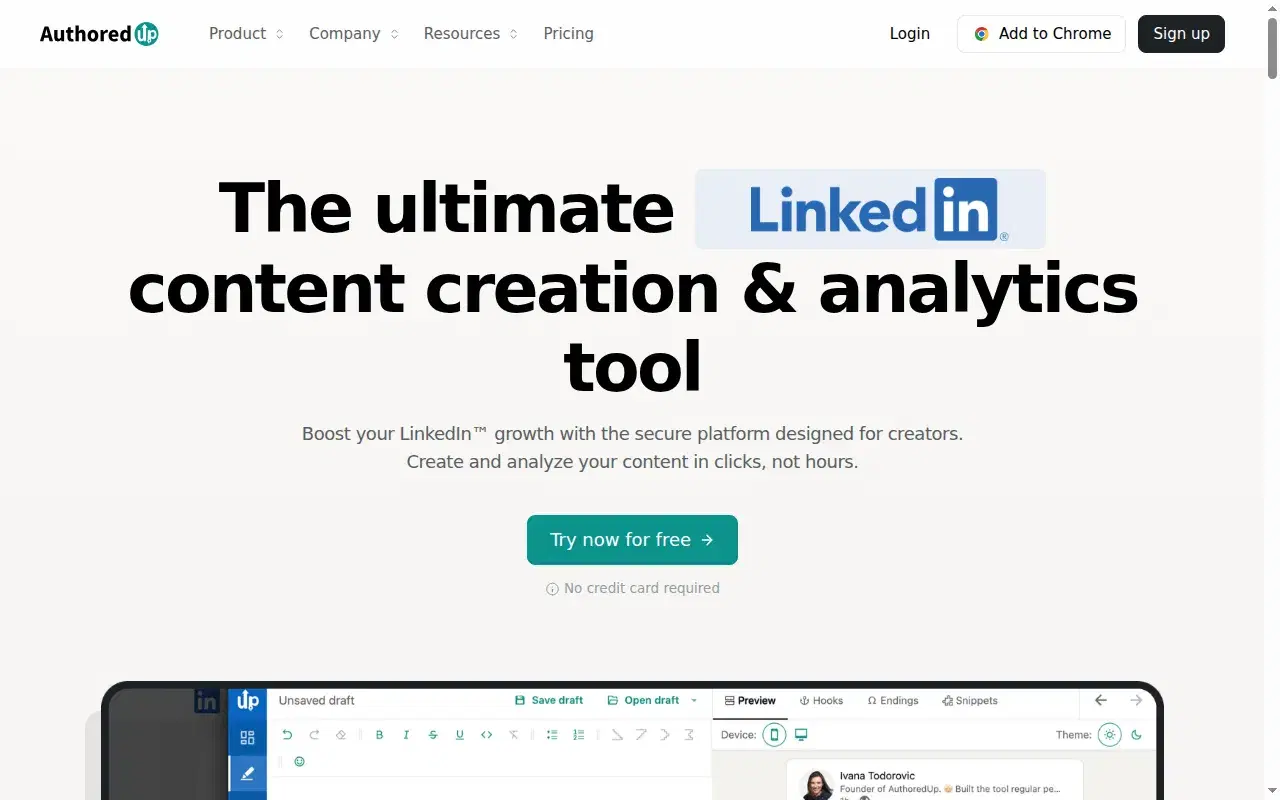
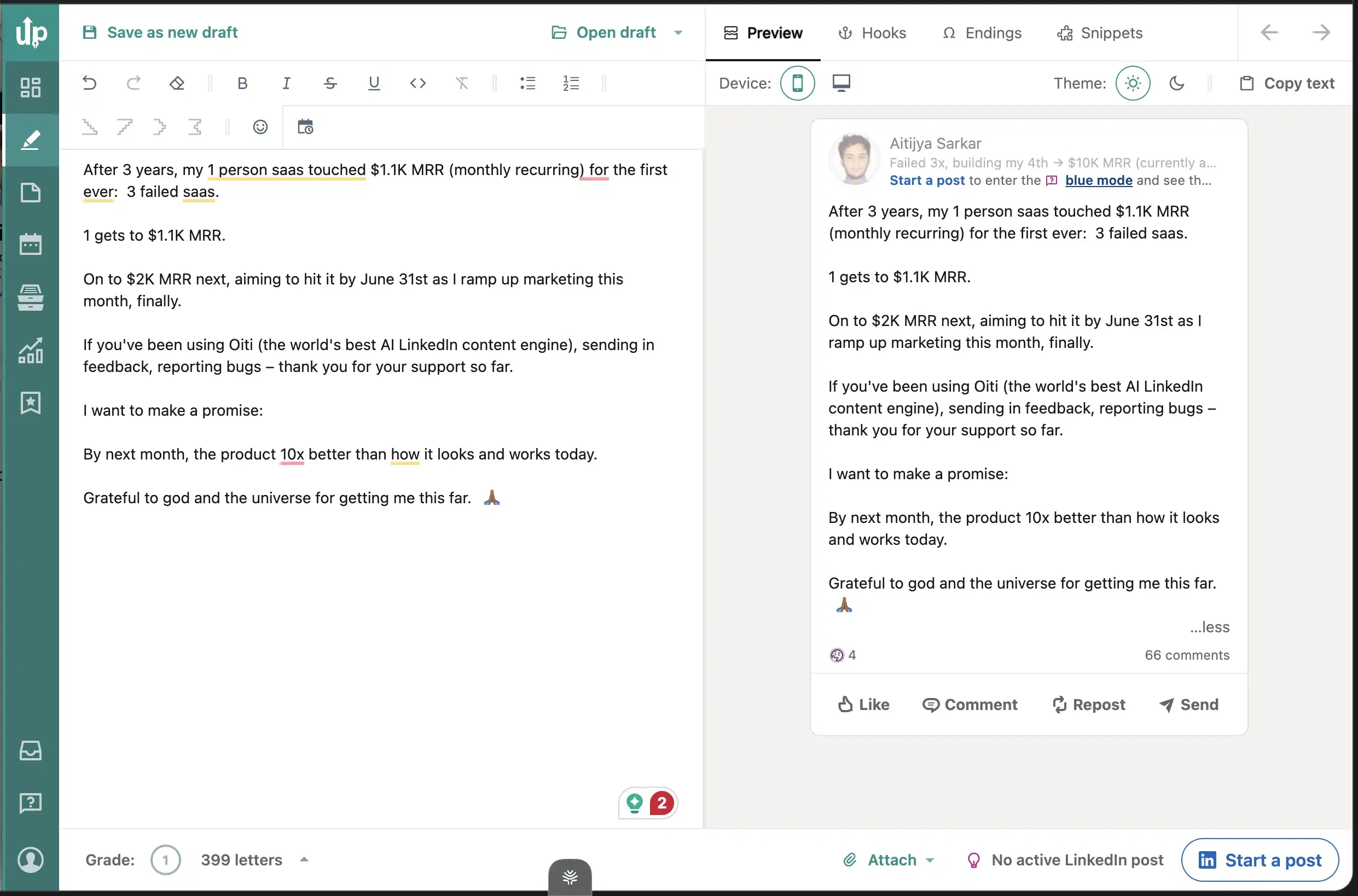
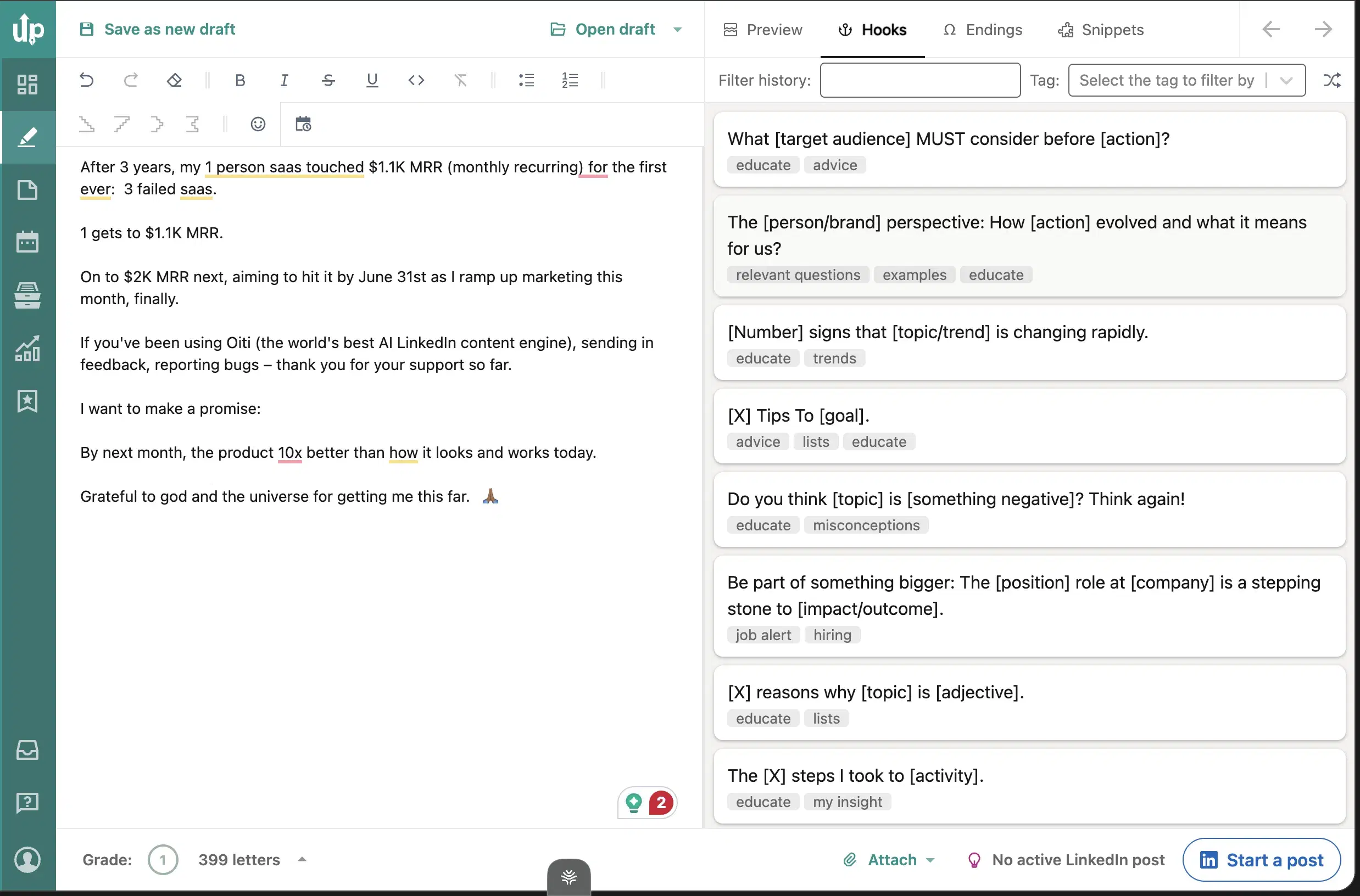
I have been a long user of AuthoredUp: they were actually one of the earliest Chrome-based extensions trying to build ethically for LinkedIn creators. Back in 2021-22, when I was still a LinkedIn ghostwriter, I used them mostly for the LinkedIn preview – I wanted to see what formatting and line breaks would look like before posting – plus their hook-variation feature, where you could swap hooks and post endings. Net-net: their LinkedIn formatter is rock solid. The team earned a lot of goodwill in the early days for being a Chrome extension that didn't violate LinkedIn's ToS. Then the launch of ChatGPT changed everything: the LinkedIn preview is still excellent, but formatting itself has been commodified – every modern tool (Oiti included) ships best-in-class formatting now. You can copy-paste into LinkedIn from almost anywhere and it retains the structure you want. The bigger problem: as AI tools launched, AuthoredUp's whole product surface narrowed. Tools like Oiti ship the full LinkedIn content feature set – AI formatting improvements, mobile formatting, hook improvement, deep context engine, the actual writing of the post. AuthoredUp doesn't have any of those. They don't have a knowledge base. They don't have built-in memory. When I signed up, their dashboard said an AI ghostwriter was on the way – but as of writing, they haven't shipped one.
When I tested it
LinkedIn ToS risk is the other piece. LinkedIn is actively clamping down on Chrome-based extensions for LinkedIn. Look at what happened to Shield Analytics – they had to shut down in May 2026 because LinkedIn and Google started clamping down on chrome extensions.
Review receipts
Key features
Best-in-class LinkedIn rendering preview: Matches LinkedIn's actual formatting — bold, italic, line breaks, the 210-char cutoff.
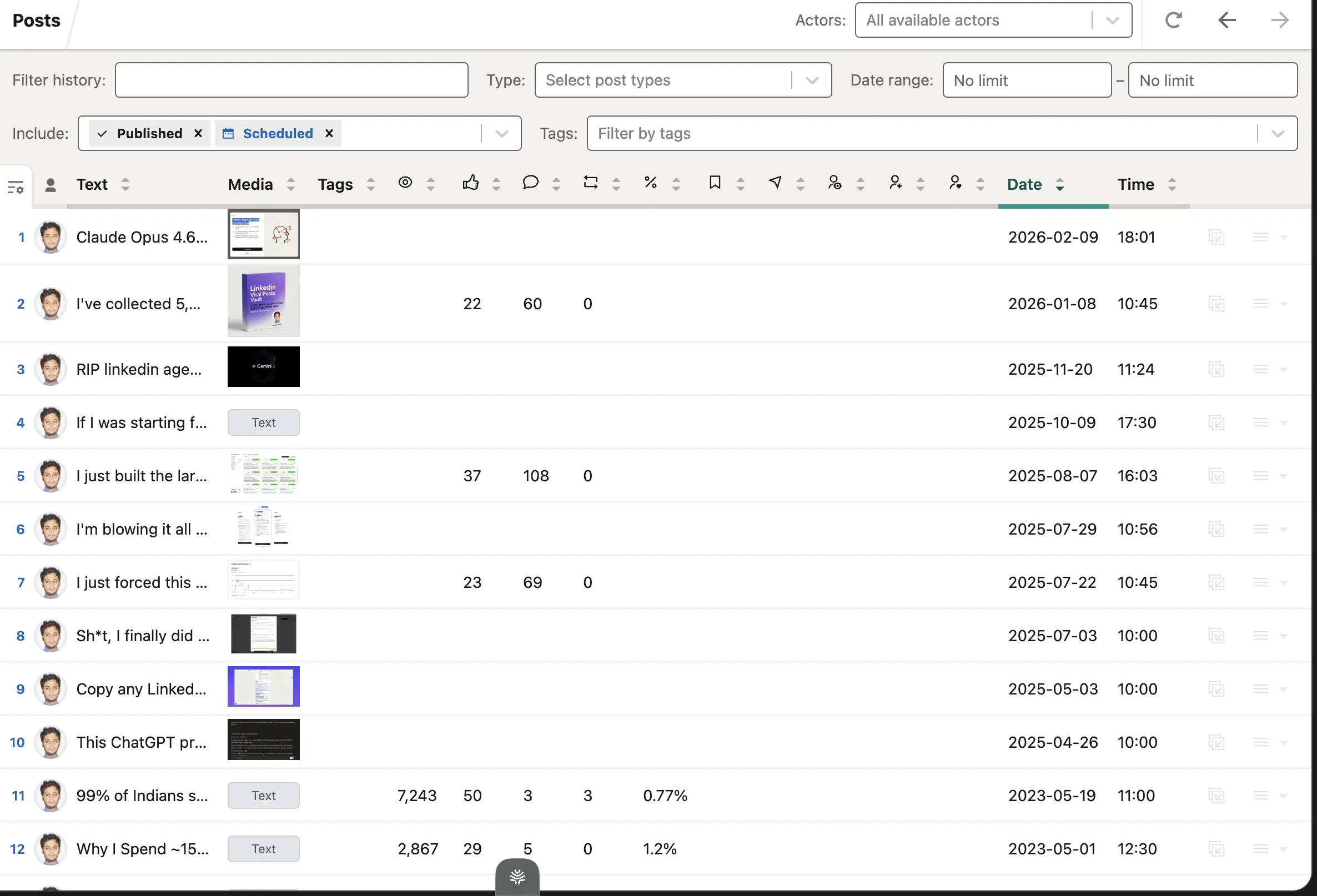
Saved drafts + templates: Reusable post-template library with placeholder variables.
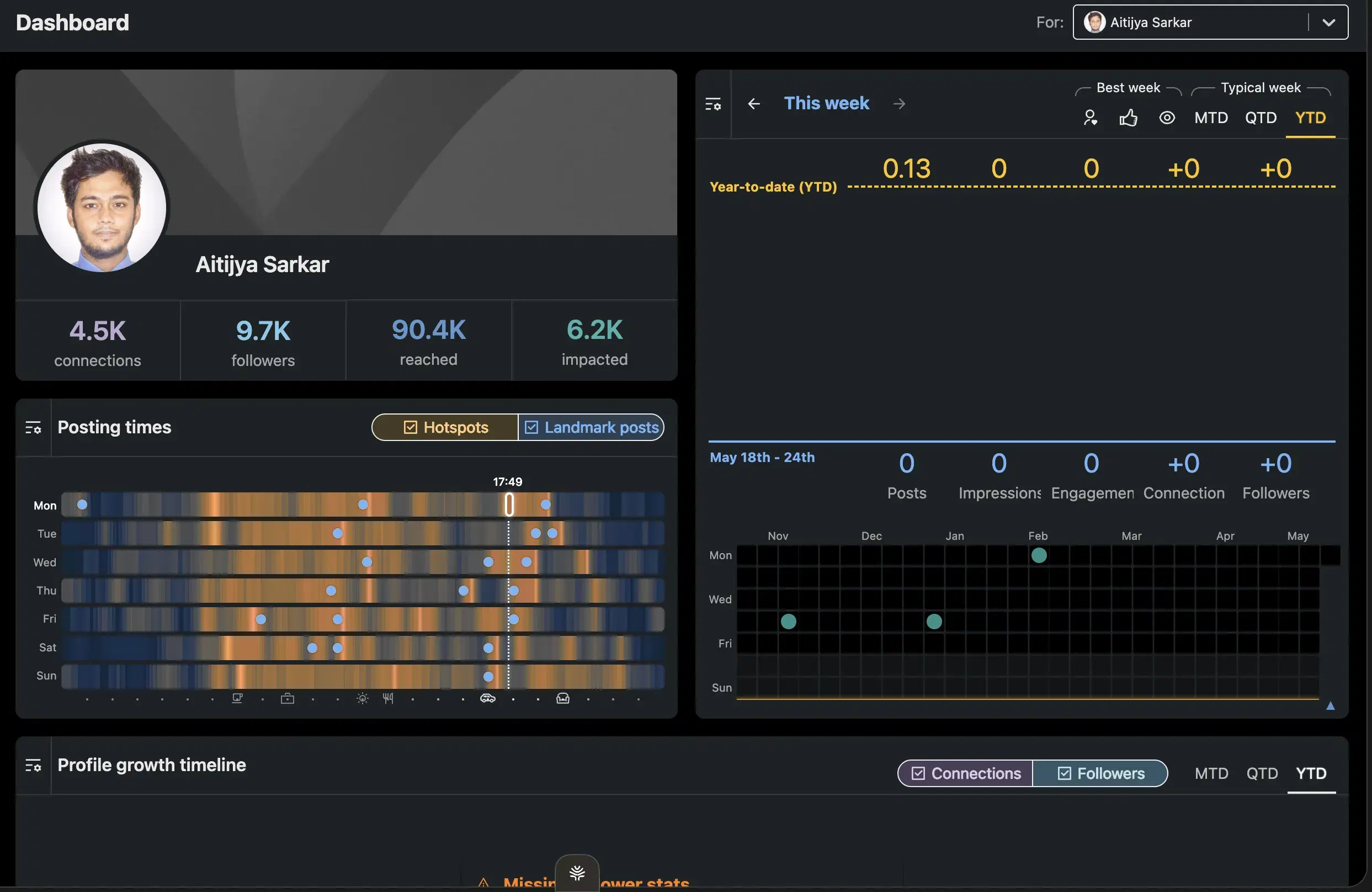
Light analytics layer: Per-post and per-account analytics that LinkedIn's native dashboard doesn't surface.
Hook variation feature: Swap hooks and post endings to test different opening structures.
Best for
- Creators who already write their own posts and want them to look right.
- Power users who specifically want AuthoredUp's formatter polish (with the Chrome-extension risk understood).
Pricing
Free tier + paid · Free tier available
Pros
- Post formatter is rock solid. Still best-in-class for LinkedIn formatting and preview.
- Pioneered ethical Chrome-extension building for LinkedIn. One of the earliest adopters of Chrome-based LinkedIn content tools.
- Light analytics dashboard included. Fewer features than Shield, but real LinkedIn engagement data — useful if you're tracking your own posts.
Cons
- Chrome extensions are getting banned. Shield Analytics shut down in May 2026 from this exact class of risk. The category is fragile. Oiti uses official LinkedIn APIs only — not affected by these bans.
- No AI writing layer. Only formatting. Their dashboard says an AI ghostwriter is "on the way" — but nothing has shipped. Full AI content engine + best-in-class formatting is what Oiti puts in one tool.
- No knowledge base. No memory. Pure stateless tool. Every session starts fresh. Oiti pairs a persistent persona + KB + long-term memory layer.
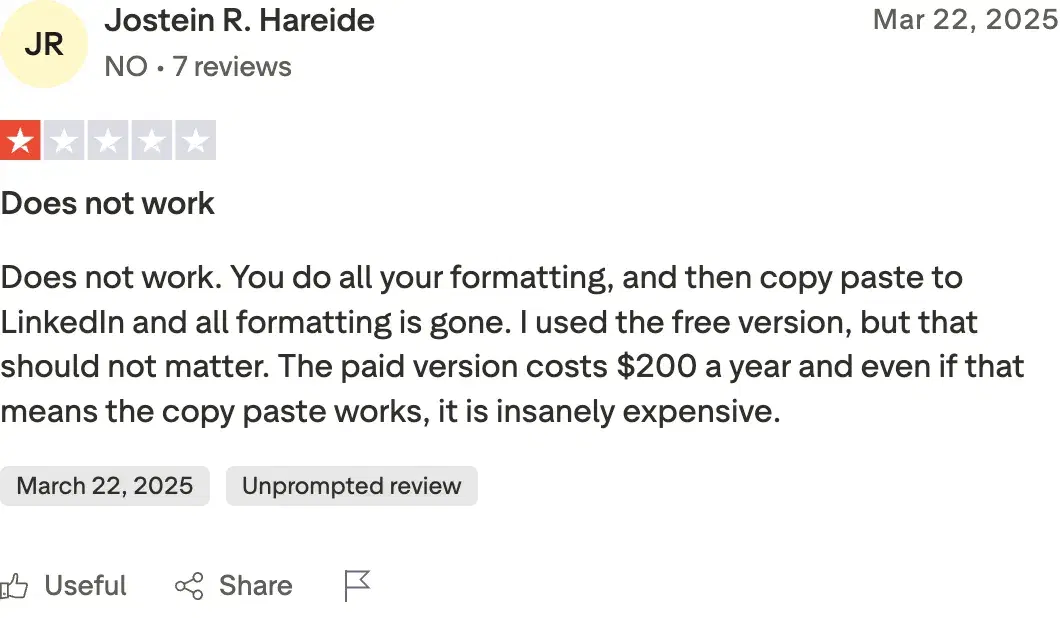
- Trustpilot — "formatting is lost on paste". Jostein R. Hareide rated 1/5 on Trustpilot saying formatting disappears when pasting to LinkedIn. Different from my experience — I've used AuthoredUp's formatter for years and it's been rock solid — but worth flagging the complaint exists.(source)
Best for teams + carousels at premium pricing
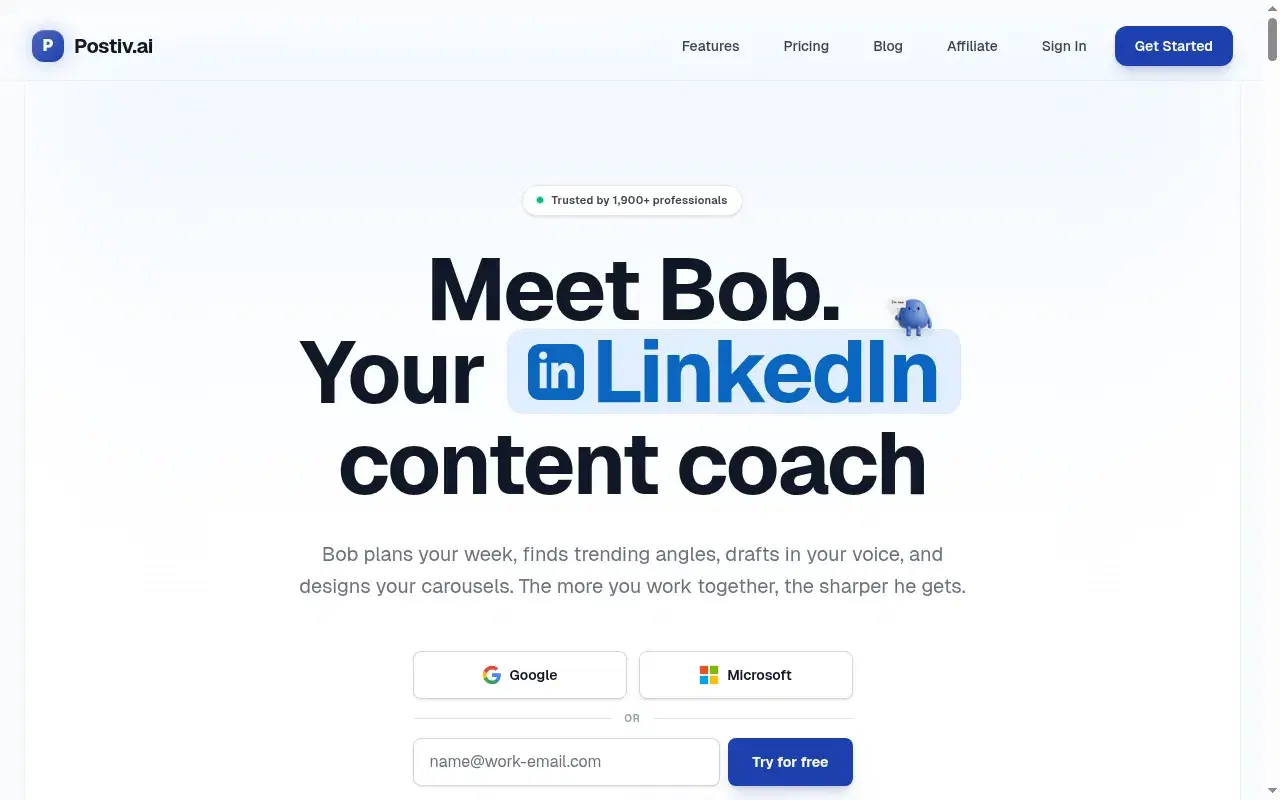
Postiv is going where the category is going. Their direction – agentic flow with knowledge inputs, chat-style composer, KB-equivalent assets feature, inspiration tab – is the right direction. Where Postiv genuinely wins: carousels and slide-deck workflows. They have pre-built carousel workflows that work well, and 7 infographic templates that are decent (Oiti has ~40, but Postiv's are usable). If your primary medium on LinkedIn is carousels, Postiv beats Oiti here. Where it falls down – the persona/memory layer is shallow.
When I tested it
I tested by creating a post on a topic around "LinkedIn content". Postiv did NOT pull intelligently from my past LinkedIn posts, even though the product implies it does. The persona setup is form-based ("who do you want to write for?") – same gap as ContentIn and MagicPost – not the structural extraction from your past 100 posts that Oiti does. There's no dynamic memory that adapts across chats so across sessions, your feedback resets. The output came off generic because of those layers being shallow. UI-wise, it felt vibe-coded. Color branding felt off (personal taste).
Key features
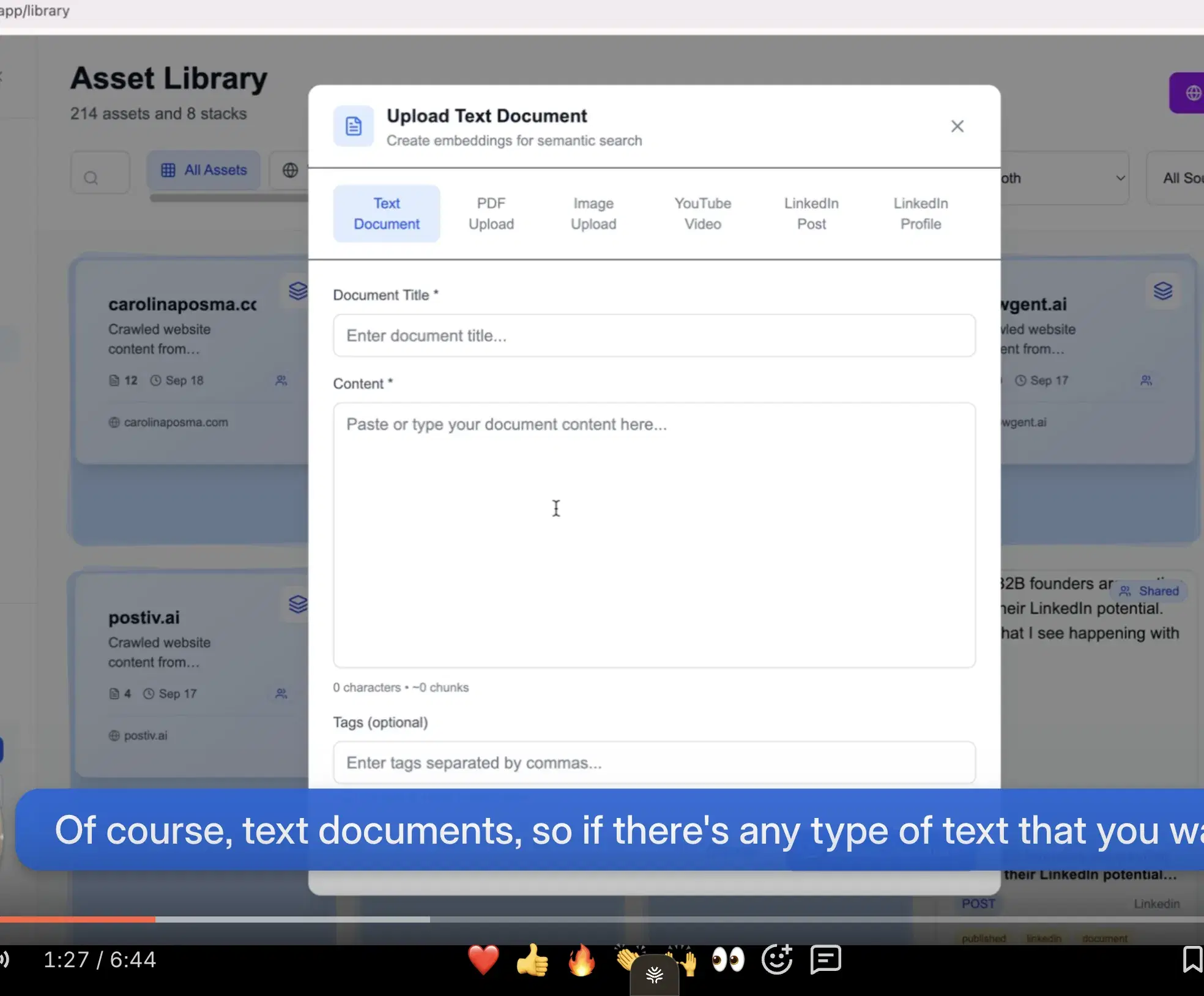
Pre-built carousel workflows: The one feature where Postiv beats Oiti. If carousels are your primary medium, this is the lane.
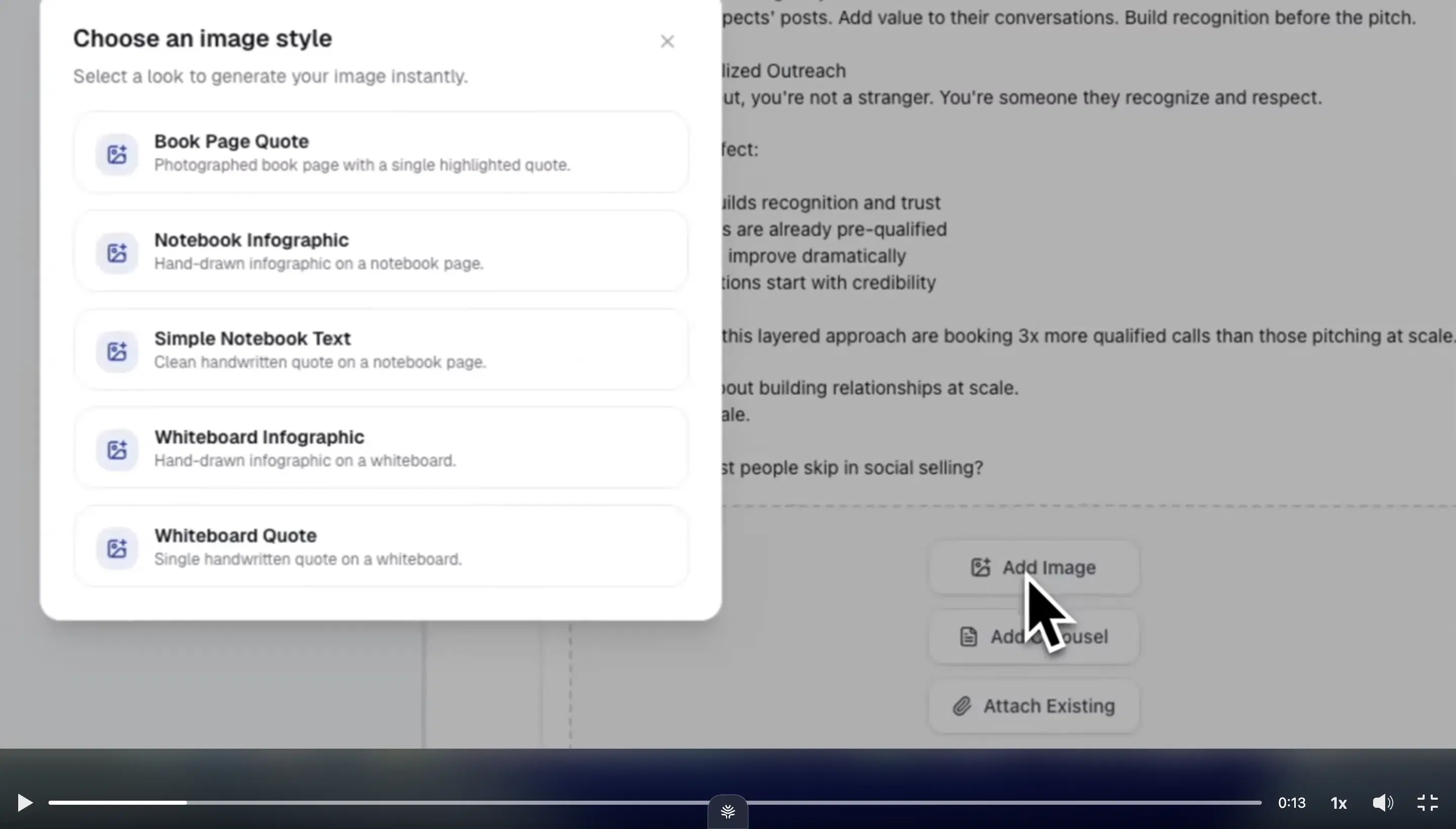
Chat-style composer: Agentic direction is right. Chat + inspiration tab + 7 infographic templates.
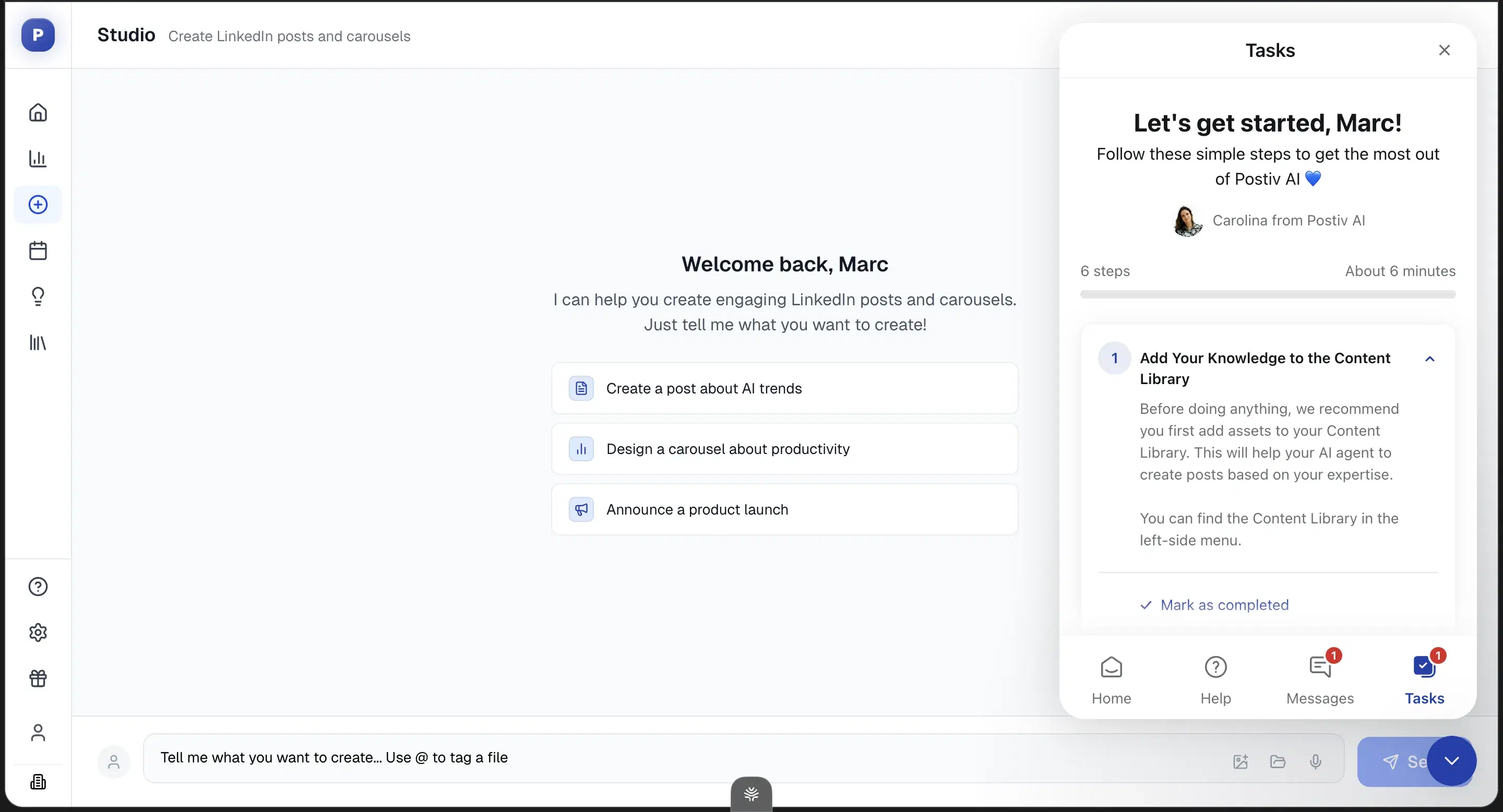
KB-equivalent assets feature: File uploads for grounding posts in your material — closer to a real KB than form-based personalization.
Transparent pricing tiers: $99 / $229 / $399 with seat add-ons. No hidden tier locks.
Best for
- Carousel-heavy publishers — if your primary LinkedIn output is carousels + slide decks (not posts), Postiv's pre-built workflows are worth the $99.
- Teams that want a unified workspace with seat-based add-ons and transparent pricing visibility.
Pricing
$99 / $229 / $399 per month + per-seat add-ons · Trial (requires $1 card-on-file)
Pros
- Carousels + slide-deck pre-built workflows are real. This is the one feature where Postiv beats Oiti. Worth crediting.
- Agentic direction is the right direction. Chat composer + KB-equivalent assets + inspiration tab + 7 infographic templates.
- Transparent pricing tiers. $99 / $229 / $399 with seat add-ons. No surprises post-signup.
Cons
- Persona + memory + RAG layers are shallow. Form-based persona setup, no dynamic cross-chat memory, RAG didn't pull from my past LinkedIn posts in testing. Output came off generic. Oiti's persona is built from your past 100 posts + ICP painpoint web search; long-term memory persists across sessions; KB-grounded research agents run before drafting.
- No one-click templates from inspiration. Postiv has the inspiration tab but no equivalent of Oiti's "use as inspiration → 1-click structural template" loop. That loop is the wedge that closes the bridge between "what works on LinkedIn" and "who you are."
- Entry $99/mo is 3–5× alternative AI writers at similar feature surface. Plus a $1 card-on-file trial paywall. ContentIn entry $15, Oiti Creator $49. Oiti Creator + Pro covers persona-grounded writing + multi-account scheduling at a third of the price.
Best for linkedin preview before publishing
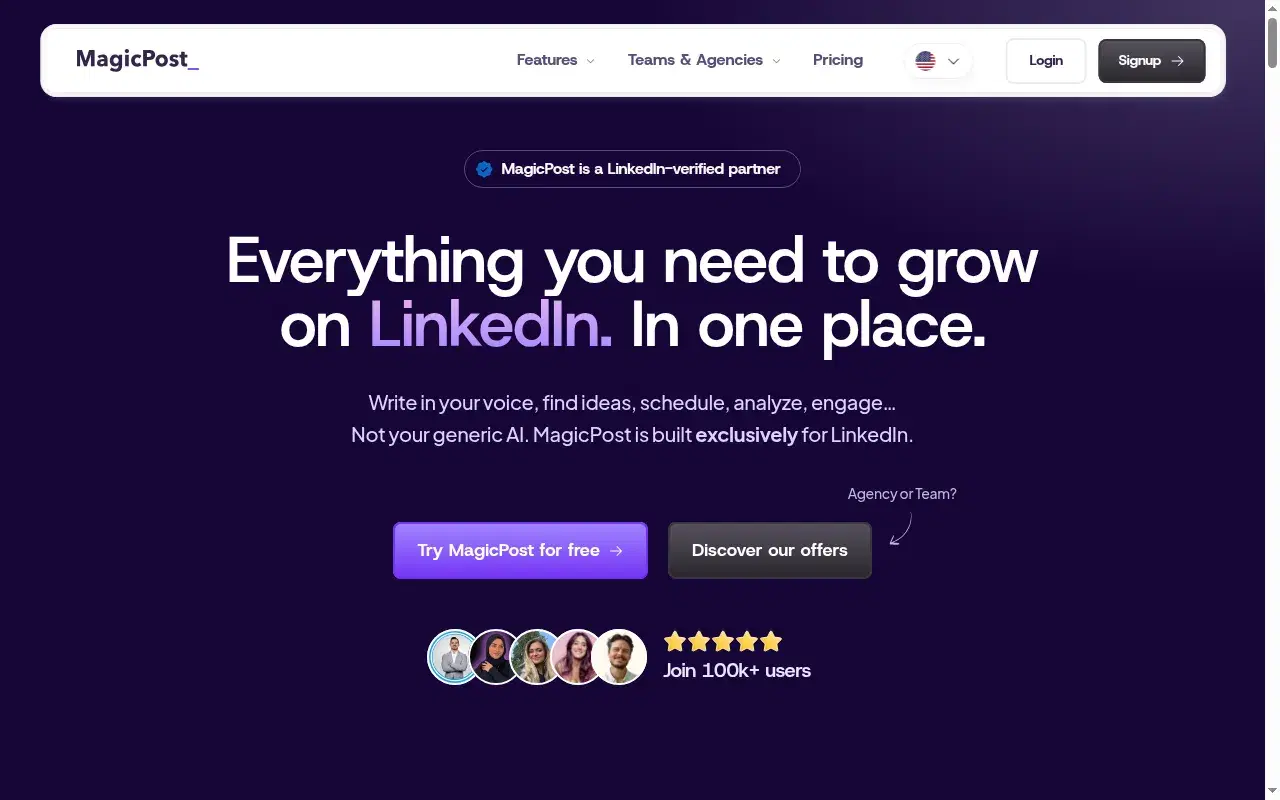
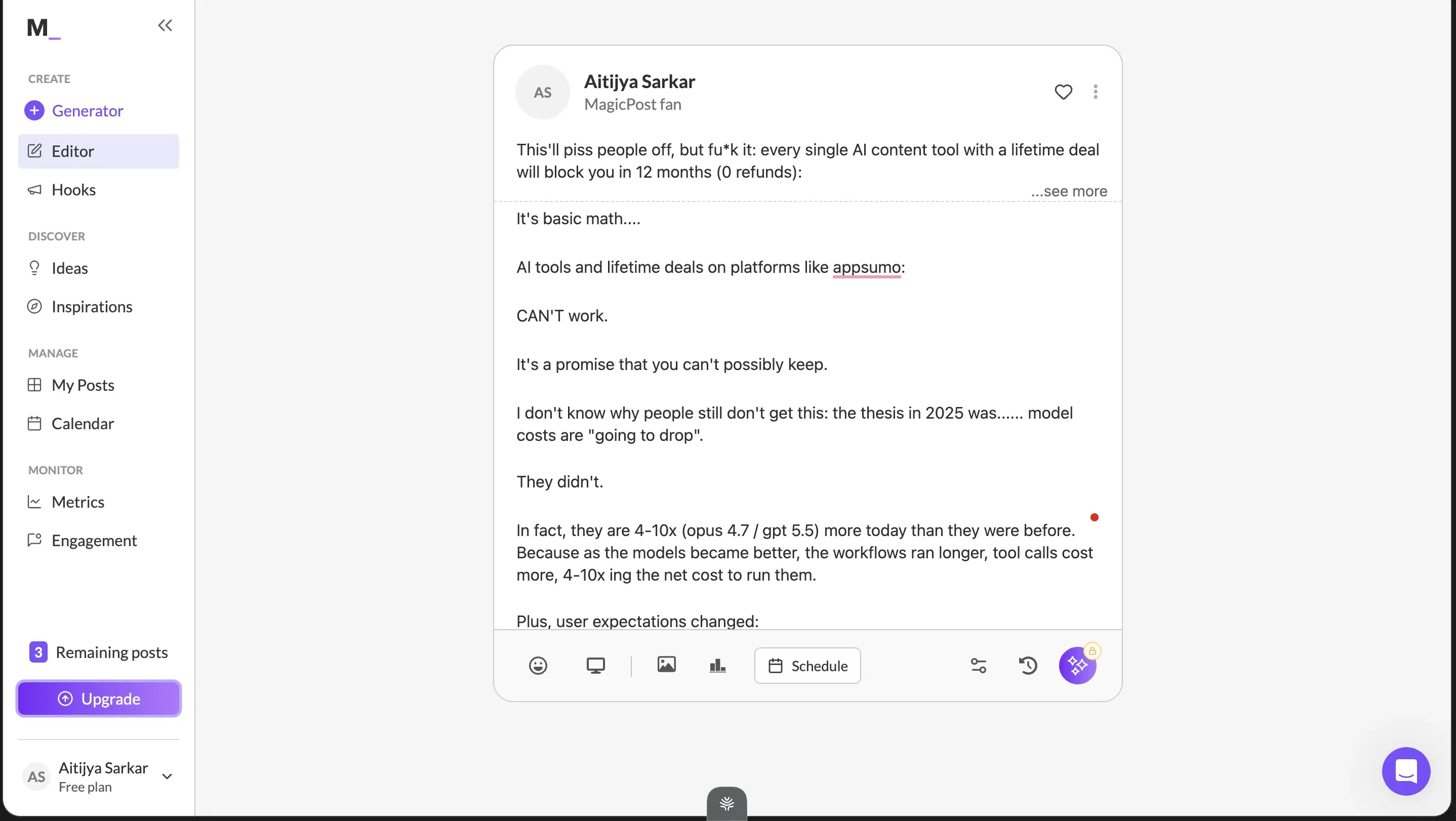
I came across MagicPost from a LinkedIn post an influencer ran on it, which made me want to check it out. So I tried it. The one thing I'd actually recommend MagicPost for: their LinkedIn preview. It shows you exactly what the post will render like before publishing – useful for verifying formatting and line breaks. The caveat is that the preview doesn't quite show the full post (the "see more" cutoff and a few rendering details are off), so even MagicPost's strongest feature has friction. Everything else underwhelmed me. The onboarding output, especially on the content side, was very vanilla. It picked up small patterns in how I write – but small patterns aren't enough. You could tell it hadn't really gone through my full archive of hundreds of past LinkedIn posts. The content input is form-based ("type what you want, get an output") rather than chat-based. There's no way to give continuous feedback or iterate.
When I tested it
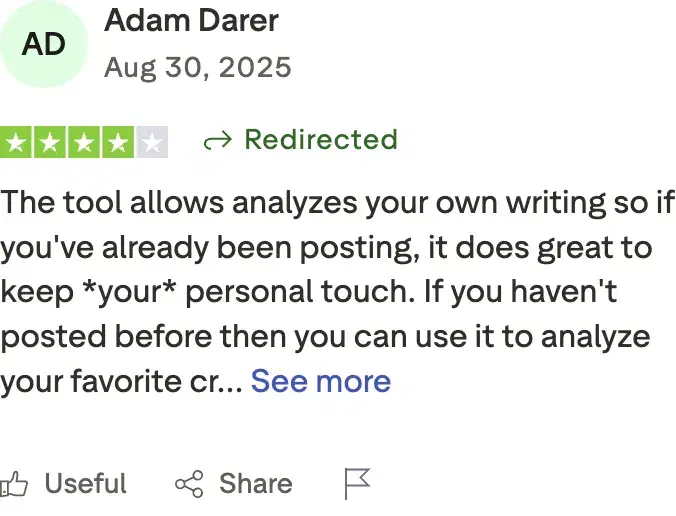
The bigger problem: LinkedIn's 360Brew algorithm actively suppresses generic content. Dwell time rules now, not likes (see LinkedIn's March 2026 engineering blog for the public source). So MagicPost's output isn't just mediocre – it's structurally working against your distribution. That said, Trustpilot tells a different story: MagicPost sits at 4.7/5 across 91 reviews. But personally, I just wouldn't recommend it.
Review receipts
Key features
LinkedIn preview: See how a post renders before publishing. Useful for formatting + line-break verification (caveat: doesn't show the full preview).
Form-based content input: Type what you want, get an output. No chat composer for iteration.
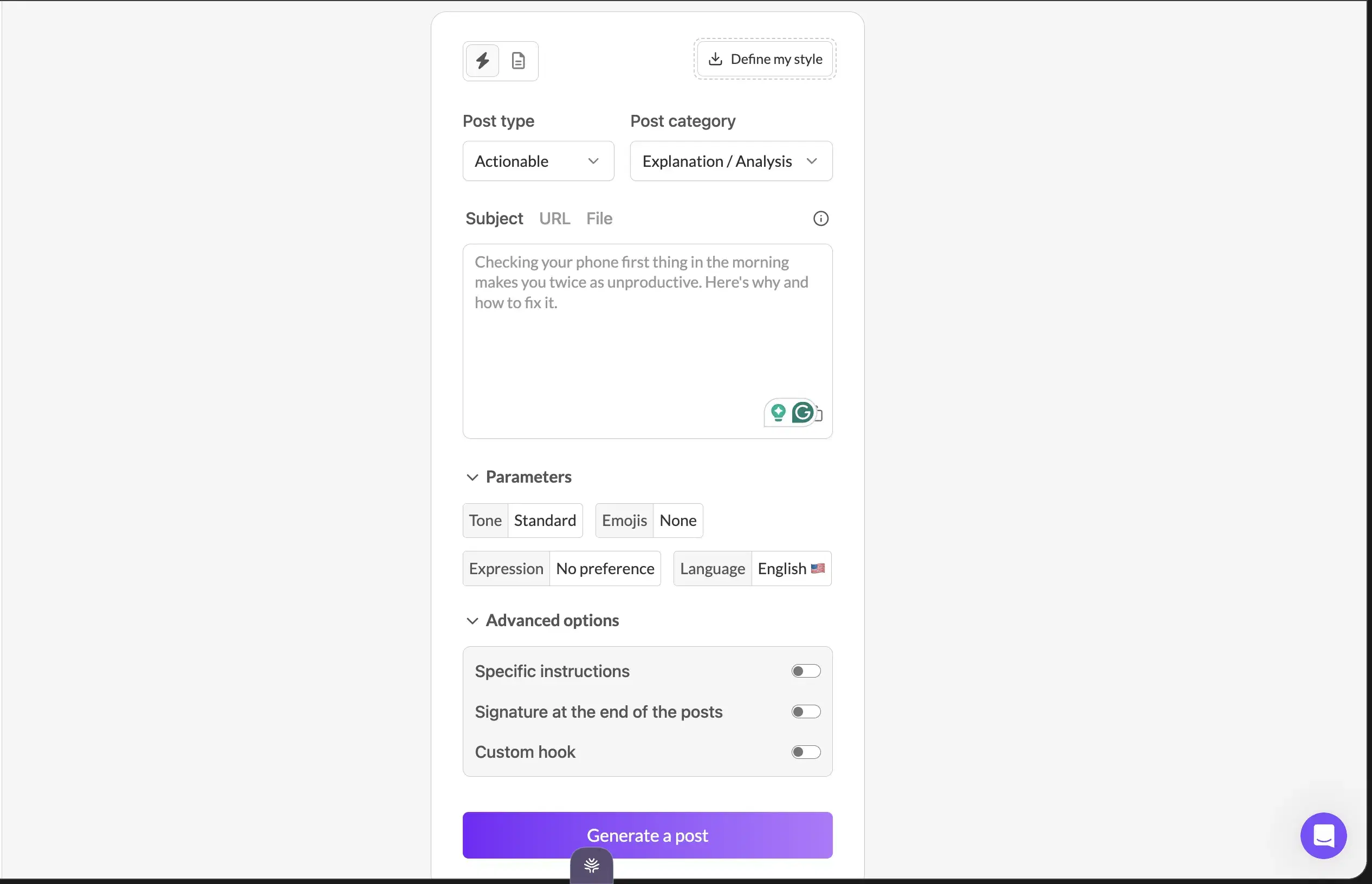
Onboarding flow is simple: Low-friction trial — small surface area to navigate.
Trustpilot social proof: 4.7/5 across 91 reviews — strongest LinkedIn-only sample in the universe.
Best for
- Casual posters who want a preview + simple AI assist and aren't trying to scale a personal brand on substance.
- People where formatting + a quick assist is enough — not where voice fidelity or research depth matters.
Pricing
Low-cost tier · Free trial
Pros
- LinkedIn-preview feature is genuinely useful. See exactly how a post will render before publishing — caveat that it doesn't show the full preview.
- Onboarding flow is simple and clear. Low-friction trial.
- Trustpilot social proof is real. 4.7/5 across 91 reviews. Most-reviewed LinkedIn-only tool in the category.
Cons
- Content output reads vanilla. Picks up small patterns of voice but no deep persona, no ICP grounding, no web search for trending material. Oiti builds a 3,000+ word persona from your last 100 posts + website + ICP painpoint search across X and Reddit.
- Form-based input flow, no chat composer. Can't iterate on output through conversation. Oiti pairs a chat-based composer with long-term memory across sessions.
- No KB. No persona depth. 360Brew actively suppresses generic output. The post is structurally working against your distribution under LinkedIn's 2026 dwell-time algorithm.(source)
Best for budget-first ghostwriters
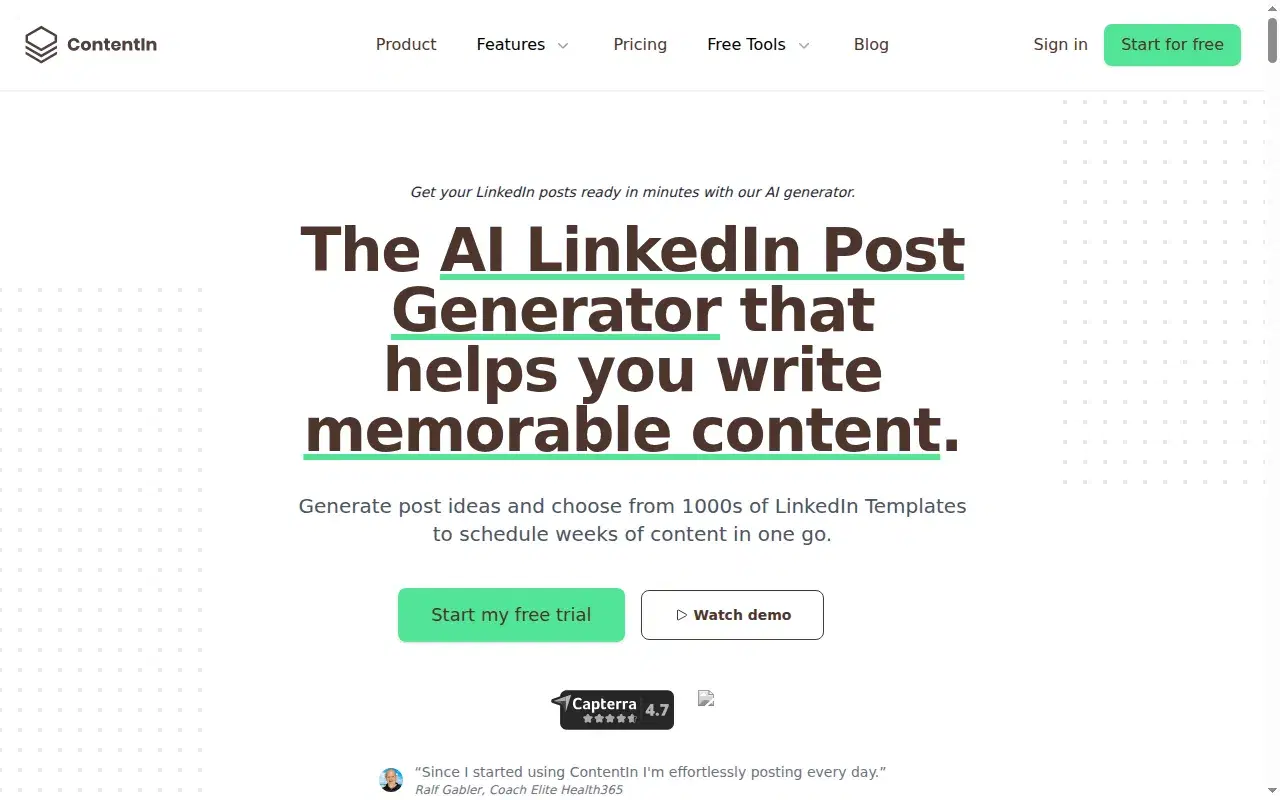
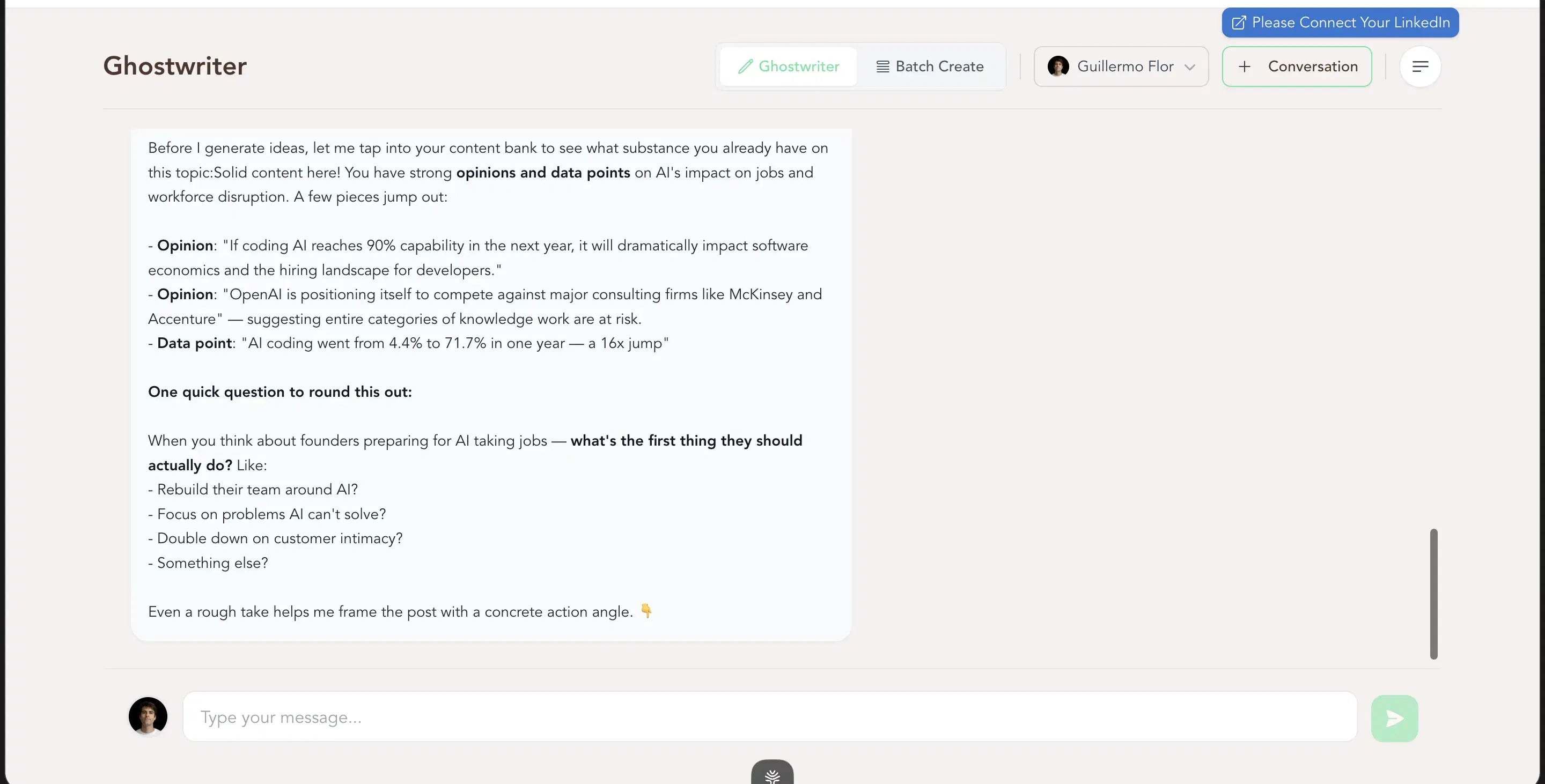
ContentIn is the cheapest entry on this list. $15/mo undercuts the category by 2–3×. Same "ghostwriter for LinkedIn" positioning as Oiti, at less than half the price. I trialed it. The honest framing: right surface, wrong substance. What ContentIn got right structurally is real. They ship LinkedIn-OAuth scheduling (no Chrome extension – LinkedIn-safe), a week-view calendar, a Kanban writing queue where ideas and suggestions sit and you can edit + schedule from there, and a composer + scheduling combination in one place. They're closer to a full tool than AuthoredUp's LinkedIn formatter. But where it falls down is content quality. The composer-generated content was extremely generic. It didn't ask any clarifying questions to figure out where I wanted to take a topic – it just generated it. The output read vanilla, influencer-template-flavored. Worse: it doesn't run web search for trending content. It tries to generate ideas from your past content alone, and that misses the point. What you actually want is both: your voice AND what's trending in your ICP. ContentIn does one without the other.
When I tested it
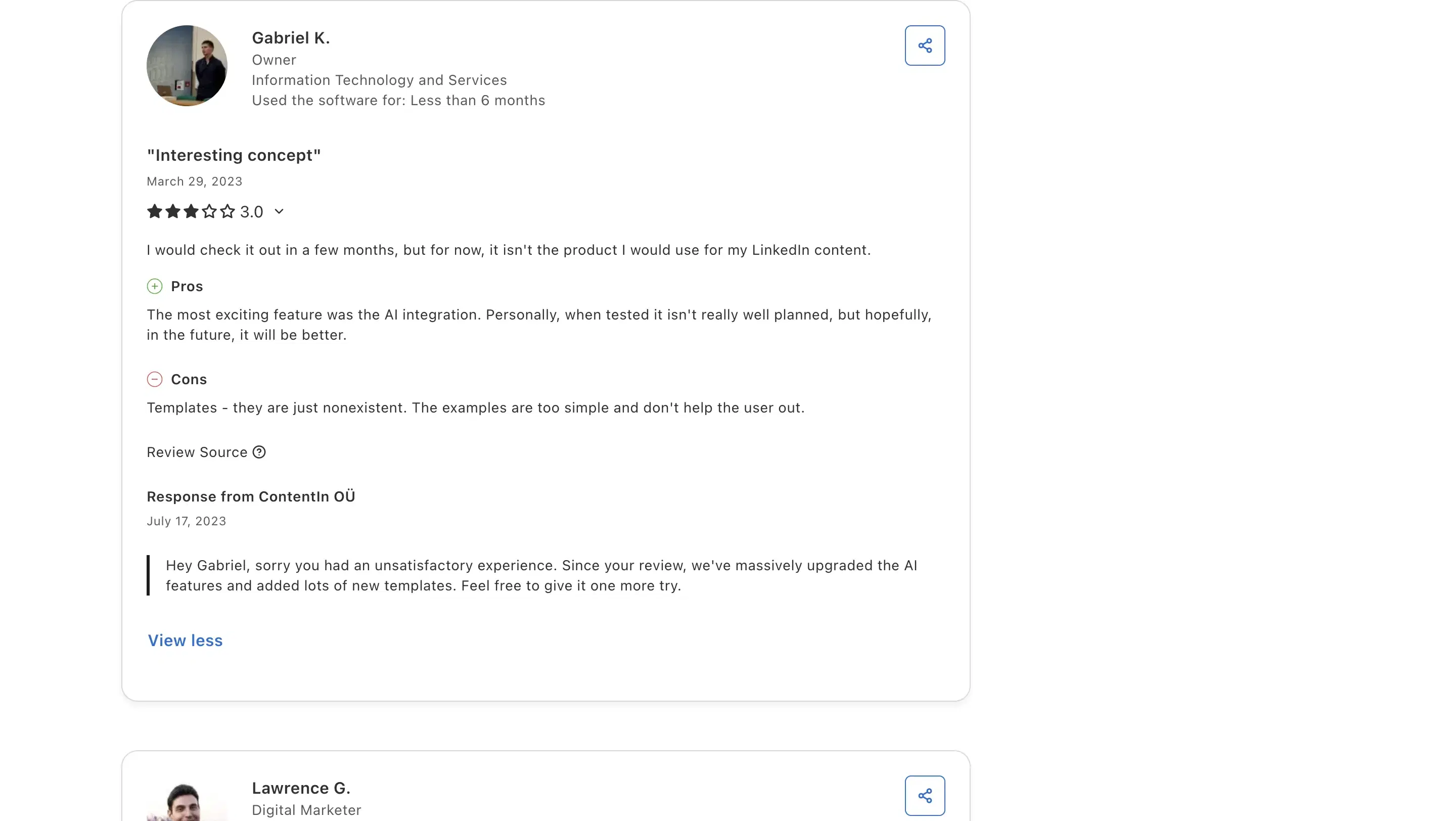
Their "personalization" is a four-question multiple-choice quiz at onboarding: "What best describes your role? What are your primary goals with LinkedIn content (1–3 max)? What challenges are you facing? How did you hear about us?" Then they use those answers to "train" your AI. Oiti's persona is a 2,000–3,000 word document built from your past 100 posts + website + ICP painpoint research across the web. The difference shows up in the output. The third flag is structural: ContentIn has a "Who from your ICP just engaged with your content" feature – they tell you which ICP people engaged with your posts. That implies they're pulling engagement-level LinkedIn data per person. How they get that data isn't obvious (my hunch: it looks like they're scraping it, which is against LinkedIn's ToS).
Review receipts
Key features
$15/mo entry undercuts the category 2–3×: Cheapest LinkedIn-AI writer at a comparable feature surface.
LinkedIn-OAuth-safe scheduling: No Chrome extension. Week-view calendar, Kanban writing queue, composer + scheduling in one place.
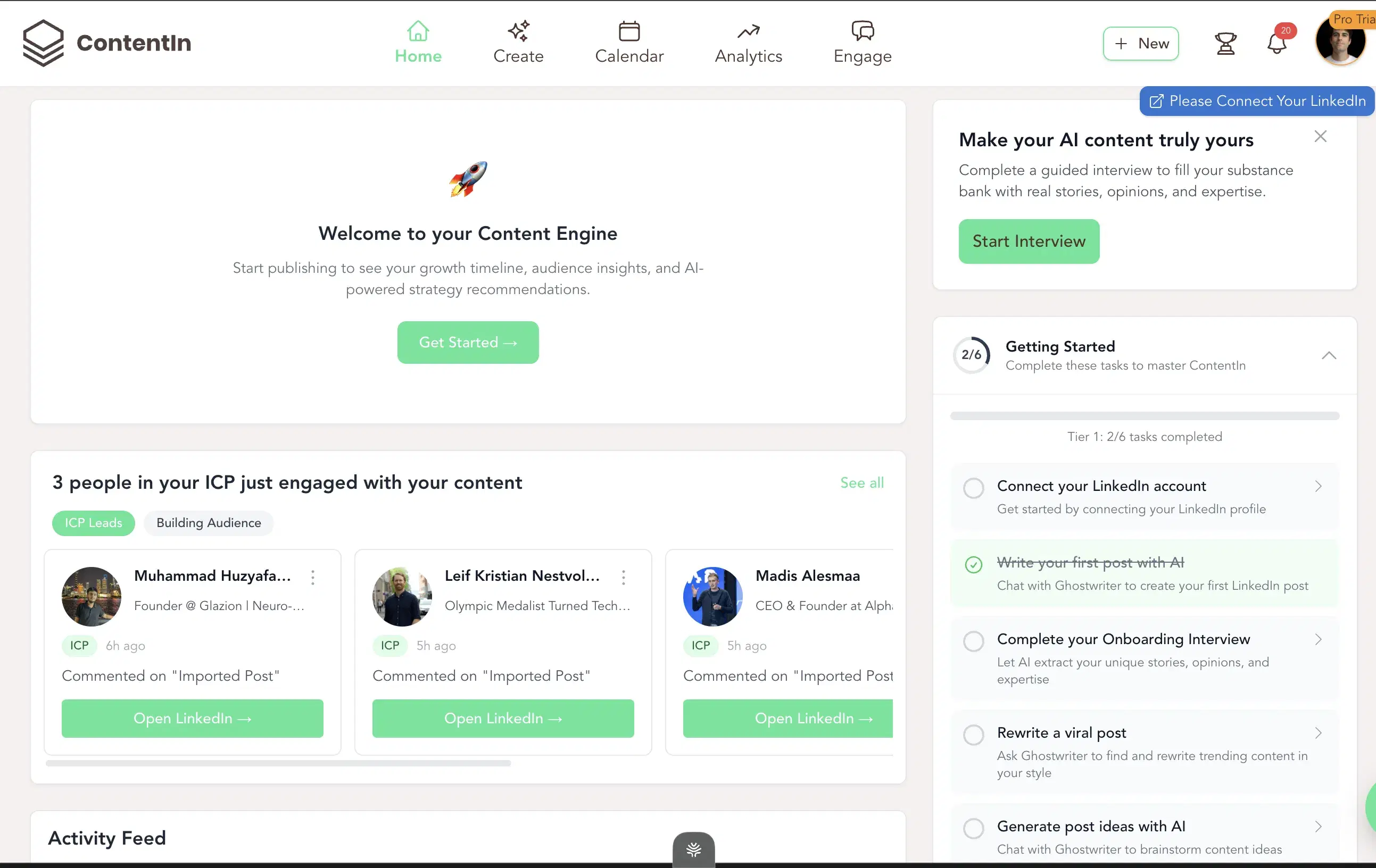
Vendor responds to negative reviews publicly on Capterra: Credibility signal — 25-review sample on Capterra is the strongest in our universe.
4-question personalization quiz: Multiple-choice onboarding — much shallower than persona extraction from past posts.
Best for
- Budget-first solo creators who don't need persona depth and want a clean Kanban + scheduling workflow at a low monthly price.
- People testing whether they want to invest in LinkedIn content tools at all — $15 is a low commitment.
Pricing
$15 / $31 / $48 per month · Free trial
Pros
- $15/mo entry undercuts the category 2–3×. Cheapest LinkedIn-AI writer at a comparable feature surface.
- Right structural product. LinkedIn-OAuth-safe scheduling (no Chrome ext), week-view calendar, Kanban writing queue, composer + scheduling in one place.
- Vendor responds to negative reviews publicly on Capterra. Credibility signal. 25-review sample on Capterra is the strongest in our universe.
Cons
- Composer-generated content is extremely generic and doesn't retain voice. Output reads vanilla, influencer-template-flavored. No questions asked before generating. No web search for trending content. Oiti runs research agents across Reddit + ICP painpoints across the live web + your KB before drafting; persona built from your last 100 posts, not a multiple-choice quiz.(source)
- "Personalization" is a 4-question quiz. Multiple-choice doesn't train an AI on who you are. Oiti builds a 2,000–3,000-word persona document from your past posts + website + ICP painpoint research.
Best for expert-led multi-channel content production
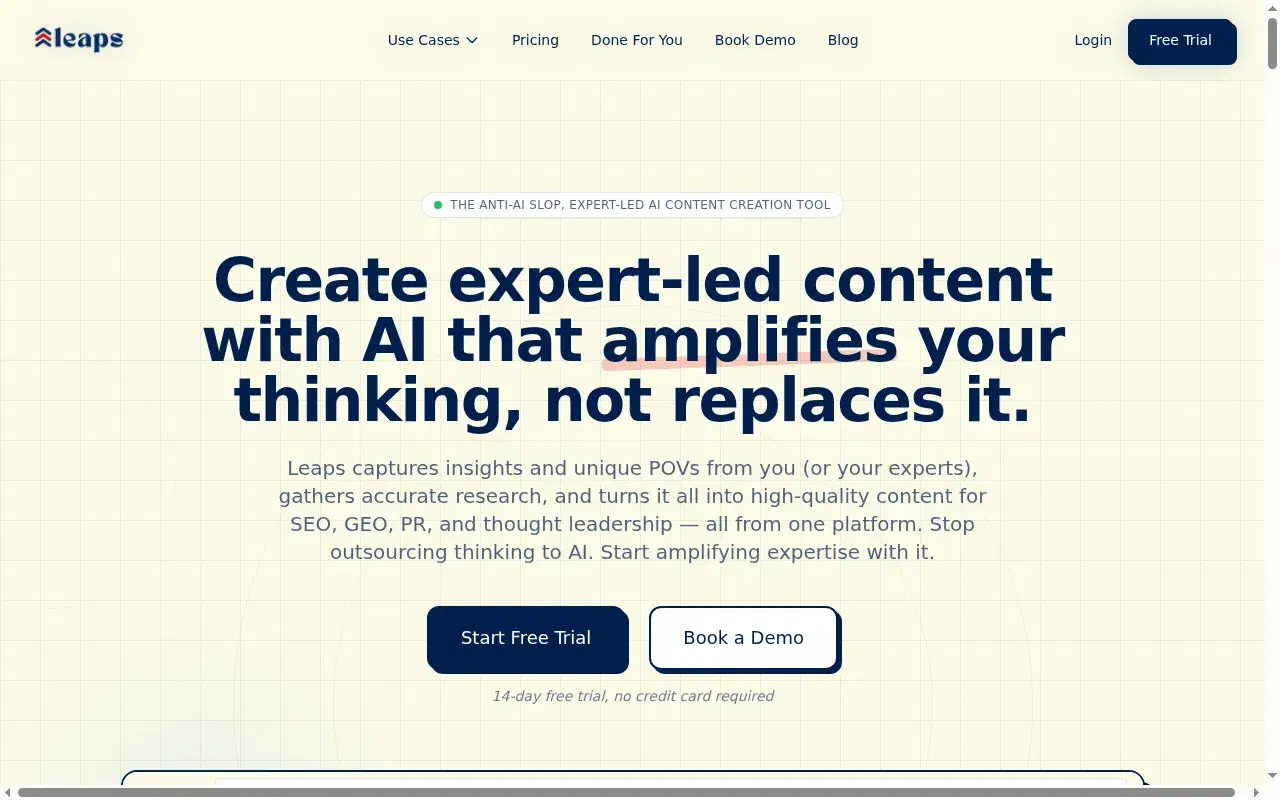
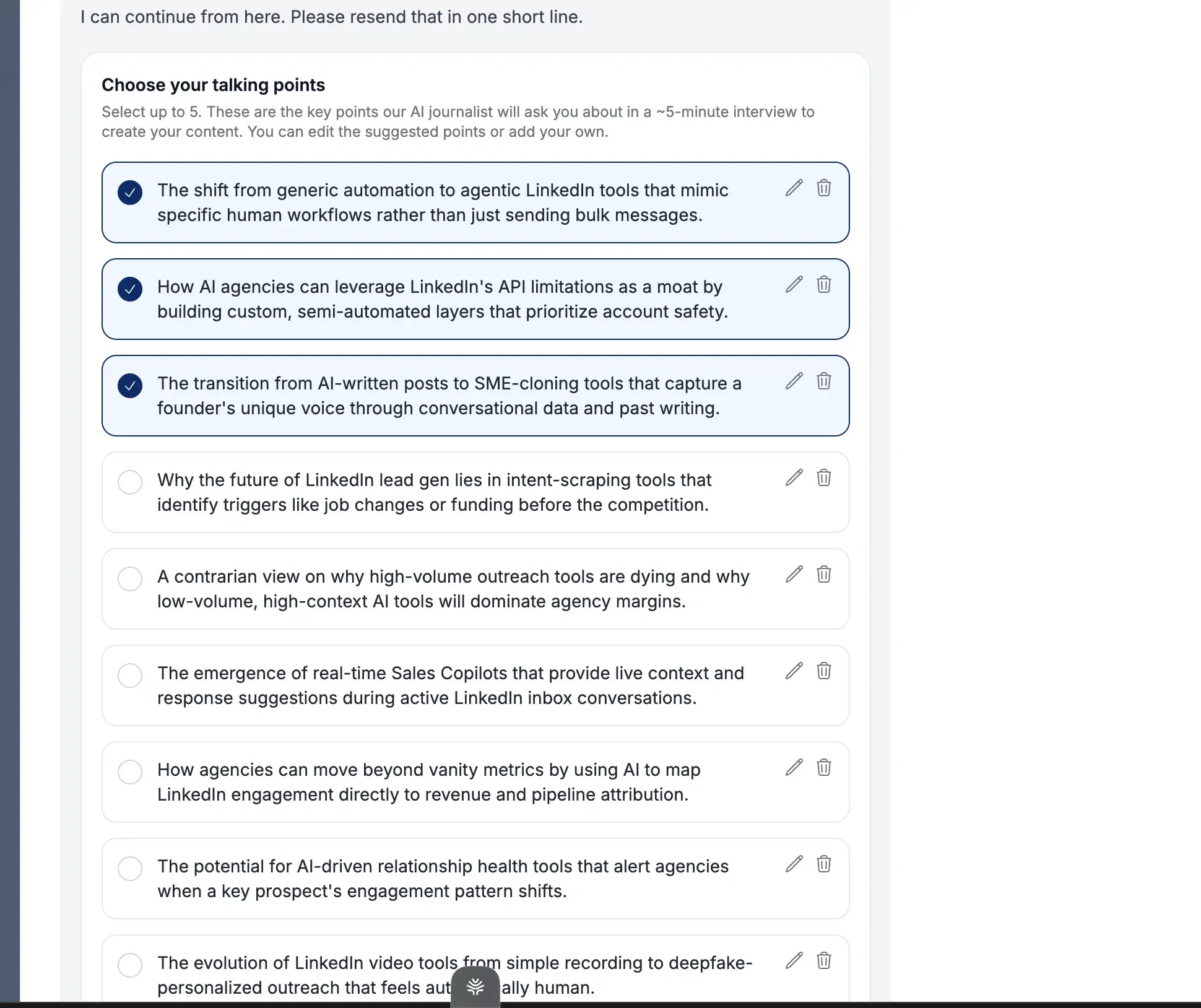
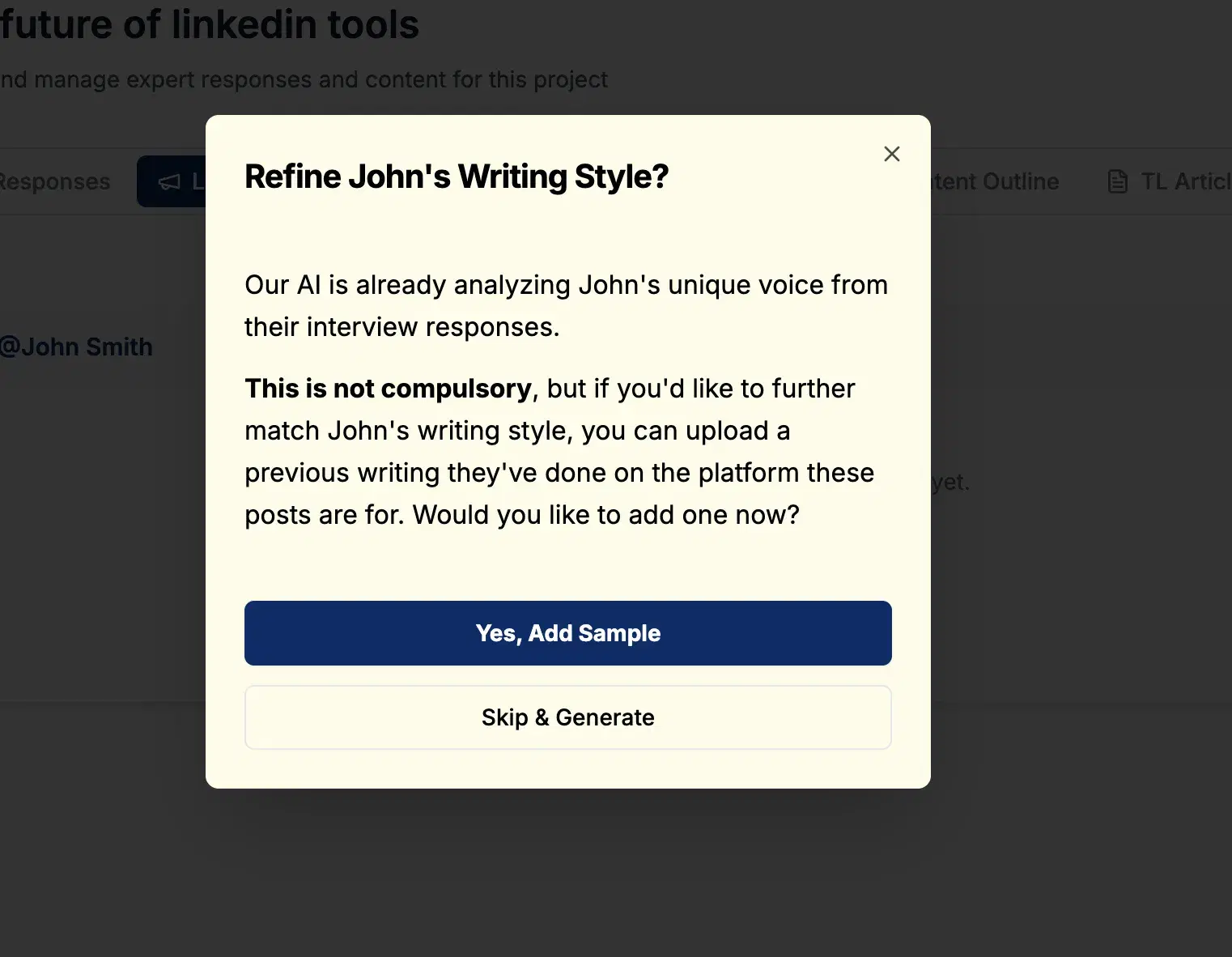
Interesting concept, wrong channel focus. Leaps' tagline is "anti-slop by design – we don't write from generic prompts. Instead, we capture your unique points of view in a short interview." That did sound interesting: their guided interview surfaces a bunch of questions and helps you create responses, rather than just asking "what do you want to write about?" The talking-points selection step lets you pick which angles you want explored. There's a built-in mic for voice-to-text, you can drop in prior writing samples to ground the voice, and they ship pre-written edit workflows ("make hook stronger", "add more details", "make the post shorter") that are quick one-click refines. The dealbreaker: it's not LinkedIn-optimized.
When I tested it
Leaps covers LinkedIn + newsletters + tweets + outlines + articles + notes. For someone whose primary need is LinkedIn content quality, that multi-channel breadth dilutes per-channel depth. The interview format is one-shot – questions → responses → output – then you start over if you want to revise. Compare to a chat-based composer (Oiti) where you iterate via back-and-forth conversation; Leaps' interview format is faster for a first draft but slower for a fifth one. There's no real-time preview on the right while you're editing, no "see more" cutoff in the preview so you can't optimize hook length to fit above the fold, no knowledge base to ingest YouTube/PDFs/past posts, no built-in memory across sessions. Plus, they're also doing SEO and GEO. LinkedIn isn't their primary focus, it's one of several.
Key features
Anti-slop interview concept: Guided interview + talking-points selection forces specificity in a way generic-prompt tools don't.
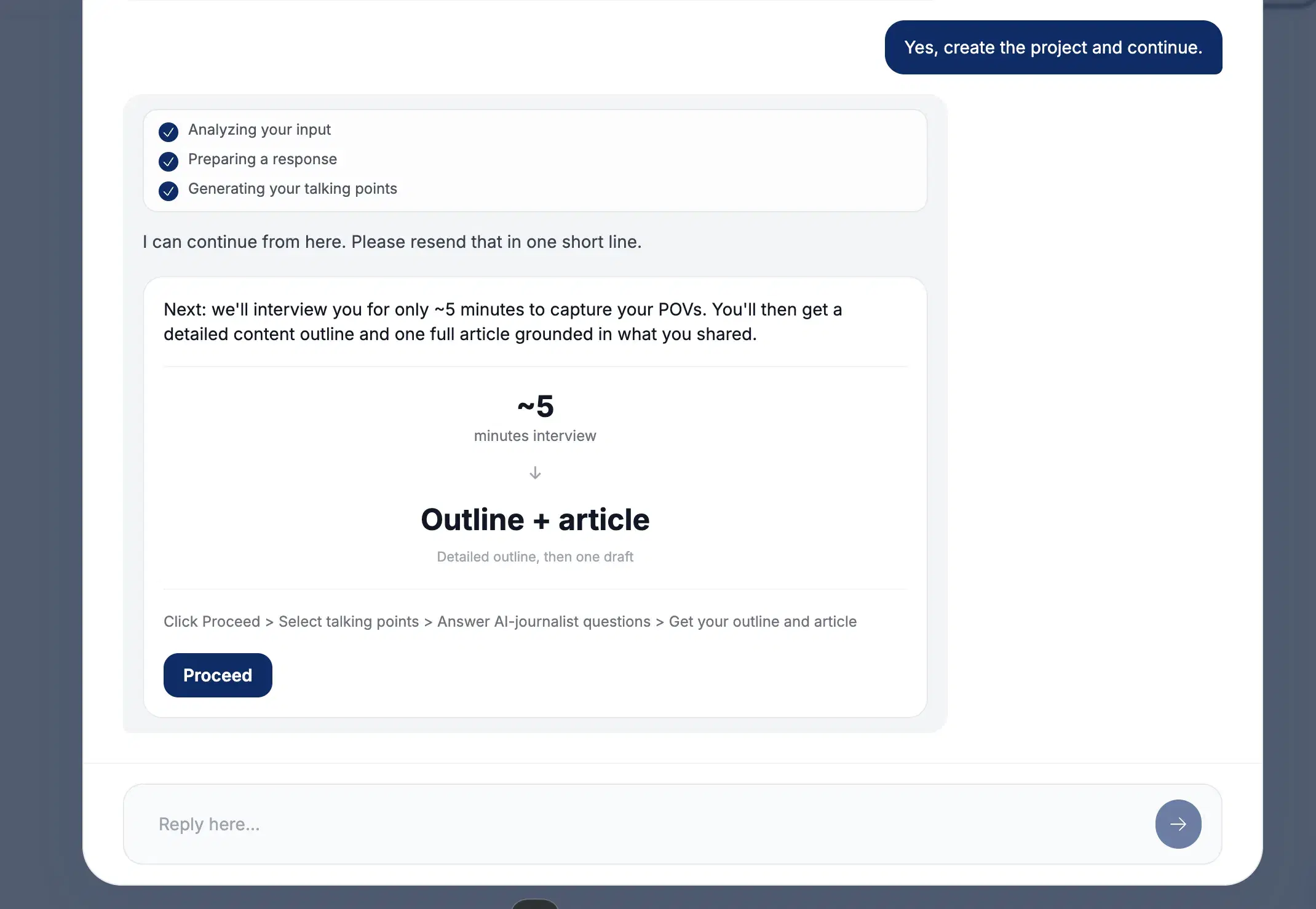
Talking-points selection: Pick which angles to explore from the answers given — narrows the output before drafting.
Multi-channel output + voice-to-text mic: LinkedIn + newsletters + tweets + outlines + articles + notes, all from one interview. Voice-to-text mic + writing-sample uploads.
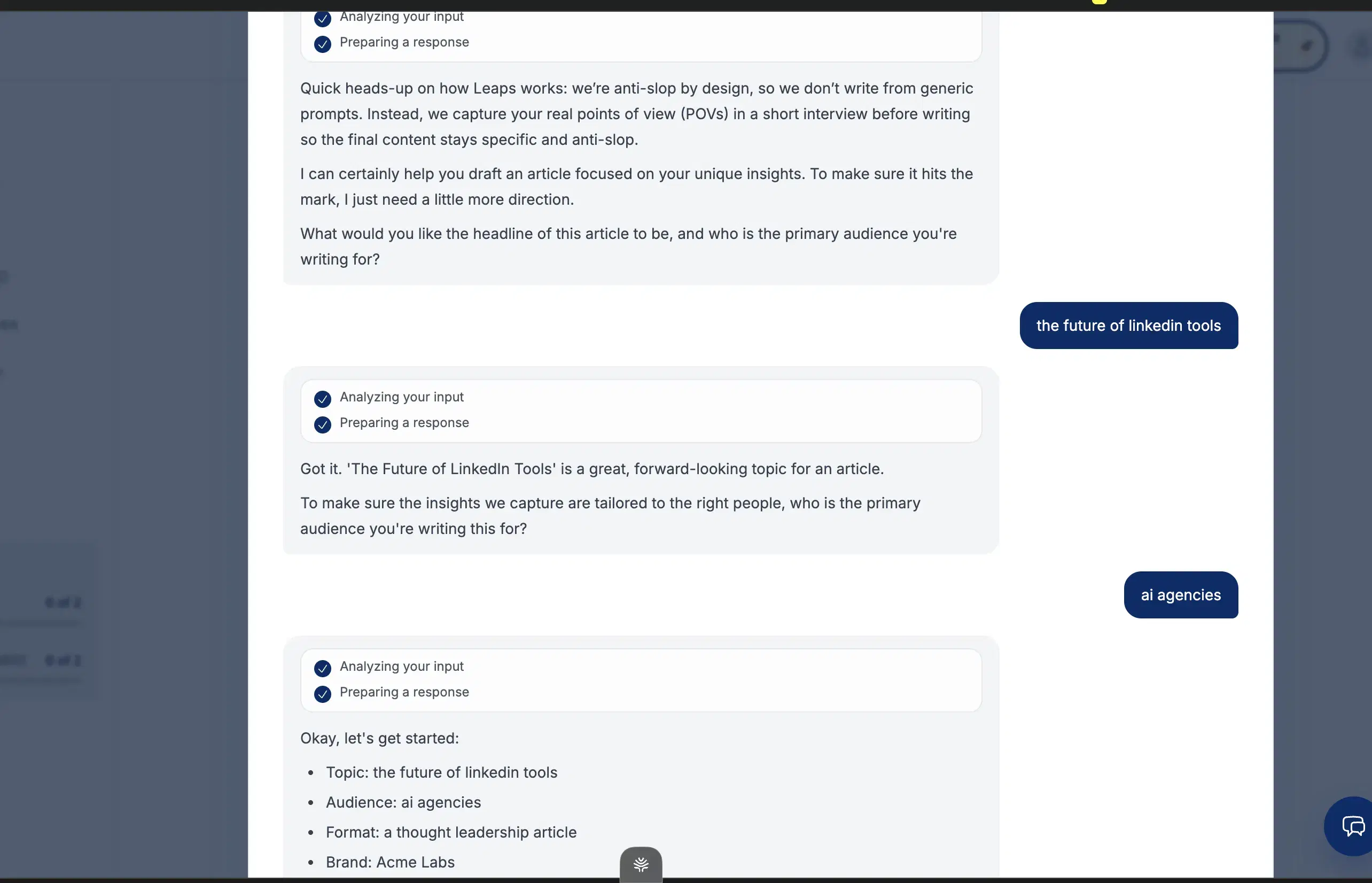
Pre-written edit workflows: "Make hook stronger", "add more details", "make the post shorter" — quick one-click refines.
Best for
- Publishers running multi-channel workflows (LinkedIn + newsletter + Twitter + long-form articles) where the interview-led model fits the production rhythm.
- People who want to capture spoken thinking via voice-to-text and convert it into multi-channel output.
Pricing
$49 Basic / $99 Pro / $149 Premium per month · Free trial, no credit card
Pros
- The anti-slop interview concept is novel. Forces specificity. Real product idea, worth crediting.
- Multi-channel output is genuinely useful for the right persona. Voice-to-text + writing-sample uploads + pre-written edit workflows make it production-ready for multi-channel publishers.
- Competitively priced. $49 Basic with unlimited team members at every tier. No per-seat fees.
Cons
- Not LinkedIn-optimized — multi-channel breadth dilutes per-channel depth. If your priority is LinkedIn-specific content quality, the channel-spread is a tax. Oiti is LinkedIn-only by design — the persona, the KB, the inspiration-template loop, the 360Brew tuning — all built specifically for LinkedIn's 2026 dwell-time algorithm.
- Interview format isn't chat-based, no real-time preview. One-shot generation per article rather than back-and-forth iteration. Oiti pairs a chat-based composer with long-term memory across sessions; every edit compounds.
- No knowledge base, no memory layer. Can't ingest YouTube transcripts, PDFs, past posts, or meeting notes. Each session starts fresh. Oiti's KB ingest + research agents pull from your past 100 LinkedIn posts + ICP painpoint web search before drafting.
Best for teams needing deep approval and scheduling workflows
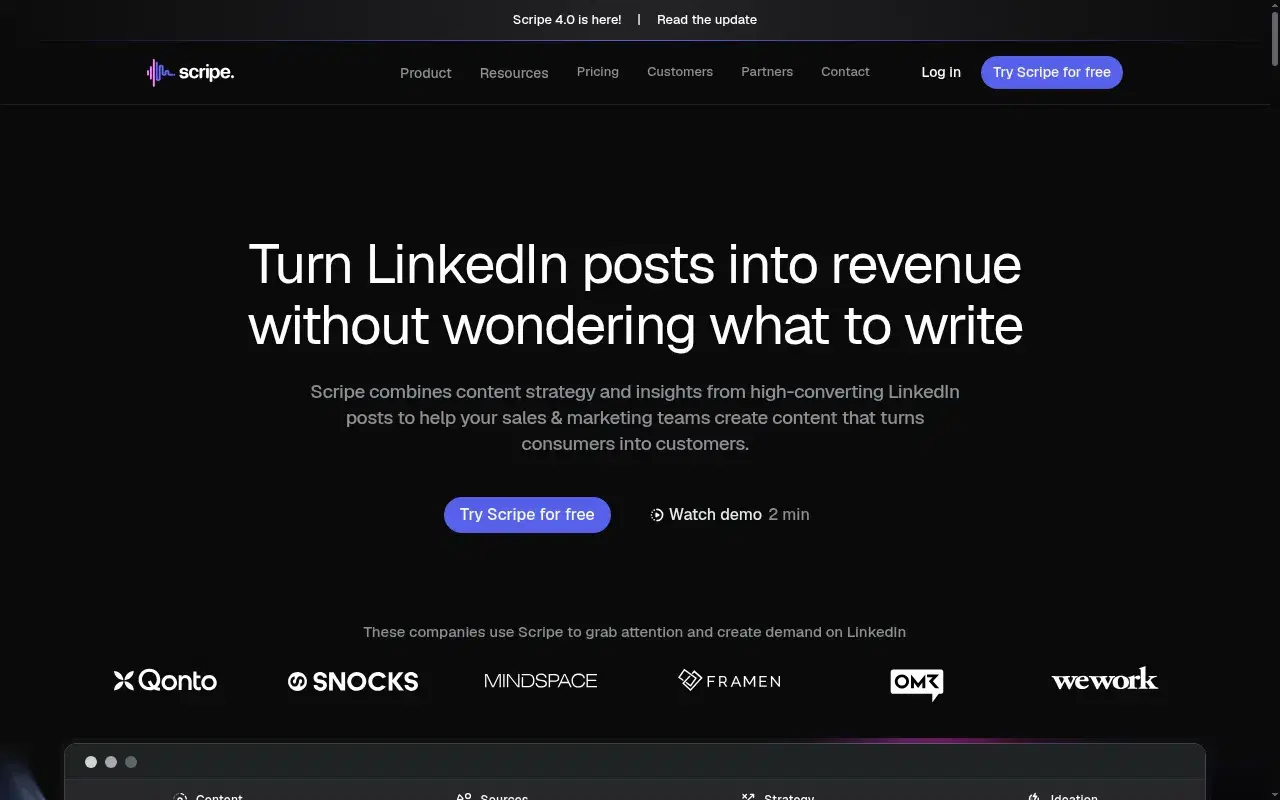
Scripe is European-founded and built for teams and multi tenant scheduling. Approval flows, shared Kanban content pipeline, shared workspace knowledge base, Amplifier seats that separate auto-engagement accounts from posting accounts, custom labels and analytics at higher tiers. If your job is to run LinkedIn content for a 5+ person team and you need the structure, Scripe genuinely thought through their workflows. But content quality at scale is the deal-breaker. Here's how it breaks down, clearly: (1) Snapshot-in-time ideas — their idea / inspiration listing is based on what's viral right now or recently, a fixed view of the LinkedIn universe at a moment, not a system that learns who you are. (2) No long-term memory — each conversation starts fresh. You can't say "I told you last week not to use em-dashes" — that context doesn't persist. (3) Knowledge base exists, but no memory layer on top — the KB holds files, it doesn't compound based on prior chat outcomes. (4) Tone-of-voice creator isn't deep enough — Scripe's persona setup is a "describe how you sound" form vs Oiti's structural extraction of who you've already been online. (5) Viral-pattern bias flattens voice — like Kleo and others, Scripe leans on viral templates; at scale this makes everyone's output sound the same.
When I tested it
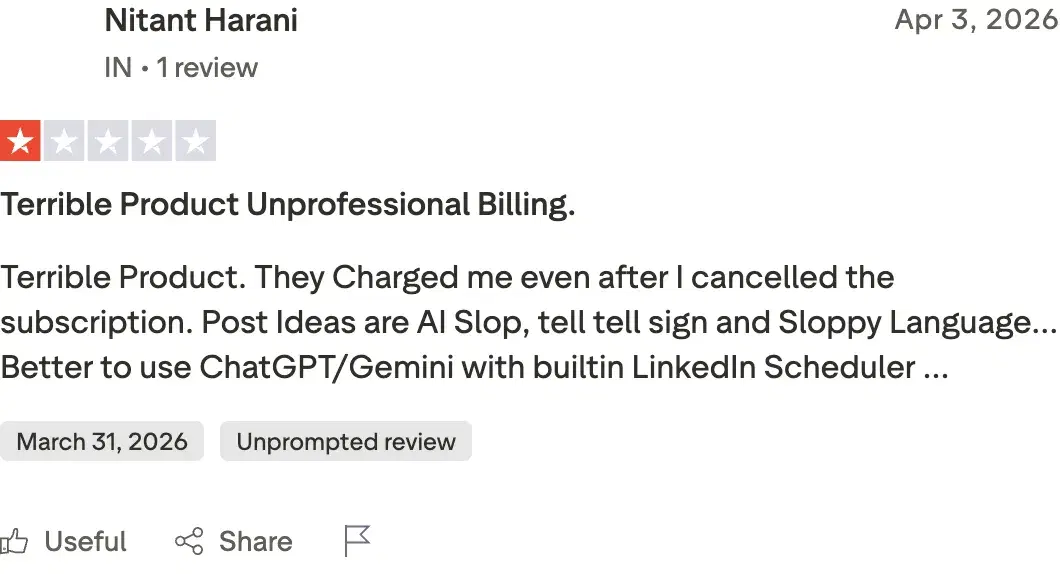
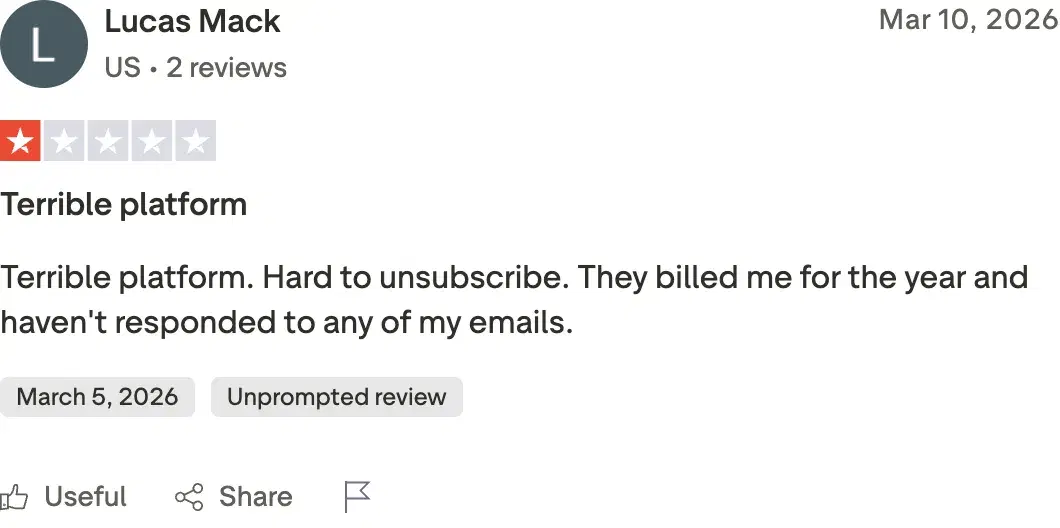
I spoke to a LinkedIn agency that was using Scripe for a finance-founder client. According to him, Scripe's content was "AI slop" – generic, with no depth, and the infographics were what he called "cringe" (verbatim words). A finance founder of a fast-growing company cannot post that kind of content – it actively damages credibility in a serious niche. Trustpilot lined up with that. Scripe is at 2.6/5 across 6 reviews, with two independent 1-star reports of being billed after cancellation. One positive too – Fabio out of Italy at 4/5: "the analytics provided in the platform are way better than the one provided by linkedin itself…" The analytics layer does work.
Review receipts
Key features
Team workflows are deep: Shared Kanban content pipeline, workspace knowledge base, approval flows at Advanced tier, Amplifier-seats model at higher tiers.
Tone-of-voice + knowledge-base bundled at Solo tier: They try the depth layer Oiti owns. The execution misses, but the structural commitment is real.
Snapshot-in-time inspiration listing: Idea / inspiration tab is what's viral right now — a moment, not a system that learns who you are.
Per-extra-account pricing: €45/mo per extra LinkedIn account. Multi-account math gets expensive fast.
Best for
- Teams of 5+ people who specifically need deep LinkedIn workflows — approval flows, shared content Kanban, shared workspace KB, Amplifier seats.
- Operators willing to absorb generic AI output in exchange for the team-workflow structure (with a strong content lead to filter the slop).
Pricing
€69 Solo / €99 Advanced / €149 Business per month + €45/mo per extra LinkedIn account · 14-day free trial
Pros
- Team workflows are deep. Shared Kanban content pipeline, workspace knowledge base, approval flows at Advanced tier, Amplifier-seats model at higher tiers. Genuine wedge vs solo-focused tools.
- Tone-of-voice + knowledge-base bundled at Solo (€69/mo). They try the depth layer Oiti owns. However, the execution misses.
Cons
- Content output is generic at scale and flattens voice. Snapshot-in-time idea listing, no long-term memory, form-style persona setup, viral-pattern bias. Oiti pairs persistent long-term memory + persona built from your past 100 posts + ICP painpoint web search.
- Billing-after-cancellation reports. Two independent Trustpilot 1-star reports of being billed after cancelling, with support not responding. Cross-platform consistency with Taplio + aiCarousels billing patterns.(source)
- Multi-account math gets expensive fast. Solo tier covers 1 LinkedIn account. €45/mo per extra. Three accounts on Scripe Solo = €69 + €45 + €45 = €159/mo (~$175 USD). Three accounts on Oiti Pro = $79/mo flat. Pro covers 3 personal profiles + 10 company pages, no per-account add-ons.
Best for curious indie buyers (with caveats)
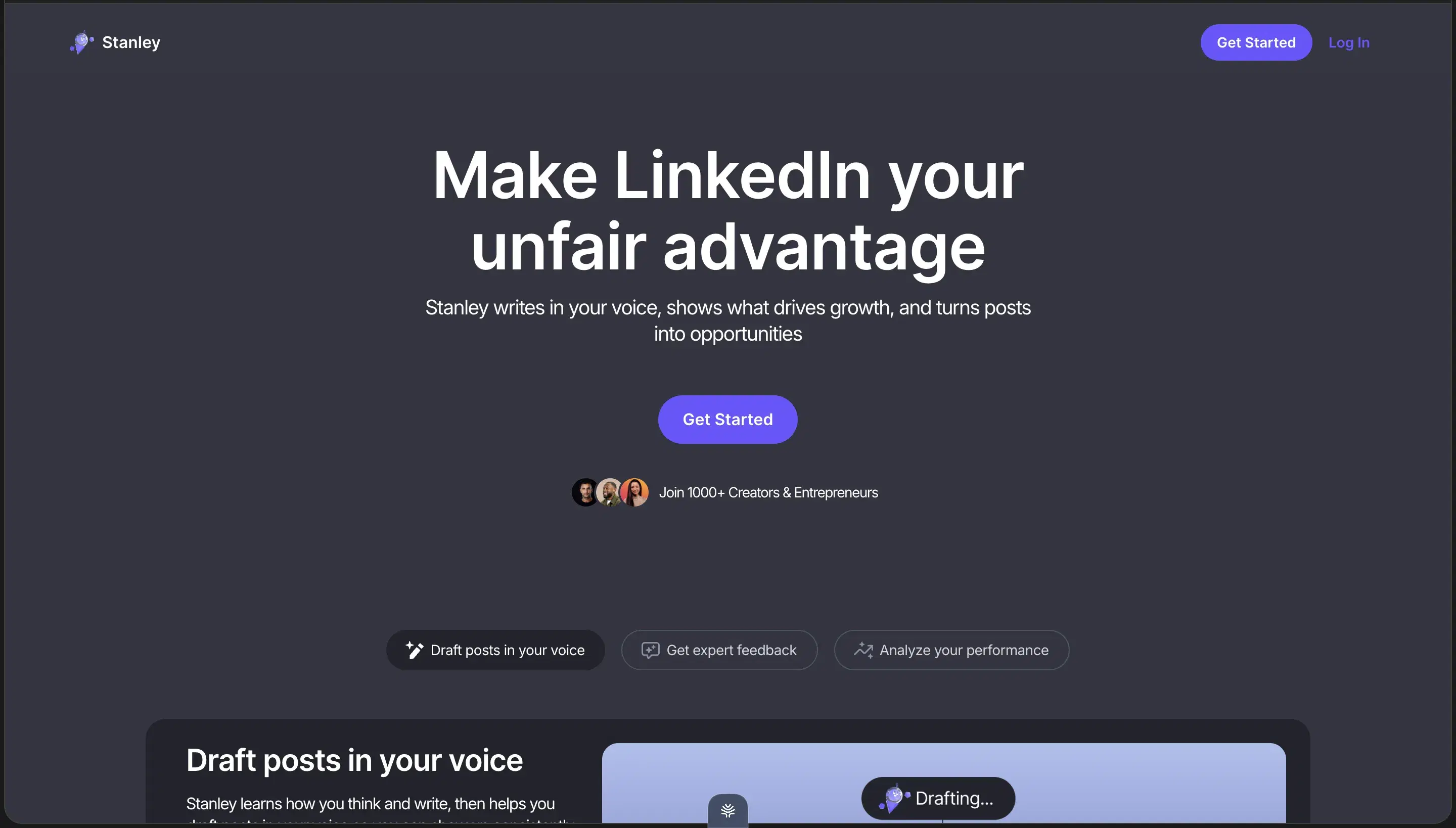
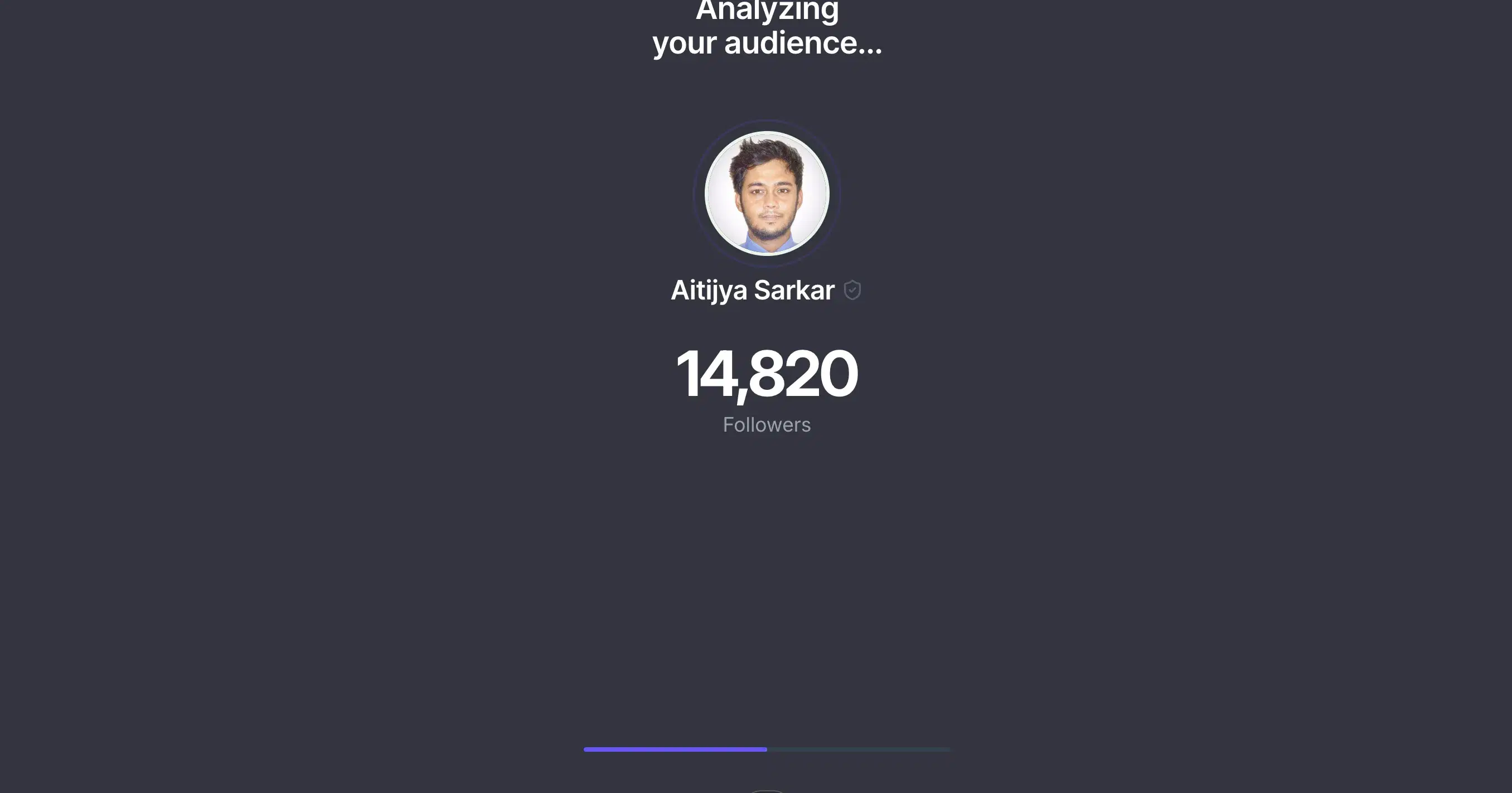
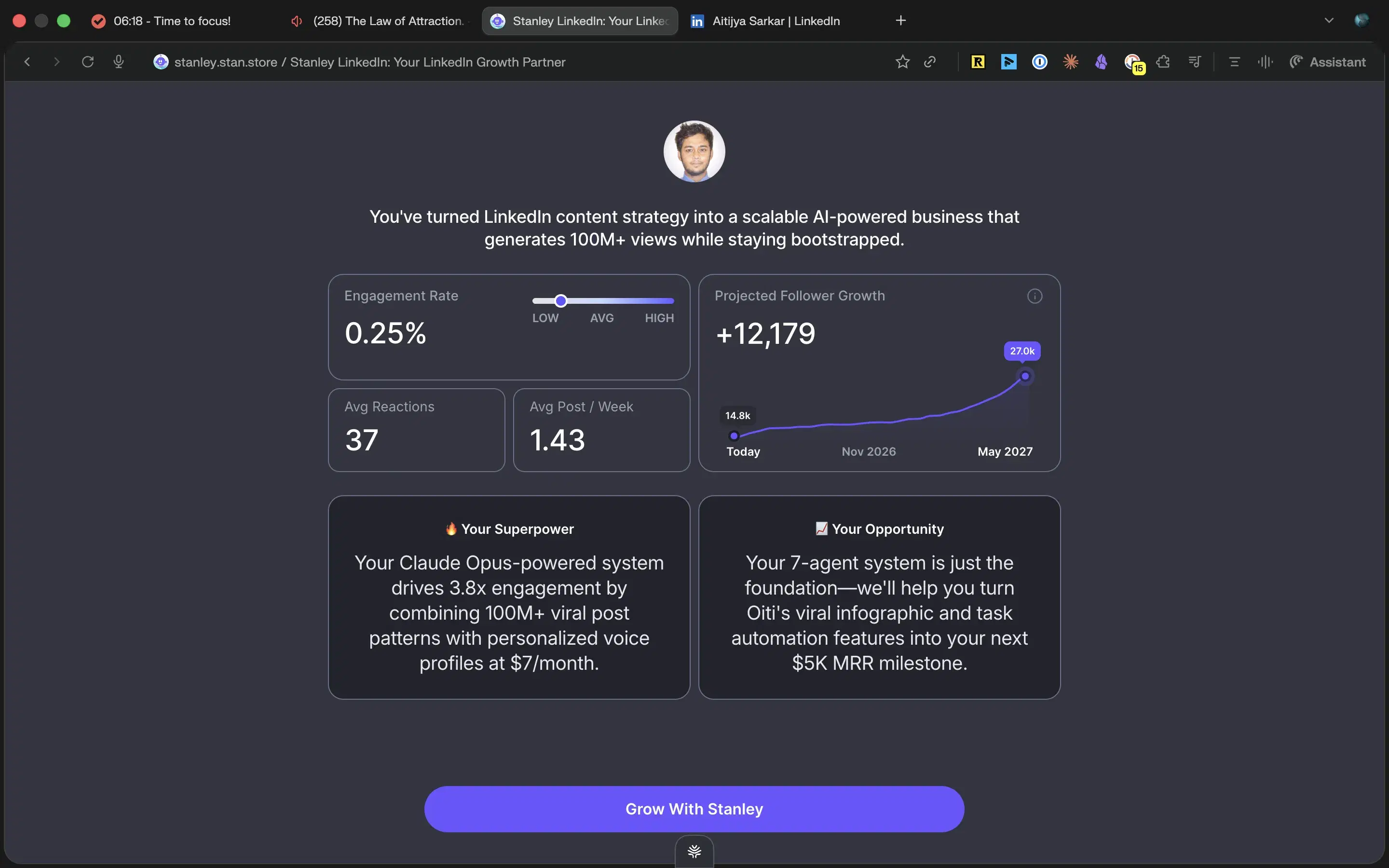
I first heard about Stanley through a paid LinkedIn influencer post – which, as I'd later realize, is how most of their marketing runs. I signed up to try it, and ran straight into a paywall before I could see anything real. No way to evaluate the writing before paying. What you can see before the paywall: a profile-analysis onboarding flow, post-engagement analysis, and a URL-enter onboarding step. The screens show real product depth on the analysis layer – but the question is what they do with that analysis once you're paying, and the only way to find out is to pay. When I got in, Stanley felt more like a coach than a writing tool. They've branded it as a writing partner – it pulls ideas from your past posts and walks you through the writing one step at a time, rather than just generating a draft and letting you edit.
When I tested it
It's not inherently bad. Some people genuinely want the coaching, hand-holding format. What I couldn't get past was the price. They're hammering on it hard – very expensive for what the product actually does, especially next to Oiti Creator at $49 or Pro at $79 covering 3 LinkedIn accounts.
Key features
LinkedIn-native focus with profile-analysis onboarding: The onboarding screen makes it clear: they ARE learning from your past posts and using that to benchmark the future.
Post-engagement analysis layer: The kind of feature most stateless tools don't ship.
Best for
- Indie creators who want the coaching, hand-holding writing format — Stanley walks you through one step at a time rather than generating a draft for you to edit.
- Curious indie buyers willing to commit to the trial-through-paywall path to evaluate the writing layer themselves.
Pricing
Opaque pre-signup; paywall hits inside the flow · No free trial
Pros
- LinkedIn-native focus with a profile-analysis onboarding flow. The onboarding screen makes it clear, they ARE learning from your past posts and using that to benchmark the future.
Cons
- Pricing is opaque pre-signup. Homepage has no $/mo. The paywall hits inside the product. Hard to compare against the rest of this list before committing time to a signup. Oiti's approach: pricing on the homepage; you can see $49 Creator and $79 Pro before any signup.
- No persona / narrative timeline / KB / long-term memory layer visible in the product surface. Oiti's approach: full 6-axis stack.
Best for viral-pattern content (one account)
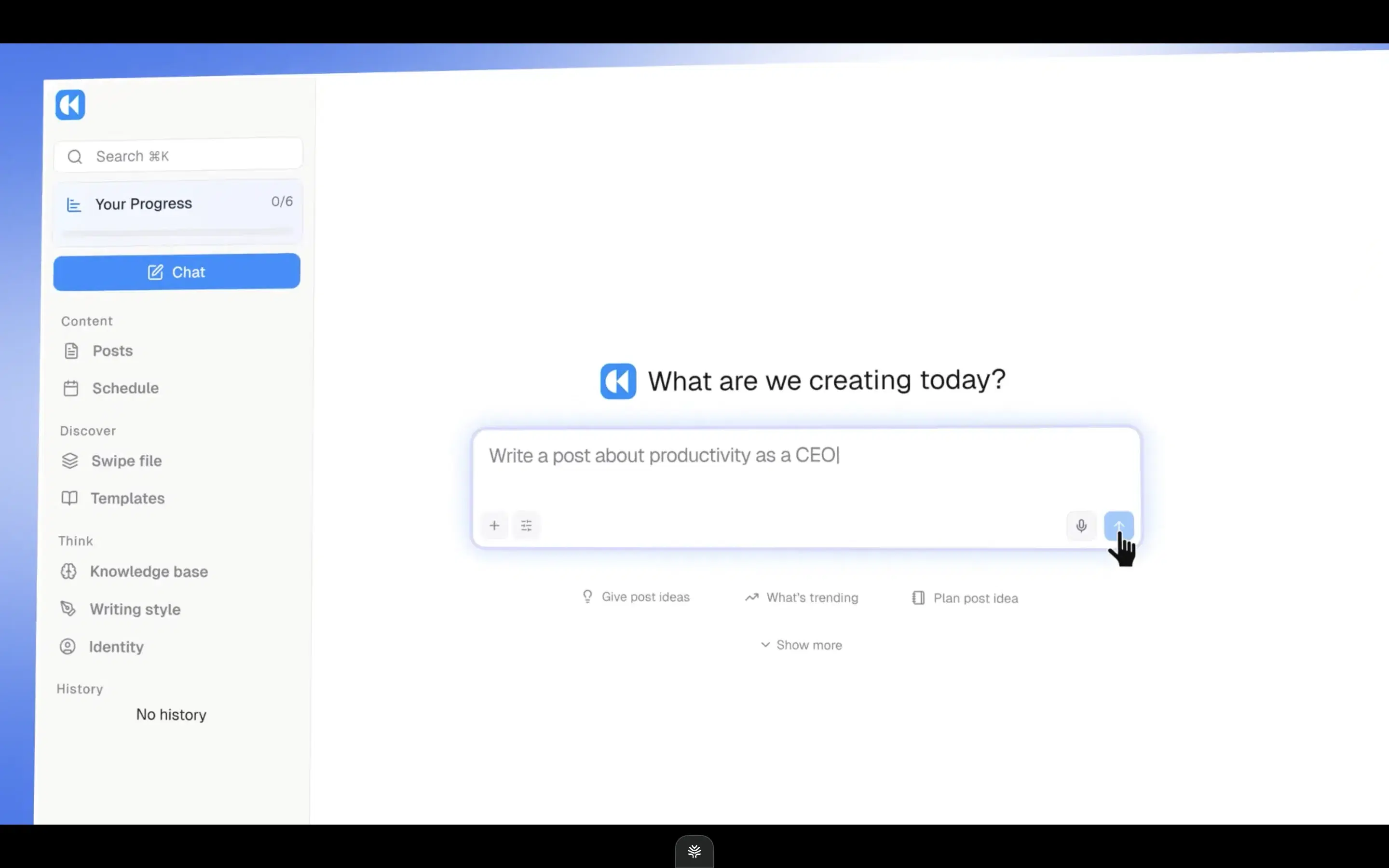
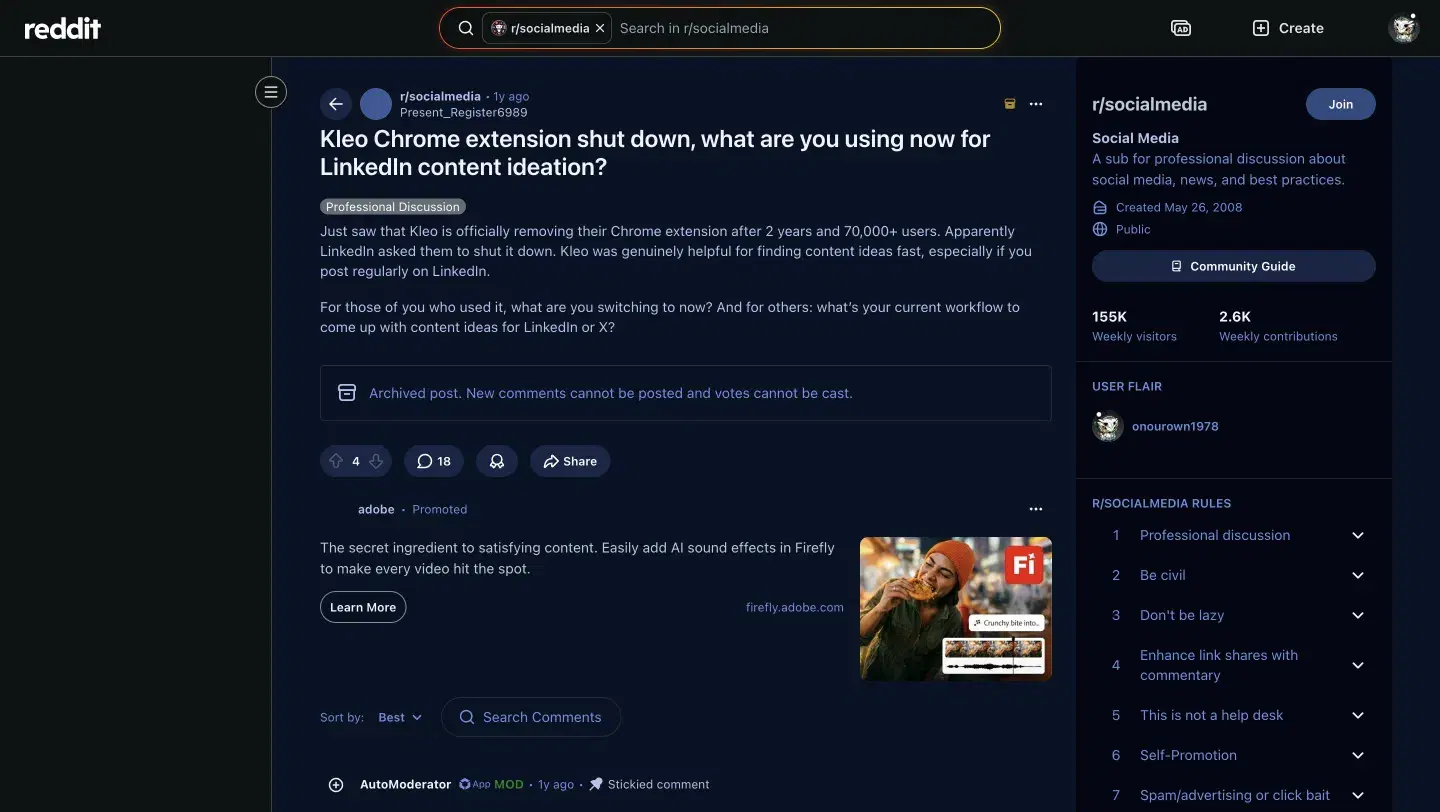
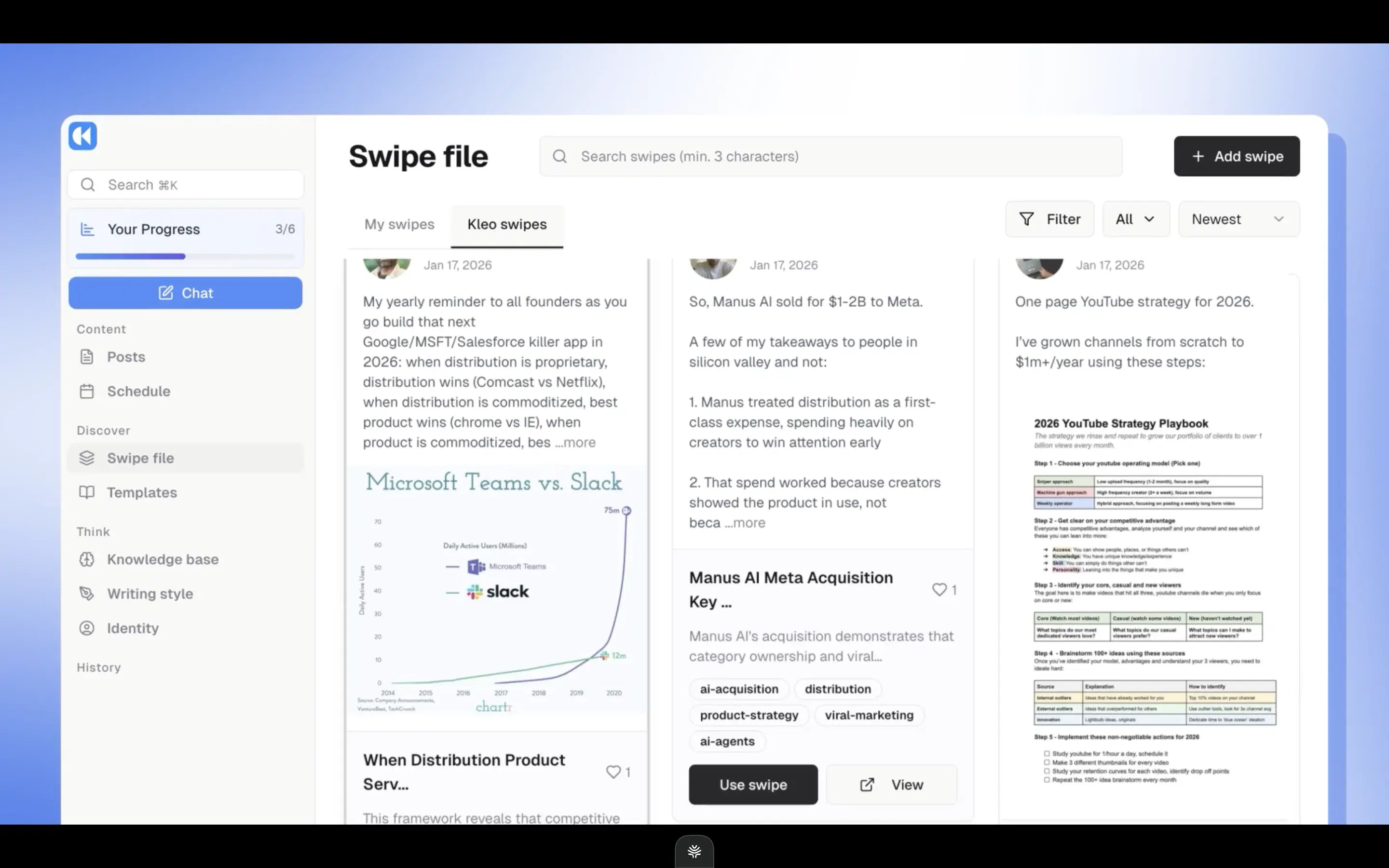
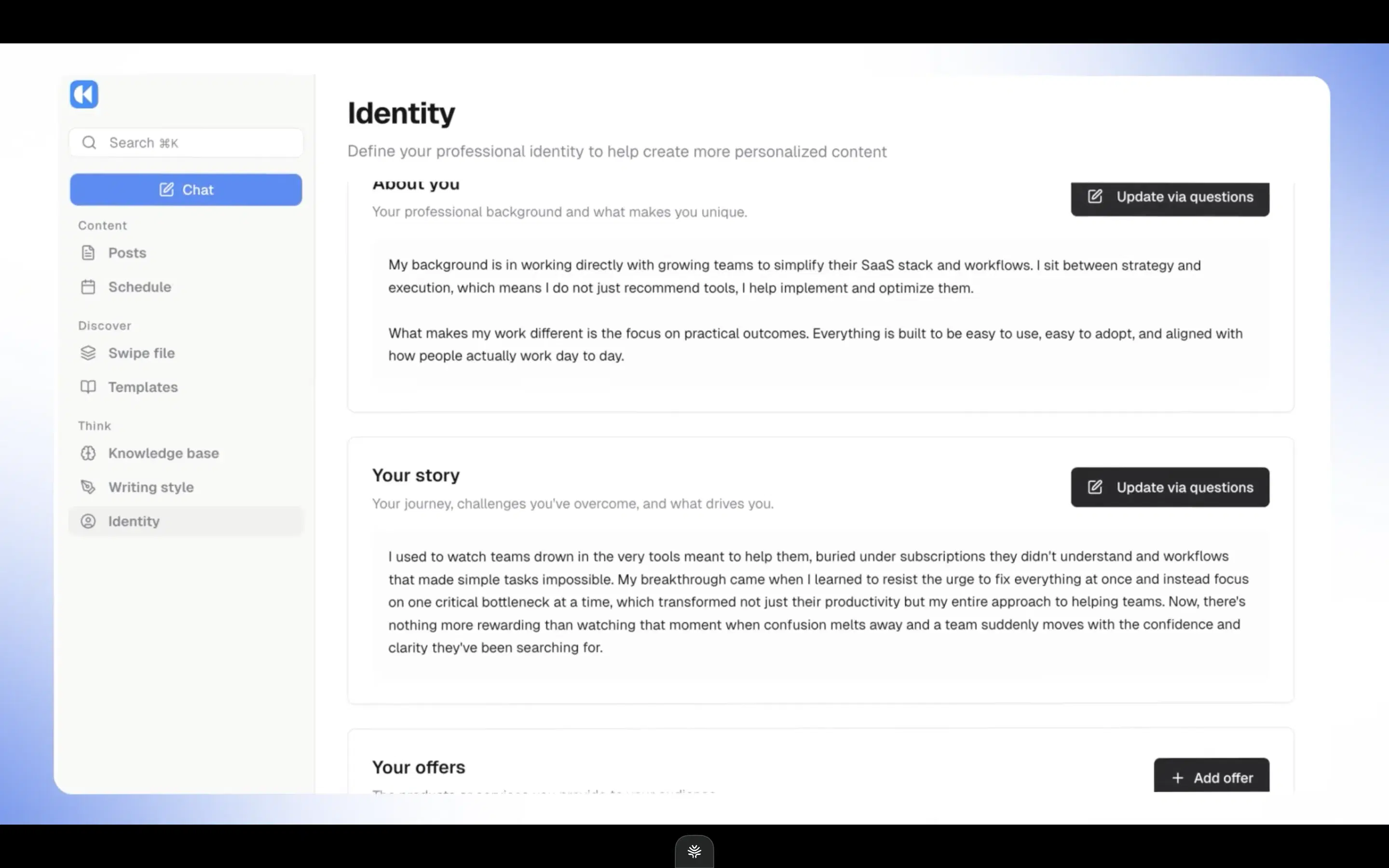
Kleo's original Chrome extension was forced offline by LinkedIn after two years and 70,000+ users. The team rebuilt. The current Kleo is a full-stack LinkedIn content tool, which is what this entry reviews. The new product has real bets: a Context Engine that mirrors Oiti's persona/KB direction, an Inspiration Swipe File that mirrors Oiti's 1-click templates, and a chat composer with feature parity on the writing surface. Infographics aren't as polished or as varied as Oiti's, but they exist and they're well done. What Kleo specifically optimizes for: viral content, fast. Their angle is opinionated around viral formats. If you want viral content for one LinkedIn account and you don't mind the price, that's the lane. Where it falls down: them trying to make you go viral flattens the voice and tone.
When I tested it
Going viral is often the wrong play — for boring niches, for educated audiences, for anyone whose distribution depends on credibility rather than reach. The new algorithm rewards dwell time, not virality. A post that 200 people read for 90 seconds outperforms one that 2,000 people skim in 4 seconds. Optimizing for viral patterns bakes in the wrong outcome. The other reality: no free trial, $99/mo single-account. Annual is $999 (~$83/mo) but you can't evaluate the product without paying $99 upfront. I moved on from Kleo specifically because of this math — Oiti Pro at $79/mo covers 3 personal LinkedIn accounts vs Kleo's single account at $99.
Review receipts
Key features
Built for viral content fast: Kleo's opinionated angle is around viral formats.
Context Engine: Mirrors Oiti's persona/KB direction. Real bet on grounding posts in who you are.
Chat composer + infographics: Feature parity on the writing surface. Infographics aren't as polished or as varied as Oiti's, but they exist.
Pivoted away from Chrome extension: After LinkedIn forced the original extension offline, the team rebuilt as a full-stack tool — credit for the pivot.
Best for
- Someone who specifically wants viral-format content for one LinkedIn account, doesn't mind the $99/mo, and is willing to use the tool intelligently (not let viral-pattern bias flatten their voice).
- Single-account creators willing to commit to $99/mo with no trial.
Pricing
$99/mo or $999/yr (~$83/mo effective) · No free trial currently
Pros
- Built for viral content fast. Kleo's opinionated angle is around viral formats. If you specifically want viral-pattern content for one account, this is where the product opinion lives.
- Feature parity with Oiti on the writing surface. Chat composer + inspiration tab + infographics. Infographics aren't as polished or as varied as Oiti's, but they exist and they're well done.
Cons
- Viral-format opinion flattens voice. Strongest angle = biggest pitfall. Chasing viral patterns flattens what makes your voice yours. For boring niches or educated audiences, going viral is often the wrong play. Oiti's narrative timeline + tone clone prioritize voice fidelity over viral pattern matching.
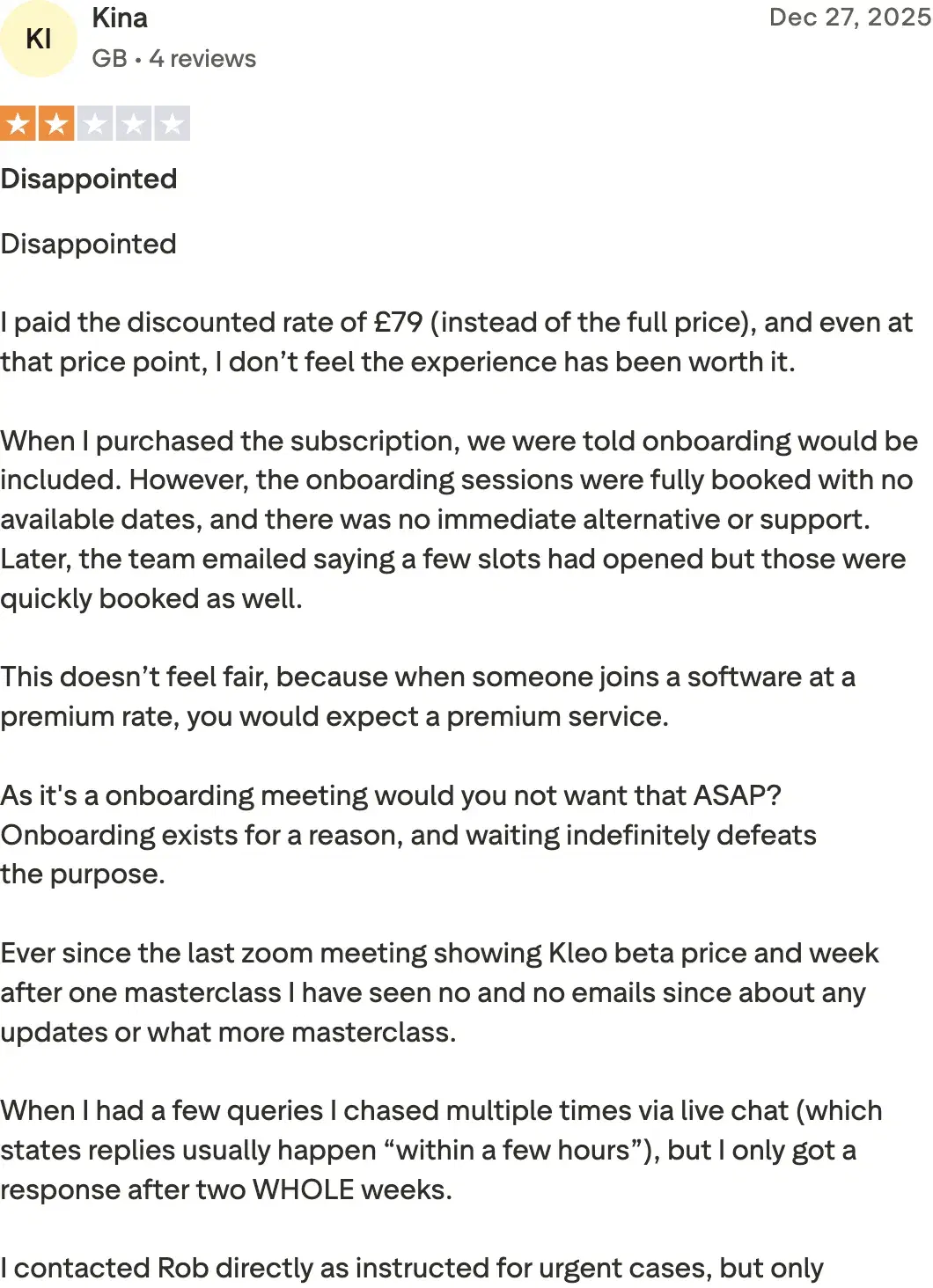
- No free trial. $99/mo single-account. Can't evaluate without paying $99 upfront. Kina UK Trustpilot 2/5: even at the discounted £79, didn't feel the experience justified the price. Oiti Pro at $79/mo covers 3 personal LinkedIn accounts; Creator $49; 7-day free trial with no usage cap; 50% off yearly for early adopters.(source)
- No long-term memory. Primitive KB. Every session starts fresh. Oiti pairs persistent long-term memory across sessions + KB that ingests YouTube + PDF + meeting notes + competitor posts.
How to choose
If your top concern is safety / ToS → Oiti (official APIs only) or Supergrow (also official APIs). Skip anything Chrome-extension-based for outbound or scheduling. The category is under active LinkedIn pressure — Shield Analytics shut down in May 2026, Kleo's extension was forced offline, AuthoredUp is fragile.
If you're budget-first, under $30/mo → ContentIn at $15/mo is the cheapest credible option. The structural product is right; the content quality has a ceiling. Pair the trial with Oiti's 7-day free trial (no usage cap) and compare the output side by side before committing.
If you want a thinking partner for long writing sessions → Oiti. The persona + memory + KB layer is the wedge nothing else closes in this list. Deep context, memory that compounds, a real KB to ground research.
If you're a ghostwriter or agency writing for 3+ clients → Oiti Pro at $79/mo. Multi-Clone, multi-voice, multi-account scheduling, separate KB per client — built for this workflow. Pro isn't agency-only; many solo users opt up for the multi-voice headroom (different personas for different content streams, founder + company page, two unrelated projects).
If you only need formatting → Oiti's free LinkedIn Text Post Formatter (no signup, AI hook audit included), or AuthoredUp paid if you want the polish — understanding that their Chrome extension puts your account at risk.
If you only need scheduling across multiple accounts → Supergrow's scheduling is the genuine wedge in this list. Oiti Pro covers the same scheduling at $79/mo and adds the writing layer.
If your primary LinkedIn medium is carousels and slide decks → Postiv. Their pre-built carousel workflows are the one thing where they genuinely beat Oiti. Pay for it if carousels are what your audience actually reads.
If you publish across multiple channels (LinkedIn + newsletter + Twitter + long-form articles) → Leaps, if the interview-led ghostwriting model fits your production rhythm. Specifically not for LinkedIn-only creators; the multi-channel breadth dilutes per-channel depth.
If you need deep team workflows for 5+ people (approval flows, shared workspace KB, custom analytics) → Scripe (with the caveat that the writing quality plateaus). Pair with a strong content lead so the structure doesn't carry generic output to your audience.
The verdict
Two months trying Taplio and testing 9 alternatives taught me one thing: Taplio's actual product moat — its 1M+ post inspiration library — survived the AI era. Almost everything else around it is now slower, riskier, and more expensive than what shipped after it. For content alone, Oiti is the pick: voice fidelity over time, persistent memory, KB ingest, no Chrome extension, multi-account scheduling on Pro at the price of one Hootsuite seat. For scheduling across multiple accounts, Supergrow. For formatting only, AuthoredUp (with the Chrome-extension ToS caveat fully understood). For everything-in-one-tool, Taplio still wins on scope — but only if you need outbound and comment automation, which can actively harm your account through browser extensions. Yearly plans are 50% off for early adopters right now: $49 Creator → $245/year ($24.50/mo effective), $79 Pro → $395/year ($39.50/mo effective). Expires when the early-adopter window closes — no renewal at this rate.
7 days free · No usage limits