I Tried the 7 Best MagicPost Alternatives in 2026 (Honest Review)
Six years ghostwriting on LinkedIn. Hands-on with all seven. Here's the honest ranking across persona depth, memory, LinkedIn safety, and pricing.

Why I wrote this
The short answer
The short answer
Oiti #1, Supergrow #2, AuthoredUp #3. Trustpilot loves MagicPost (4.7/5 across 91 reviews — the strongest showing of any LinkedIn-only AI tool I've tracked). But I found the content really generic — and that's why most users start looking for alternatives.
Jump to: the full ranking · methodology · FAQ.
I first tried Magicpost last year after reading a post from an influencer hyping it up.
Tried the onboarding: set it all up, and then got the ai to create a post for me. The output wasn't at all what I was expecting: the context it built from my LinkedIn felt vague and surface level — it tried to capture patterns from a handful of recent posts, not the hundreds I've actually published. The first draft was fine. Then I read it again and realized: this could have come from anyone. Same old generic templated content, generic structure, generic hooks. The kind of LinkedIn post that LinkedIn's 360Brew algorithm — a 150-billion-parameter LLaMA 3 decoder documented in LinkedIn's March 2026 engineering blog — buries because there's nothing to hold a user's attention.

Then I started testing everything else in the ai linkedin content space.
Only to face similar disappointment.
I realized not much has changed.
BACKGROUND: I've been ghostwriting LinkedIn content since 2020. 100M+ views across roughly 50 profiles — SaaS, crypto, blockchain, insure-tech, deep tech, dev tools. I've paid for, trialed, or shipped client work on virtually every LinkedIn AI tool you can think of.... Taplio, SocialSonic, AuthoredUp, MagicPost, Supergrow, Kleo, ContentIn — the whole list.
But none of them solved the generic ai slop problem, so I quit LinkedIn ghostwriting and built Oiti — the AI clone for LinkedIn content, instead.
This piece ranks the seven MagicPost alternatives I'd actually recommend a client in 2026. Some I paid for over years (Taplio 2021, AuthoredUp 2020–2021). Some I trialed for this article (MagicPost, ContentIn, MeetSona).
So, re: my honest take on the 7 best MagicPost alternatives in 2026 — you have my short answer above, now.... the long one's below.
The 7 best MagicPost alternatives at a glance
Sorted by overall fit for solo creators and small teams writing on LinkedIn in 2026. Click any tool name to jump to the full writeup.
| # | Tool | Pricing | What sets it apart |
|---|---|---|---|
| 1 | Oiti | $49 – $79 / month (50% off yearly: $245 Creator / $395 Pro) | 3,000-word persona + long-term memory + KB + chat composer |
| 2 | Supergrow | $19 – $139 / month | Kanban scheduling, deep multi-tenancy workflows |
| 3 | AuthoredUp | $19.95 / month ($16.63/mo billed annually) | The strongest LinkedIn formatter in the category, hook variation engine |
| 4 | Taplio | $39/mo Starter (zero AI credits) / $65+/mo Standard (AI unlocks) | Viral post library, household brand recognition |
| 5 | ContentIn | $15 / $31 / $48 per month | Aggressively low entry pricing |
| 6 | MeetSona | $24/mo (5 voice interviews/mo) / $59/mo (15 voice interviews/mo) | 10-minute voice interview builds the persona |
| 7 | Kleo | $99/mo or $999/year (~$83/mo effective) | Survived the LinkedIn extension shutdown and rebuilt |
Why people are looking for MagicPost alternatives
- The content output is vanilla. MagicPost picks up patterns in your content from a handful of recent posts — not your full archive of hundreds. Shallow persona, shallow output.
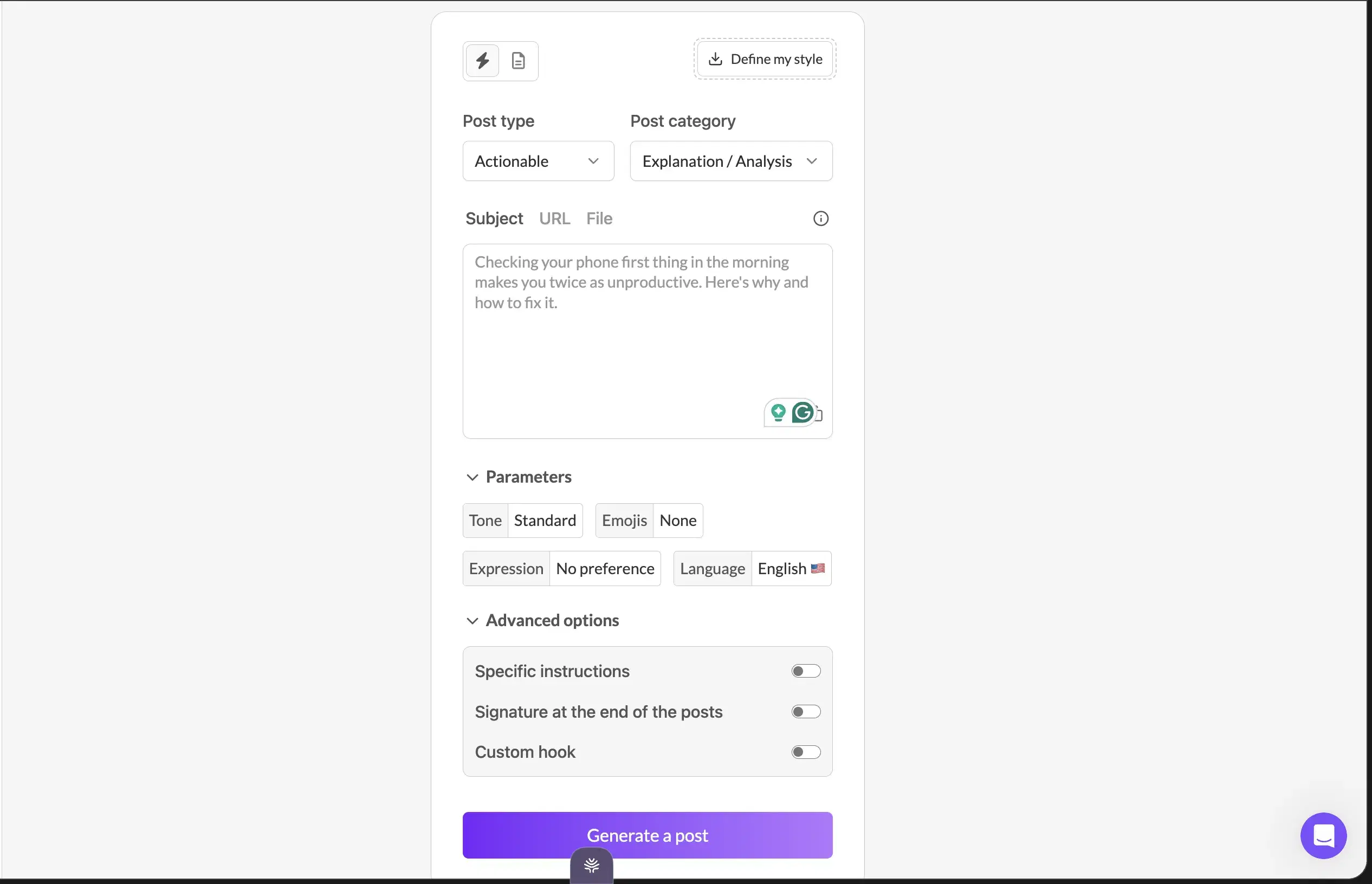
Generate view — pick a style, type a topic, get a draft. No iteration. - No chat composer. Input is form-based: type what you want, get an output, accept or restart. No iteration, no continuous feedback loop. The final post is only as good as your first prompt.
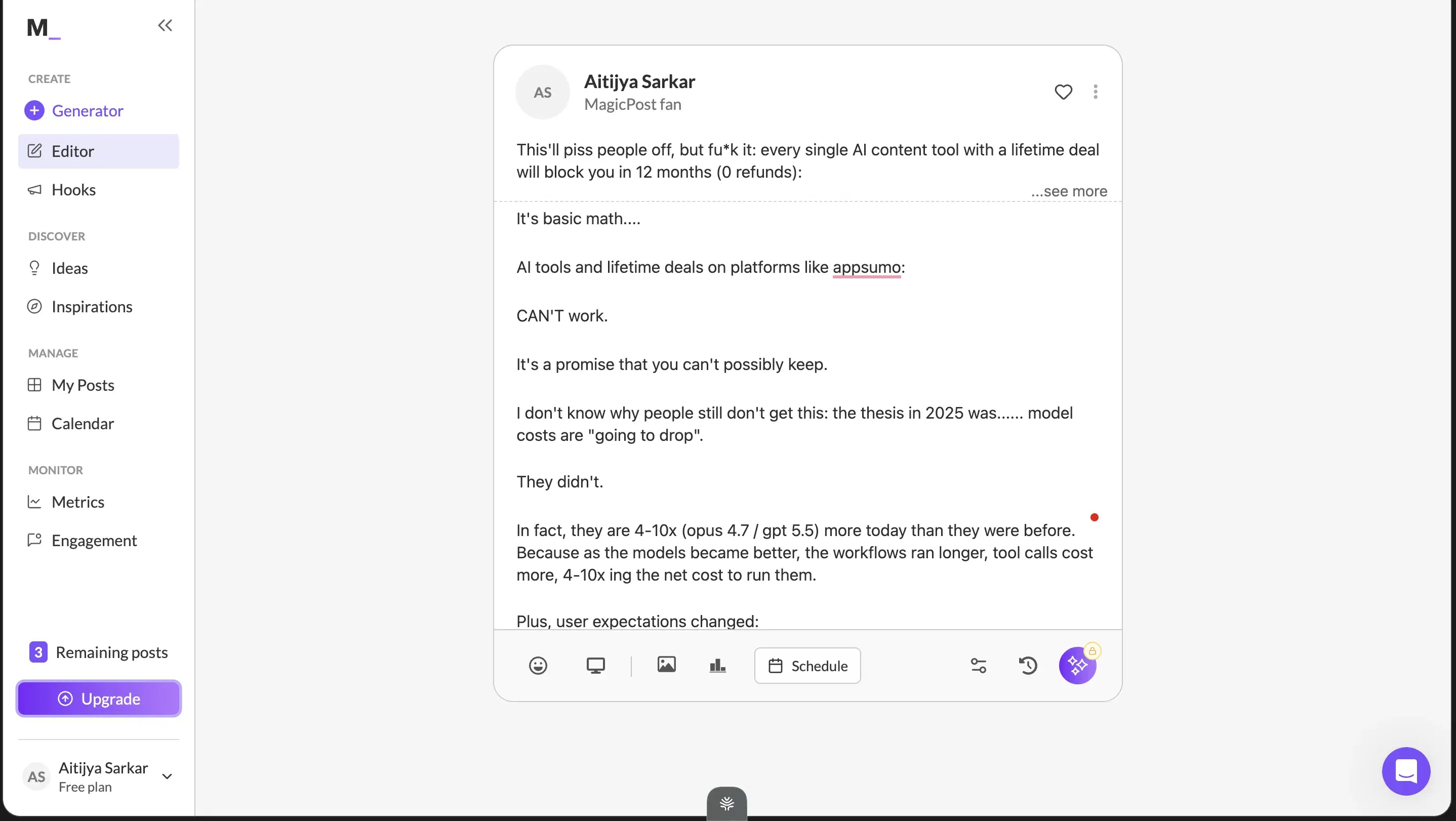
Editor — edit-in-place + preview, but no back-and-forth chat. - No real knowledge base. MagicPost can't ingest YouTube videos, PDFs, meeting notes, or competitor posts. The persona is built from your existing posts only — nothing live for what your ICP is actually complaining about right now.
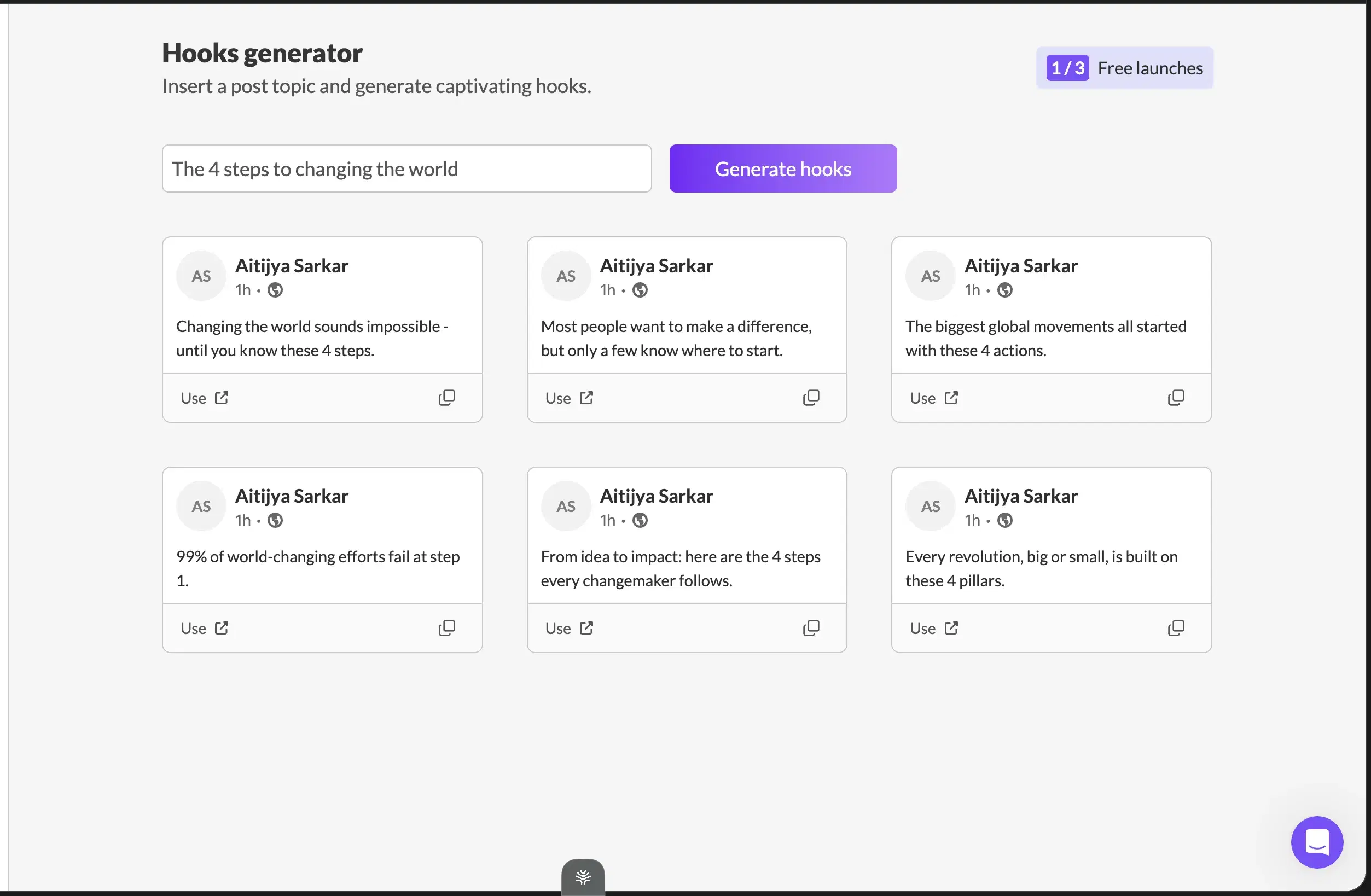
Hooks generator — surface patterns, no KB or research grounding underneath. - The LinkedIn preview doesn't fully render. The "see more" cutoff and a few edge-case rendering details are off. MagicPost's strongest feature still has friction.
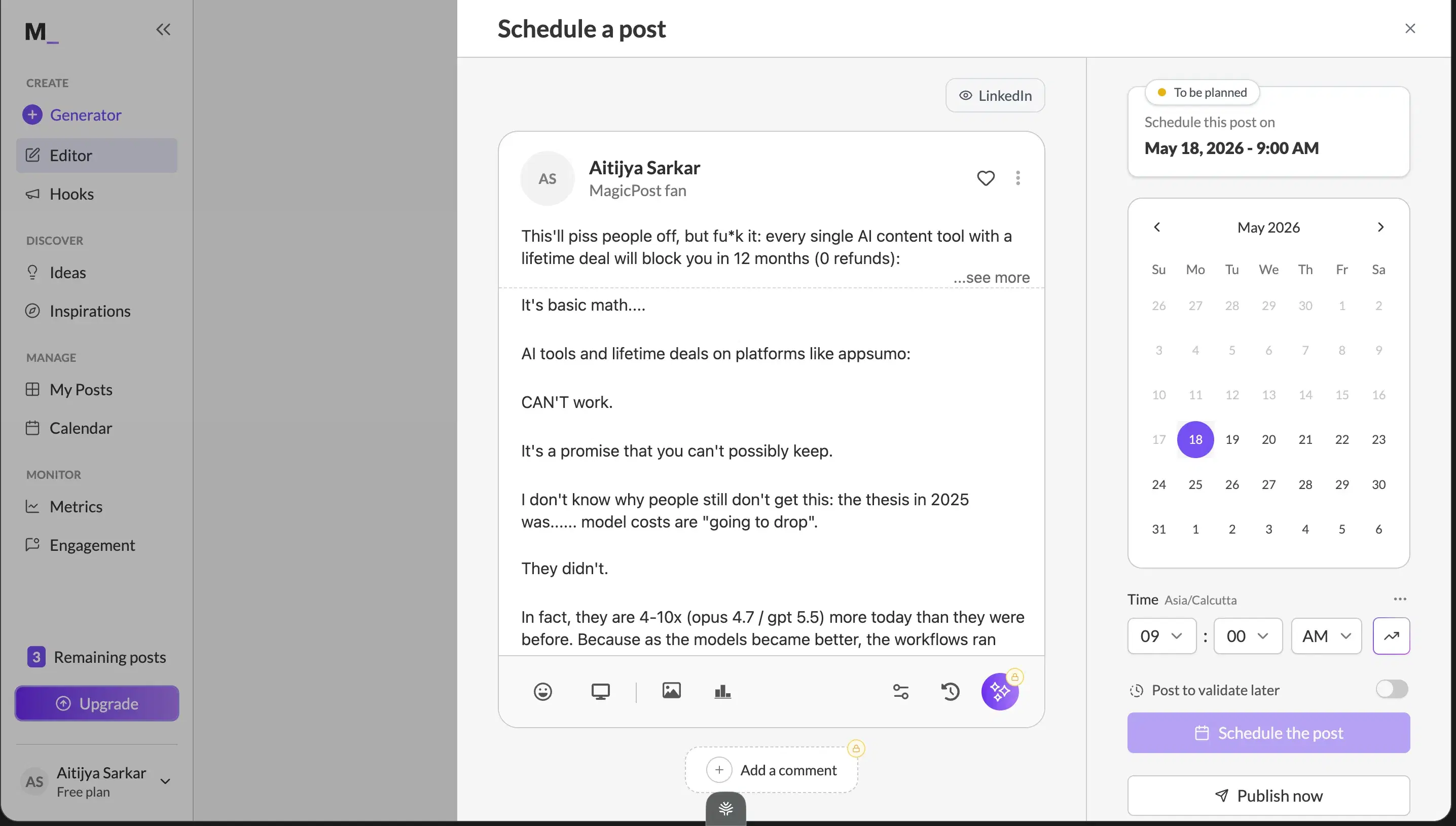
Editor + scheduling sheet — preview is close, but not fully LinkedIn-accurate.
Onto the 7 alternatives next — and how I tested them.
How I tested
I tested all eight tools hands-on — signed up, walked the onboarding, ran content through the composer. Then scored them on the same 6 axes:
Persona depth
Does the tool build a real picture of who you are, or extract surface level patterns from your last five posts?
Chat vs form
Can you iterate, push back, give continuous feedback — or are you typing into a one-shot form?
Long-term memory
Does "don't use em-dashes" stick across sessions, or are you retraining every content session?
KB and research grounding
Does it ingest YouTube videos, PDFs, meeting notes, and run a research agent before drafting — or hallucinate stats?
LinkedIn safety
Official Marketing Developer Platform APIs, or browser-extension injection that risks your account?
Pricing transparency
Stated price vs effective price after AI features unlock.
The 7 best MagicPost alternatives in 2026
Best for solo creators / ghostwriters / agencies who care about deep self adapting context engines
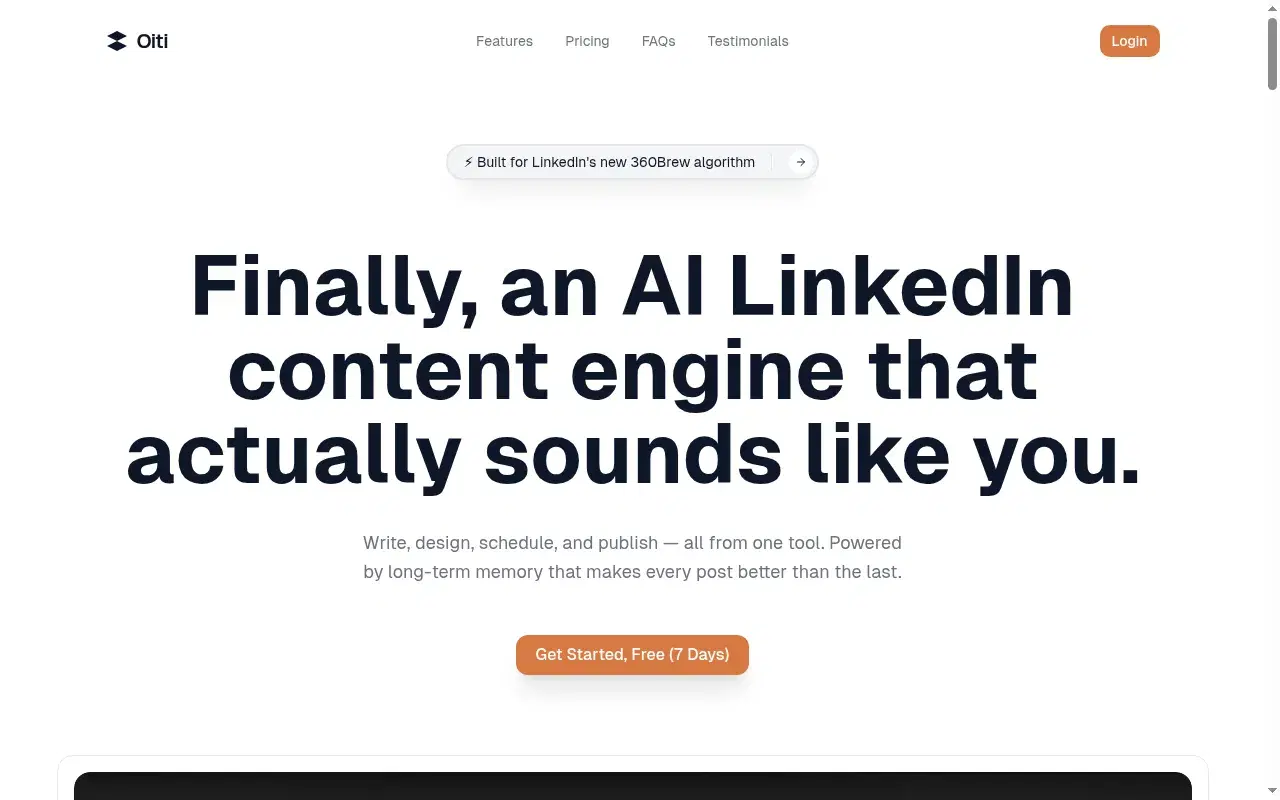
Disclosure: Oiti is mine. I built it because every existing LinkedIn AI tool I'd paid for or trialed was solving the wrong half of the problem. MagicPost extracts patterns from a handful of recent posts and stops there — form-based input, shallow persona, output that reads vanilla. Taplio matches topics to viral templates regardless of fit. AuthoredUp formats beautifully but doesn't write. None of them bridged "what works on LinkedIn" with "who the writer actually is" — so the output stayed at the LinkedIn average. The wedge: persistent persona + Knowledge Base + long-term memory that compounds across every chat. Most tools either show you the viral post (and leave you to reverse-engineer it manually) or generate something that sounds like the viral post regardless of topic fit. Neither is useful. Oiti's bet: inspiration → 1-click structured template, filled by a persona that knows your past 100 posts + beliefs + ICP pain, grounded in your KB.
When I tested it
Where it's different from MagicPost. MagicPost is form-input, not chat — you type a topic, hit generate, accept or restart. No iteration loop. The persona behind the output is extracted from a handful of recent posts. The content reads vanilla: generic structure, generic hooks, the kind of post LinkedIn's 360Brew algorithm (a 150-billion-parameter LLaMA 3 decoder, ranks on dwell time) buries because there's nothing to hold a reader past the first three lines. Oiti goes the other direction. Onboarding is 30 seconds: drop your LinkedIn URL and your website, Oiti reads your past posts, scrapes your site, searches your ICP's pain points across X and Reddit, and produces a 3,000–5,000-word narrative profile — voice fingerprint, brand pillars, content strategy, beliefs, ICP painpoints. That's the context every future post is grounded in. Most tools pick a side. Taplio's viral library is the biggest in the category (1M+ posts), but their AI writing prompts a generic LLM with light tone of voice instructions — the output reads templated. AuthoredUp's formatter is rock solid, but they don't have AI writing. MagicPost has form based content generation but the persona is shallow. Oiti closes the loop.
Key features
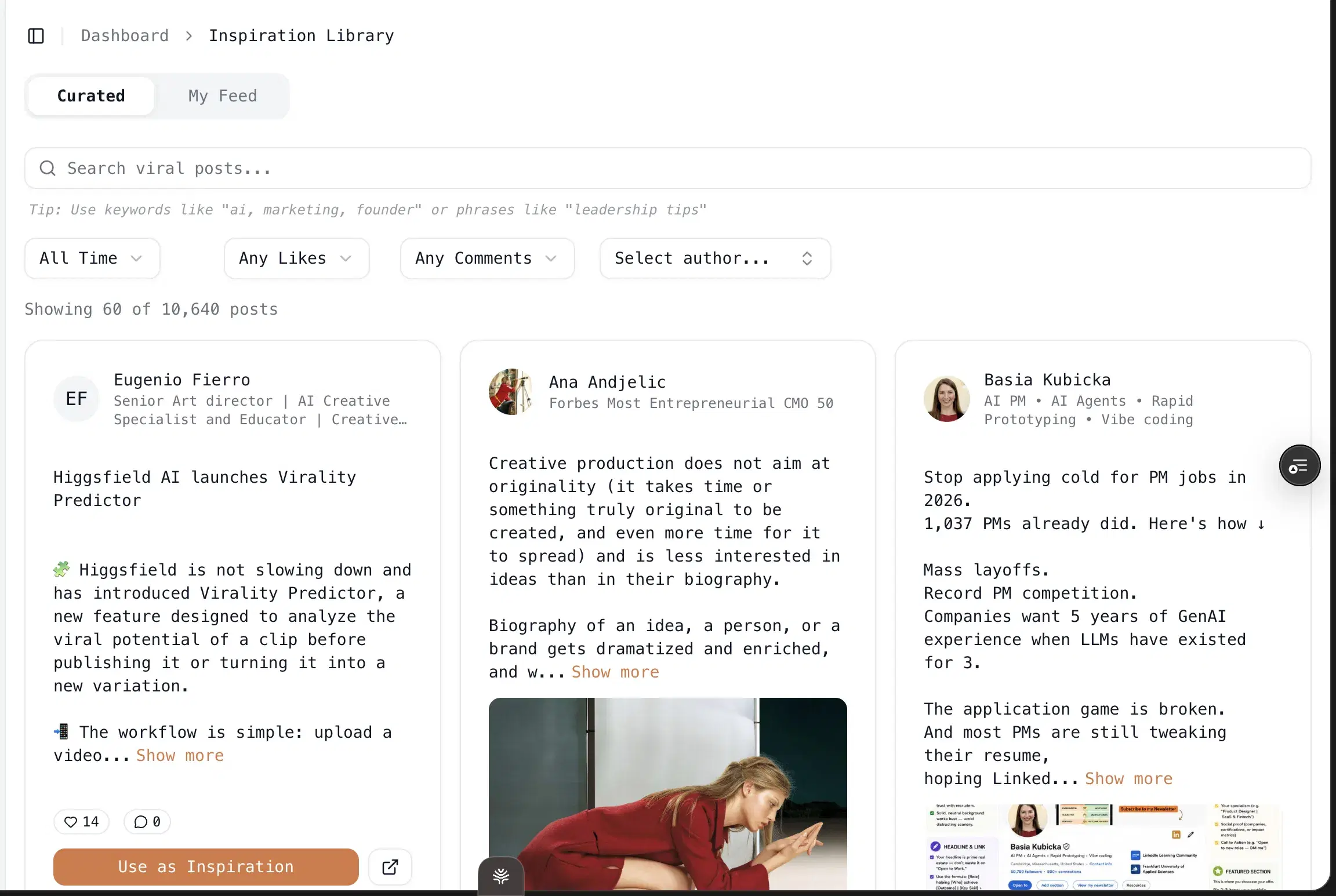
Inspiration → 1-click structured template: You see a post that's working on LinkedIn. One click extracts the structural pattern — hook shape, body cadence, payoff structure — into a reusable template you can fill with any topic. Most tools either show you the viral post (and leave you to reverse-engineer it manually) or generate something that sounds like the viral post regardless of topic fit. Neither is useful.
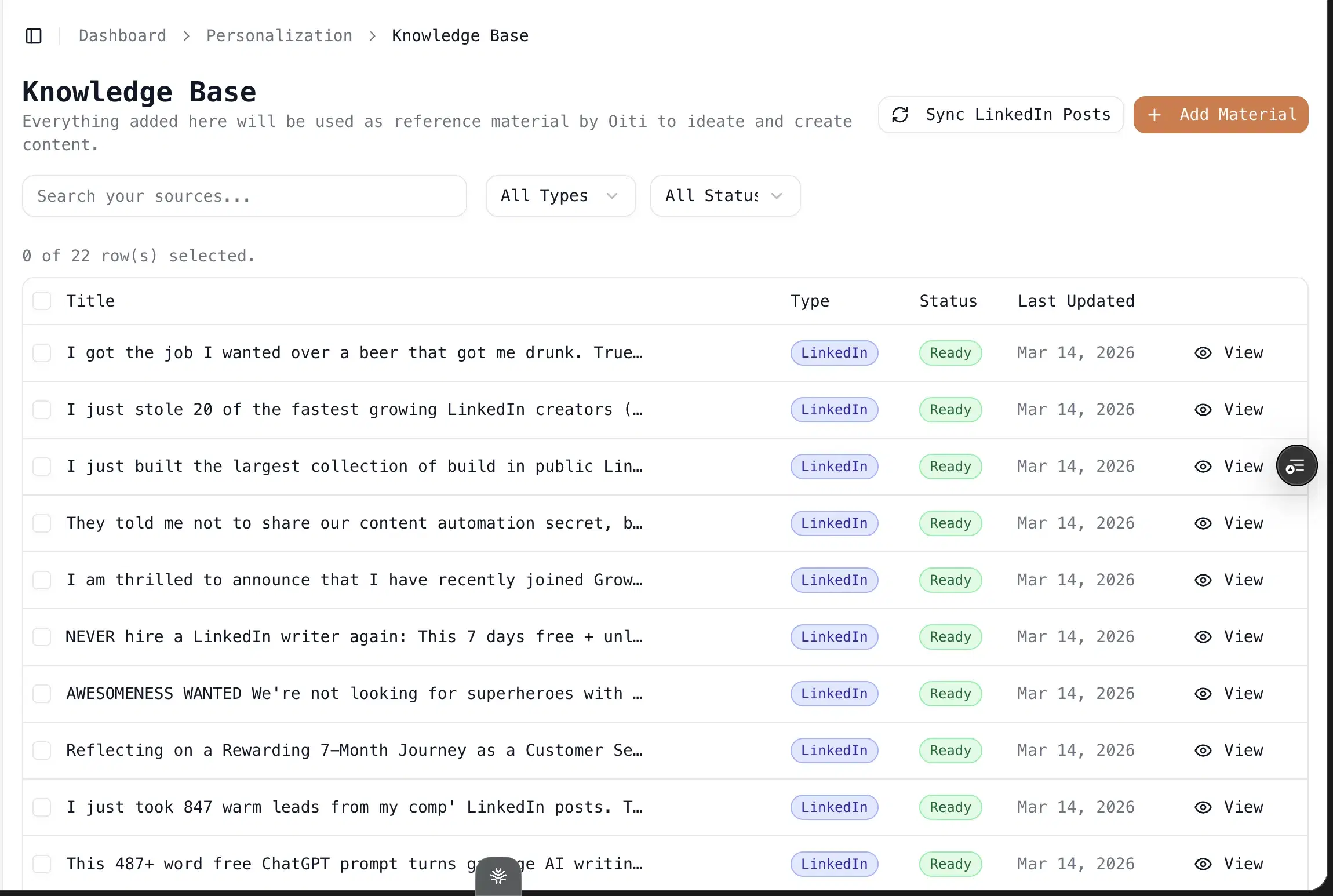
A 3,000–5,000-word narrative timeline of who you are: Drop your LinkedIn URL and your website. Oiti reads your past posts, scrapes your site, searches your ICP's pain points across X and Reddit, and produces a 3,000–5,000-word narrative profile — voice fingerprint, brand pillars, content strategy, beliefs, ICP painpoints. That's the context every future post is grounded in. Nothing else in this category builds a persona at this depth.
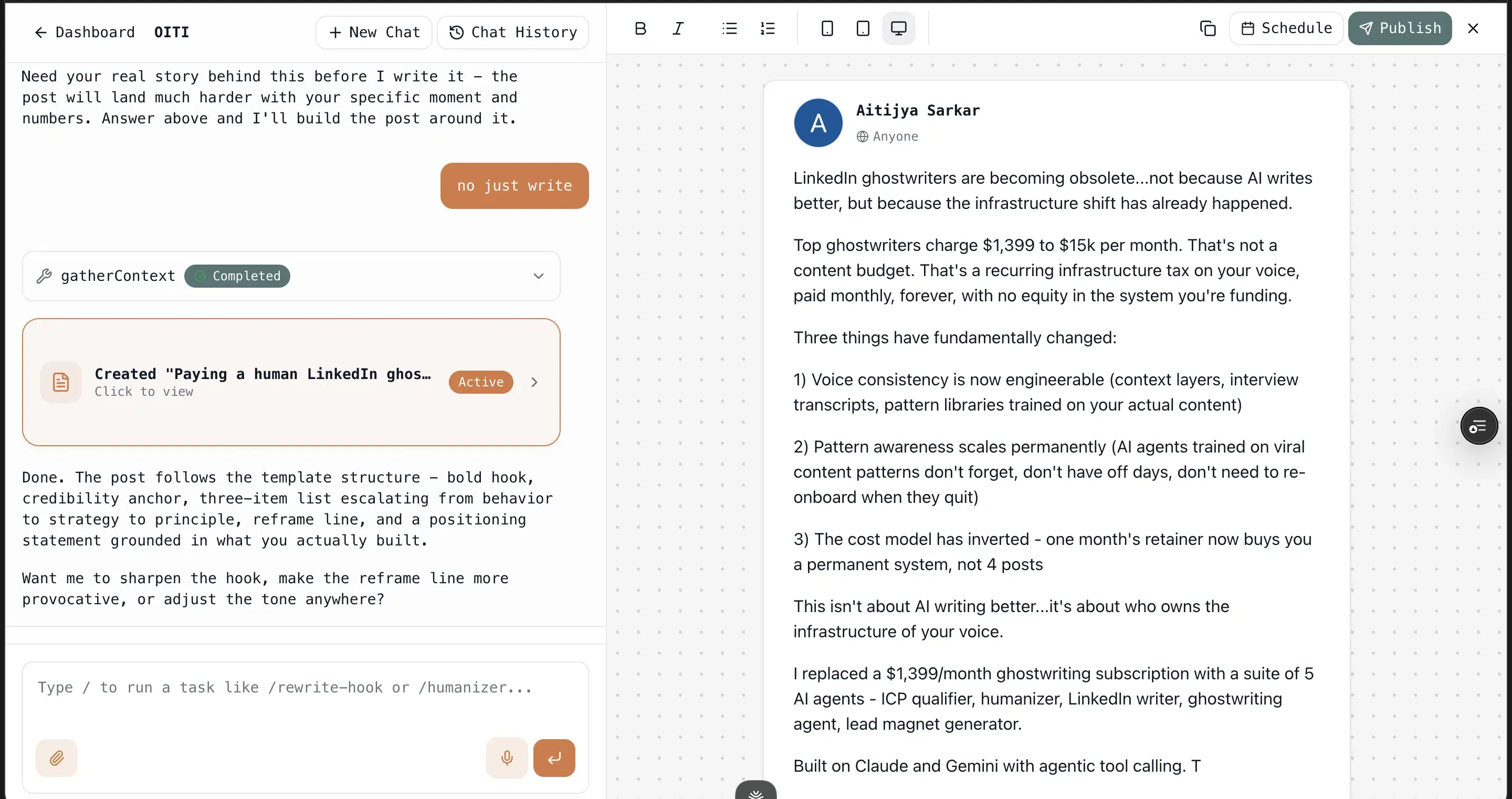
Long-term memory that compounds: Every chat, edit, and instruction sticks. Tell Oiti "I never open with 'I'" once — it never opens with "I" again. Tell it "stop using 'unlock'" — gone. The memory feeds the next session and the one after that. Most tools in this list reset between chats. Oiti gets closer to how you write over time, not further away.
Knowledge Base + 5–9 parallel research agents: Before writing any post, Oiti spawns 5–9 parallel research agents across your KB (YouTube videos, PDFs, meeting notes, articles, competitor posts) and the live web. I built this because I was tired of AI tools confidently making up facts about my own niche.
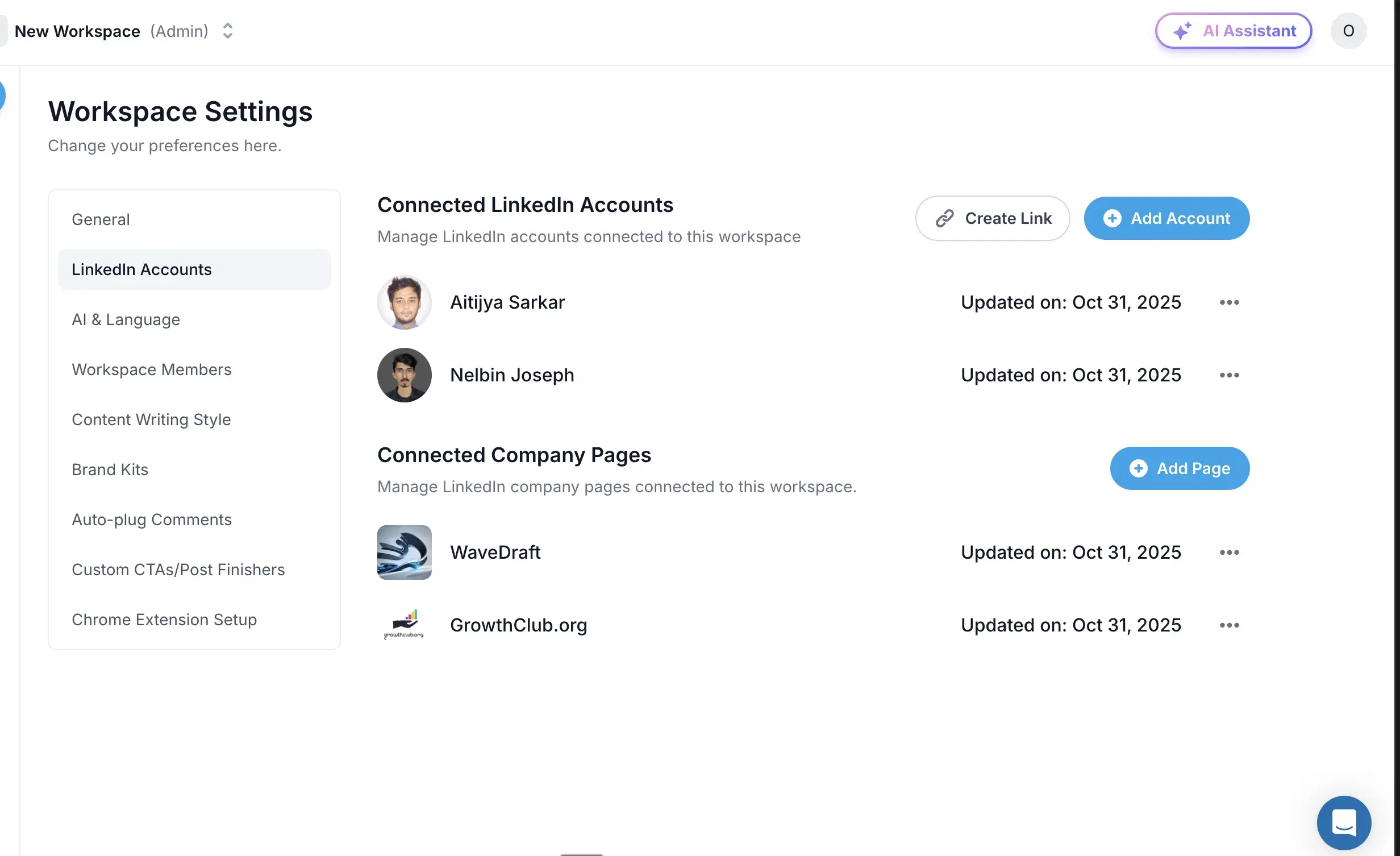
LinkedIn-safe distribution: Oiti publishes through LinkedIn's official Developer Platform APIs — 3 personal accounts + 10 company pages on the Pro plan. No Chrome extension, no auto-likes, no auto-DMs. Kleo got shut by LinkedIn in 2025 over their extension; Taplio users have caught account warnings over the automation.
360Brew-native: Generates 300+ word long-form posts plus one-click viral infographics (powered by Nano Banana Pro 3.1 + Gpt Image 2) — built for LinkedIn's 2026 algorithm that ranks on dwell time, saves, and shares not likes and views.
Best for
- Solo founders in boring or technical niches — B2B SaaS infra, fintech, wholesale, dev tools, supply chain. The kind of space where generic creator-economy ai content actively works against you.
- Ghostwriters and agencies running 3+ client voices — Pro at $79 supports 3 AI Clones with separate voice profiles; each client's voice is preserved across sessions, no retraining every Monday.
- Consultants and coaches with deep IP (book authors, podcasters, YouTubers, PDF-playbook owners) — the KB ingests transcripts and grounds every LinkedIn post in your actual material.
Pricing
$49 – $79 / month (50% off yearly: $245 Creator / $395 Pro) · 7-day, no usage caps
Pros
- The narrative timeline is the actual moat. The 3,000+ word profile of who you are and what you believe is what makes drafts sound like you — not just like your sentence patterns. Most tools stop at the tone clone.
- Memory that compounds. Drafts get closer to how you write over time, not further. No other LinkedIn-only tool has persistent memory at all — Taplio, Supergrow, AuthoredUp, MagicPost, ContentIn — none.
- Multi-account scheduling cheaper than dedicated schedulers. Pro at $79/mo covers 3 personal + 10 company pages with full AI writing on top. Buffer / Hootsuite charge more for scheduling alone.
Cons
- No mobile app. Web-only. The web app works fine on phones for calendar and scheduling, but drafting is a desktop-first experience.
- No Chrome extension. Deliberate — see the Kleo precedent below. But if you specifically wanted an in-feed overlay, Oiti doesn't have it.
- No outbound automation. Content-only by design. If you want one tool that runs DMs + connection requests + comment automation + content writing, Oiti isn't it. Pair with Lemlist or HeyReach, or take the ToS risk with Taplio's bundle. I'm opposed to outbound automation because LinkedIn punishes it — but you might not be, and that's a real use case that needs a different tool.
- No analytics dashboard yet. Roadmap-parked. If LinkedIn analytics or KPI tracking is your top priority, Oiti isn't the pick today.
Best for multi-account scheduling, official-api safe
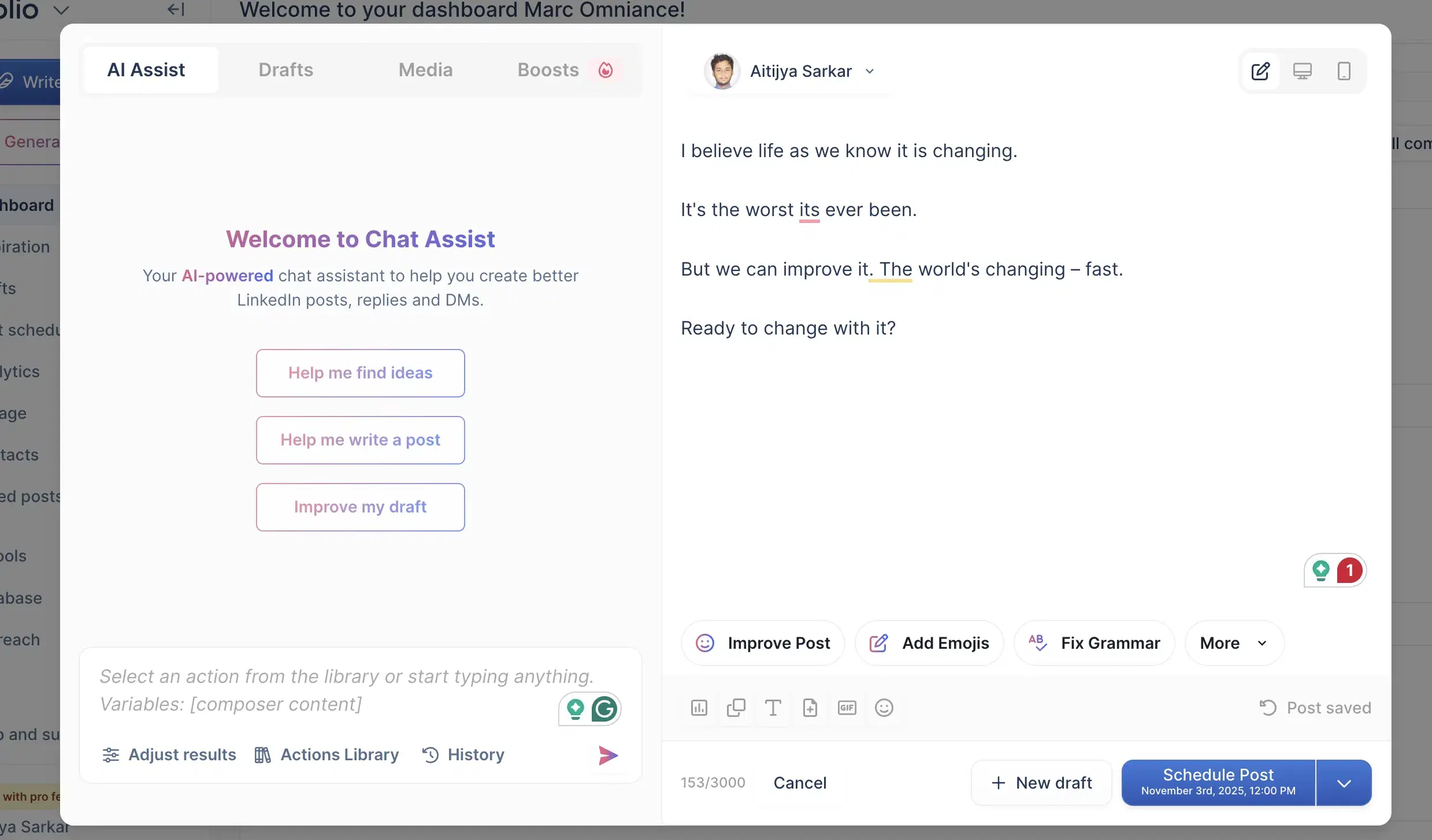
Tried it in 2023 (back when they were offering a lifetime deal). Signed up and tried it again in 2026 for this article. Supergrow was built by Indian founders, grew hard through 2023 on the same thesis I had: be the LinkedIn-safe alternative to Taplio. No Chrome extension, no auto-engagement, no ToS risk. The scheduling is API-safe, the multi-account workflows are deep, and the team isn't taking shortcuts that put your LinkedIn account at risk. The honest story: Supergrow has gotten really good for teams and scheduling. The solo creator side hasn't kept up.
When I tested it
The interface felt clunky and slow when I signed up again in 2026. The output read generic — no persona depth, no real chat composer. The feedback I gave it on one draft didn't carry to the next. Every session is square one. If you're an agency managing five LinkedIn accounts and need a real scheduling backbone with Kanban queues and built-in comment workflows, Supergrow does that well. If you're a solo creator who wants the AI writing to actually sound like you, the writing side won't deliver.
Review receipts
Key features
Official LinkedIn API scheduling: Same ToS-safe positioning as Oiti. No Chrome extension, no shadowban risk. One of the first in the category to commit to this.
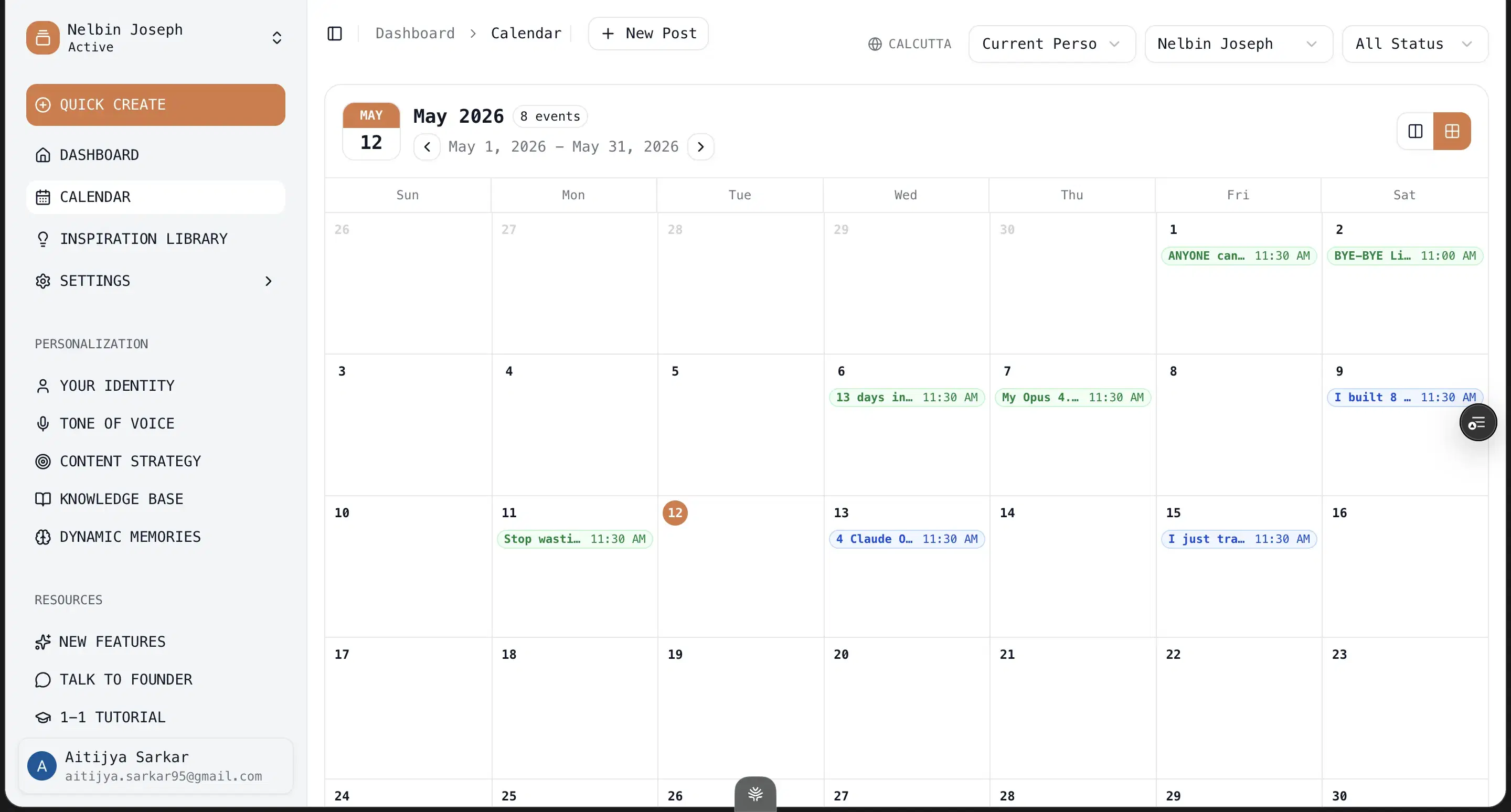
Multi-account / multi-tenancy workflows are deep: Kanban scheduling queue, built-in comment + change workflows, multi-account management. If scheduling is your actual priority, hard to beat.
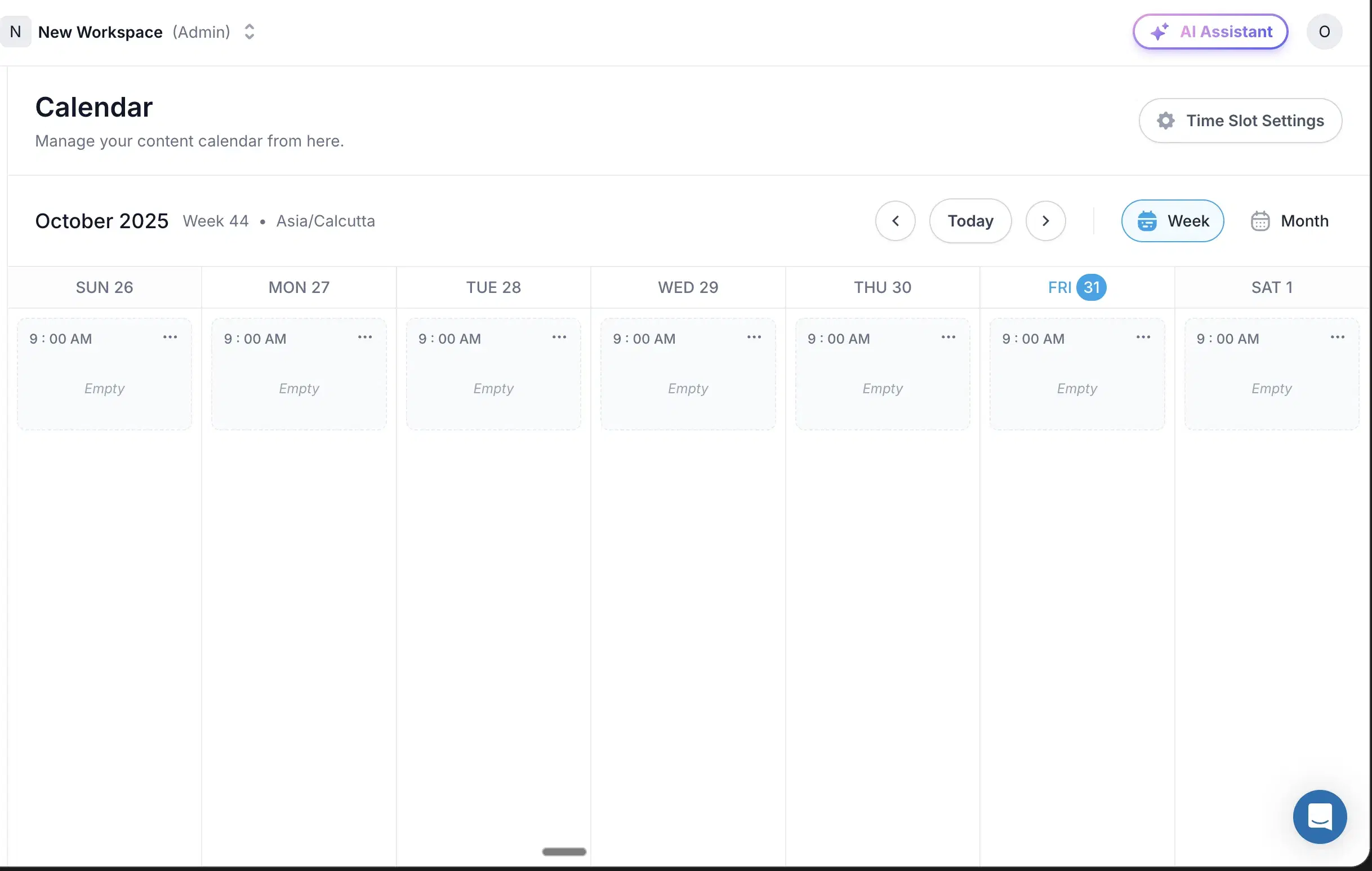
Indie founder team, well-built for what they've focused on: Built from the LinkedIn-safe-alternative-to-Taplio thesis. The team has stayed honest on safety even as the rest of the category drifted.
Best for
- Teams or agencies running 3+ LinkedIn accounts that need a real scheduling backbone and don't mind pairing it with a separate writing tool.
- Solo creators who care about voice fidelity will hit a ceiling on the writing side.
Pricing
$19 – $139 / month · Free trial available
Pros
- Official LinkedIn API scheduling. Same ToS-safe positioning as Oiti. No Chrome extension, no shadowban risk. One of the first in the category to commit to this.
- Multi-account / multi-tenancy workflows are deep. Kanban scheduling queue, built-in comment + change workflows, multi-account management. If scheduling is your actual priority, hard to beat.
- Indie founder team, well-built for what they've focused on. Built from the LinkedIn-safe-alternative-to-Taplio thesis. The team has stayed honest on safety as the rest of the category drifted.
Cons
- Generic output, no persona depth. The content reads like every other AI-on-LinkedIn tool because there's no narrative timeline underneath. Oiti's approach: 3,000-word persona built from your past 100 posts + ICP painpoint web search.
- No retained memory across posts. Feedback from one session doesn't carry to the next. Every chat is square one. Oiti's approach: long-term memory persists every edit and instruction across sessions.
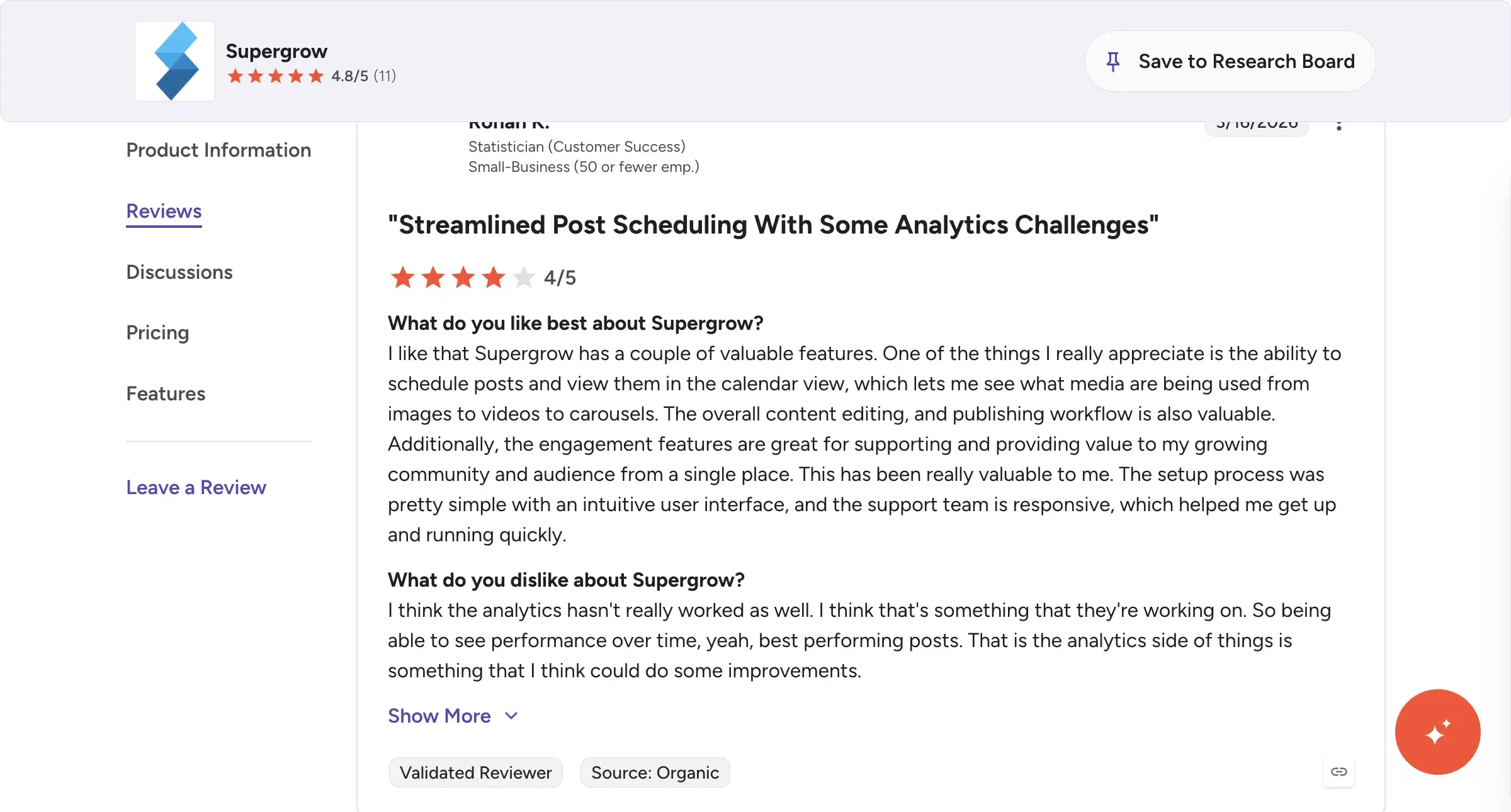
- Analytics depth is a recurring G2 complaint. "The analytics side of things is something that I think could do some improvements" (Rohan K., Statistician, Small-Business, 4/5, 2026-03-16). My testing aligned.(source)
Best for linkedin formatting + post analytics
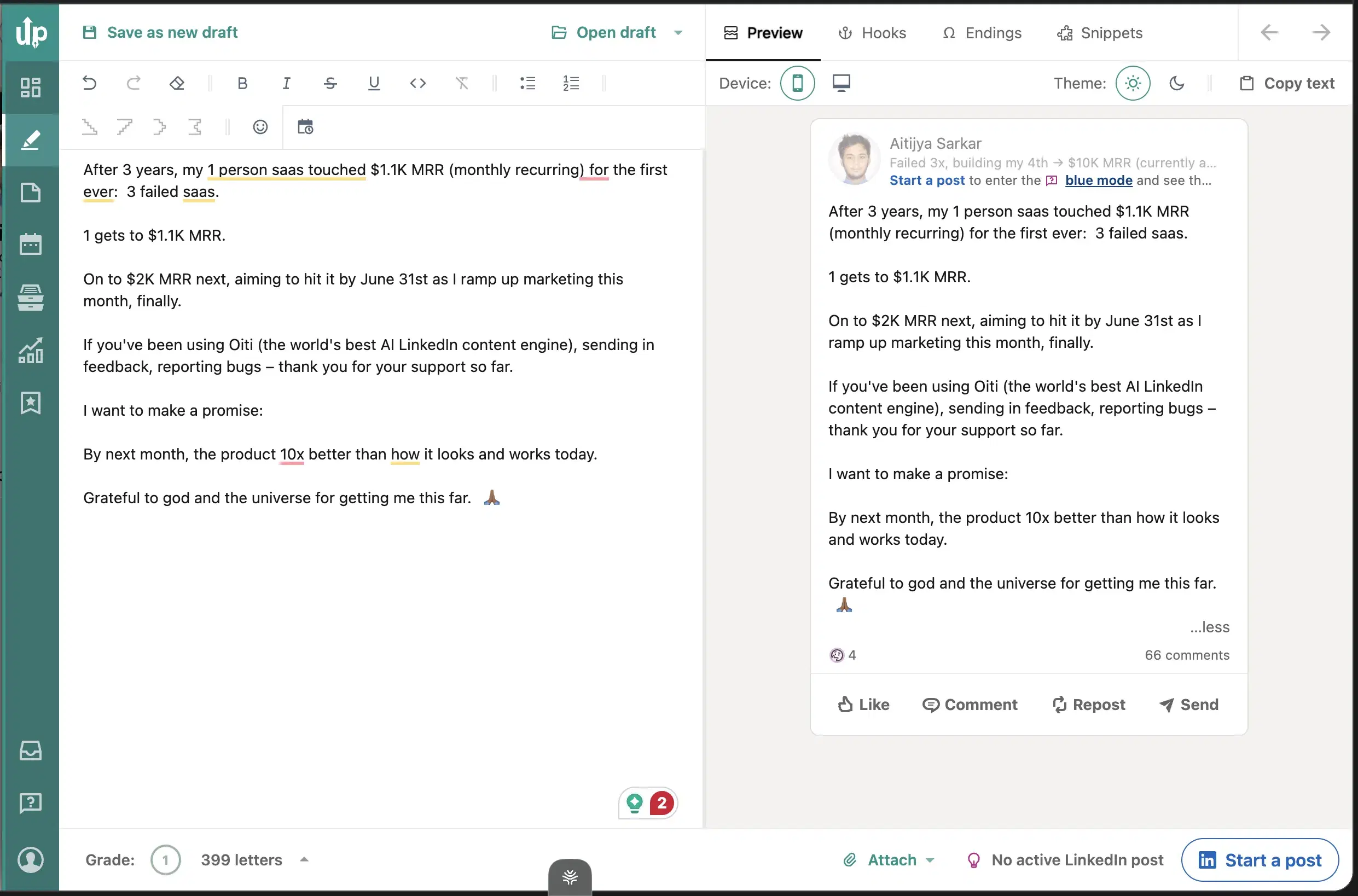
Tried it in 2026. Paid for it back when I was doing LinkedIn ghostwriting in 2020–2021. I used AuthoredUp mostly for their LinkedIn formatter preview back in 2020–2021 — I wanted to see what the line breaks would look like before posting. They were one of the earliest Chrome extensions that tried to build ethically for LinkedIn creators. No auto-engagement, no scraping, no risky cookie hooks. Net-net: their LinkedIn formatter is rock solid.
When I tested it
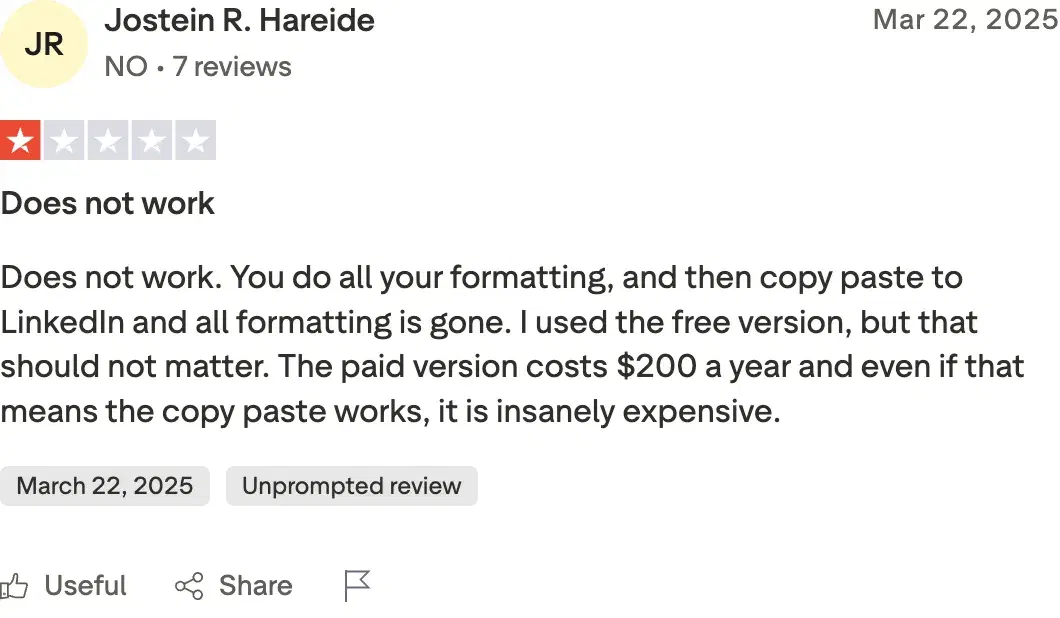
But the world moved on. ChatGPT launched. AI writing got cheap. The formatter alone stopped being relevant — every modern tool ships the formatting now. The ToS risk is the other piece. LinkedIn is clamping down on Chrome extensions, even the well-behaved ones. Shield Analytics shut down in May 2026 from exactly this class of risk. Kleo's original extension caught the same wave in 2025. While digging through reviews I came across Jostein R. Hareide on Trustpilot at 1/5 saying "formatting is lost on paste." Different from my experience — I've used the formatter for years and it's been solid for me. Could be a one-off bug on his end.
Review receipts
Key features
Post formatter is rock solid: Still the cleanest LinkedIn formatter available, with the strongest preview + hook variation engine in the category.
Category pioneer: Among the first Chrome extensions that didn't violate LinkedIn ToS. Earned that goodwill.
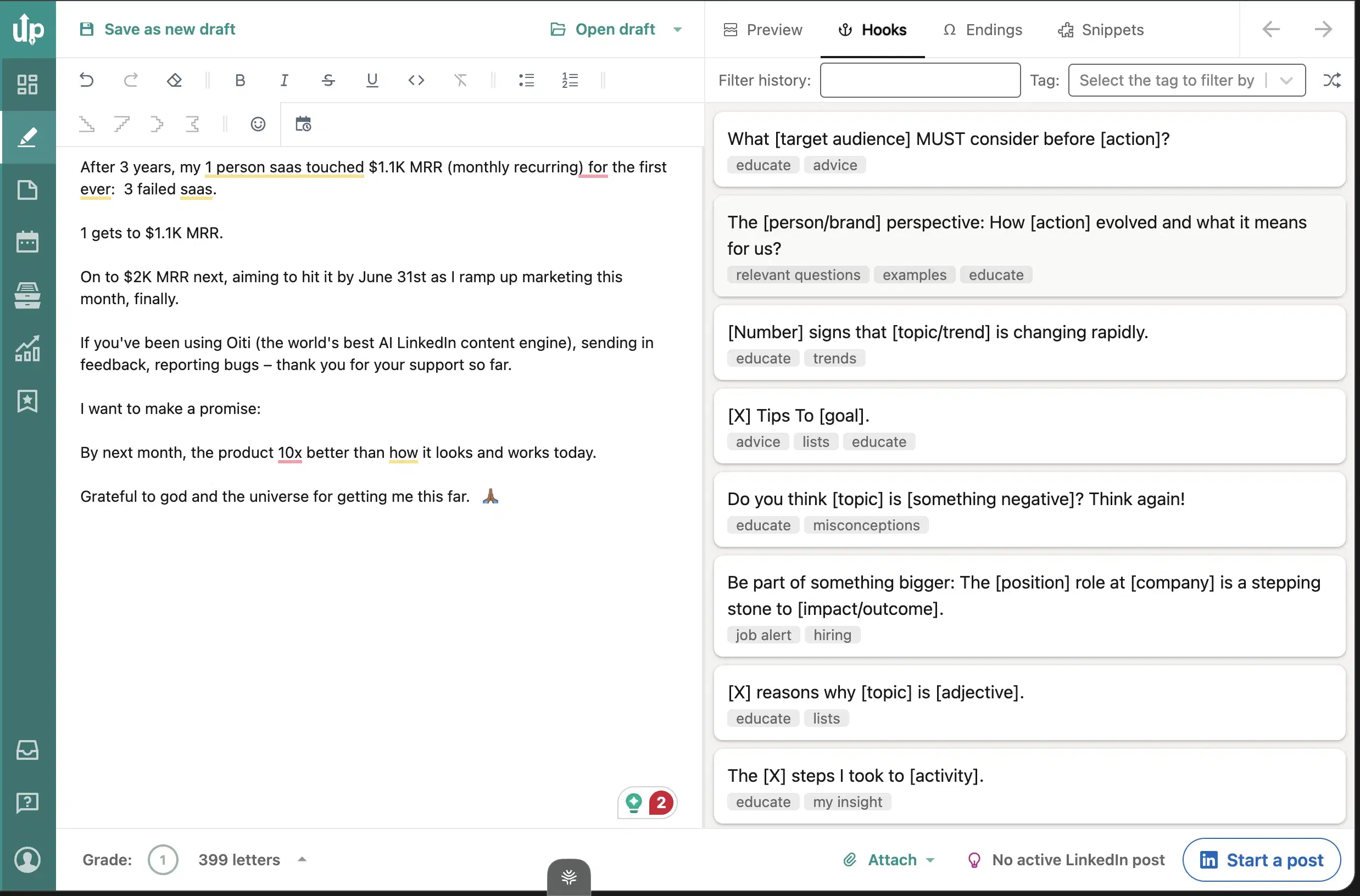
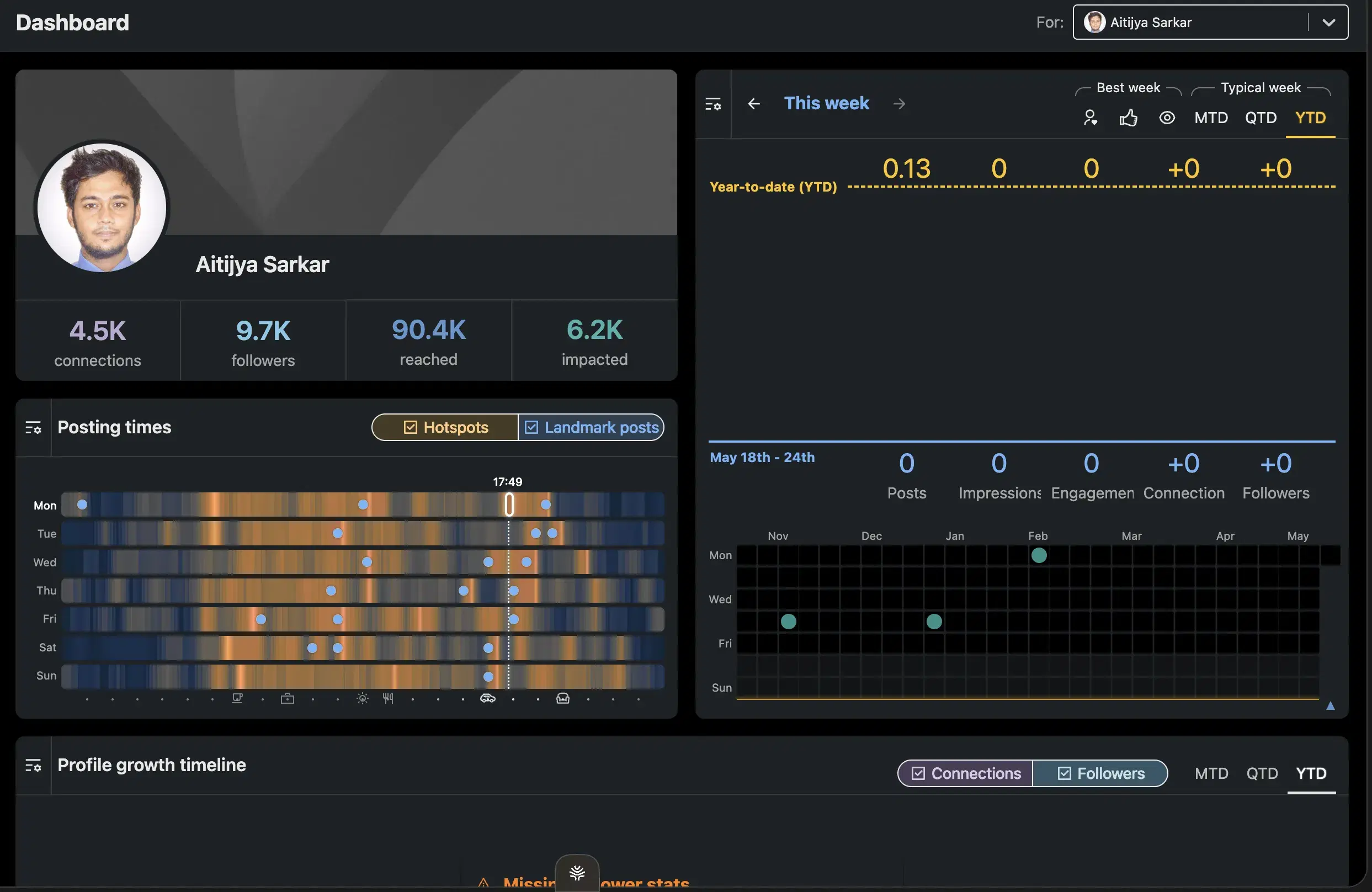
Light analytics dashboard included: Useful if you're tracking your own posts and don't need enterprise-grade analytics.
Best for
- People using it purely for formatting who don't want any AI tools. If formatting is all you need, there are free tools for that too (including Oiti's free LinkedIn Text Post Formatter, no signup).
- The niche for paid AuthoredUp is narrow.
Pricing
$19.95 / month ($16.63/mo billed annually) · 14-day, no credit card
Pros
- Post formatter is rock solid. Still the cleanest LinkedIn formatter available, with the strongest preview + hook variation engine in the category.
- Category pioneer. Among the first Chrome extensions that didn't violate LinkedIn ToS. Earned that goodwill.
- Light analytics dashboard included. Useful if you're tracking your own posts and don't need enterprise-grade analytics.
Cons
- Chrome-extension category under LinkedIn pressure. Shield Analytics shut down in May 2026. Kleo's extension was forced offline. Oiti's approach: official LinkedIn APIs only — outside this risk entirely.
- No AI writing, no KB, no memory. Dashboard says an AI ghostwriter is on the way, but nothing has shipped. You're still pairing AuthoredUp with a separate writing tool. Oiti's approach: full AI content engine + formatting + persistent persona + KB in one place.
- Narrow use case once formatting is commoditized. Every modern tool ships formatting now. The paid AuthoredUp niche is people who specifically want their preview polish. If you need anything beyond formatting, you've already outgrown it.
Best for all-in-one content + outbound + scheduler
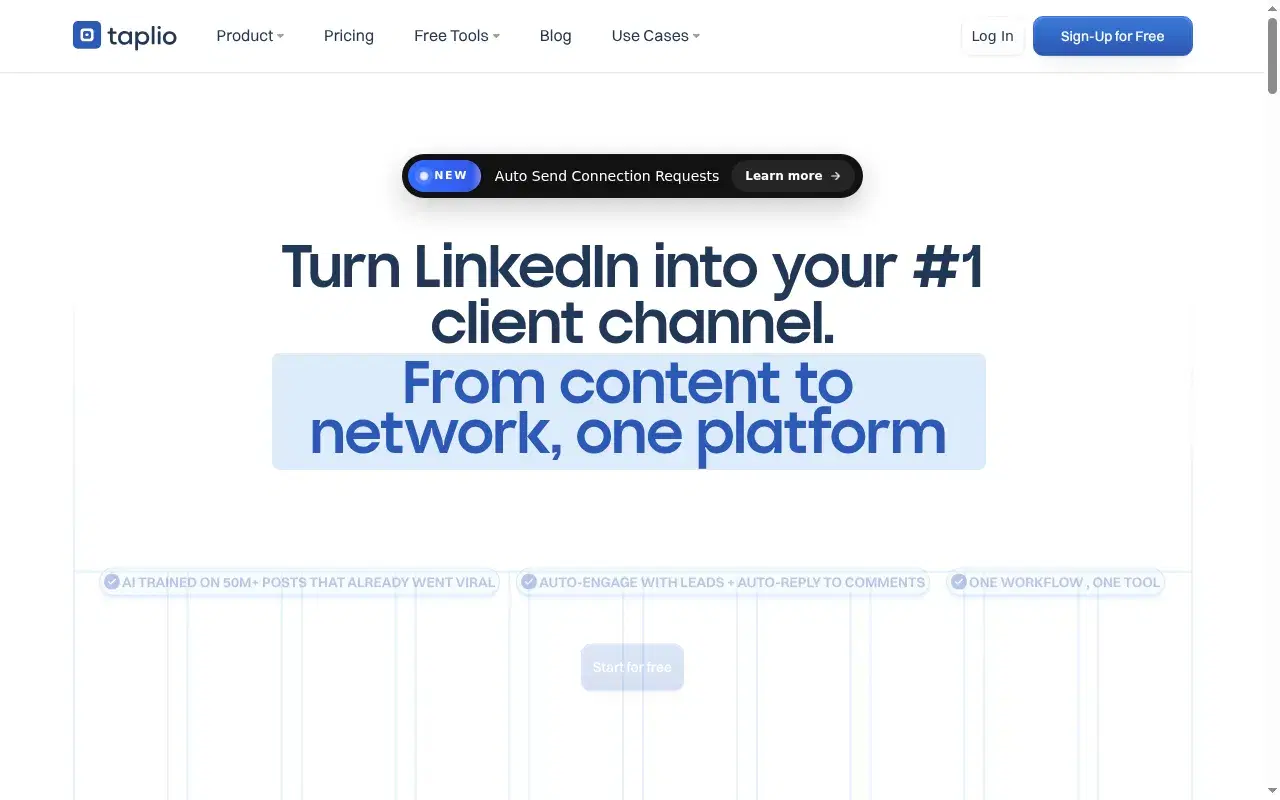
Tried it in 2026. Used it a lot back in 2021 when I was growing my own LinkedIn account. Taplio was the best LinkedIn tool in 2021–2023, before AI was a factor. One of the only tools on the market, IndieHacker-favorite, built by IndieHackers themselves. The inspiration tab back then was — and partly still is — the single most useful feature in the category: over a million LinkedIn posts you can search. That was ahead of everyone. The rest hasn't aged well.
When I tested it
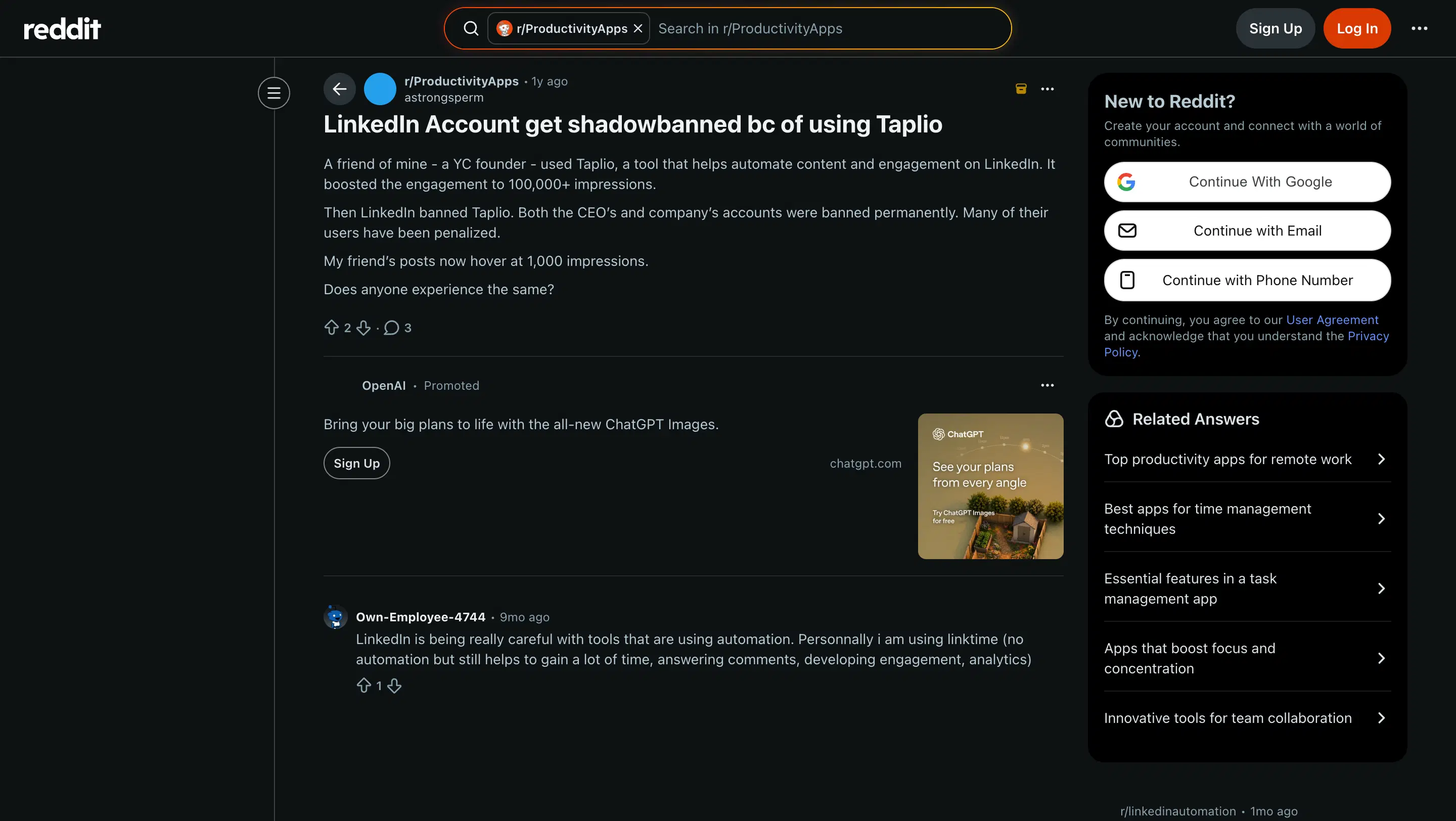
What I saw logging back in this year: they slapped AI on top of the existing pre-AI codebase. The new chatbot is a thin wrapper — no built-in web search, no KB search. The UI is cluttered with content + outbound + comment automation + analytics, and the automation surface confuses what the tool is even for. Slow, felt so.... clunky. But the content quality was the real issue. Taplio's AI output is generic in exactly the way every "AI wrapper without a persona engine" is generic. No past-posts ingest at scale, no ICP painpoint search, no long-term memory. The chatbot is basically ChatGPT with a LinkedIn system prompt strapped on. And then there's the account risk: I have a client who used Taplio before coming to me — their LinkedIn account got flagged and restricted from using Taplio's Chrome extension. The extension hooks LinkedIn cookies to run outreach, comment automation, and engagement tracking — exactly the behavior LinkedIn's clamping down on. Taplio itself is now banned on LinkedIn — they're not on the platform they're supposed to help you grow on. Since the Lemlist acquisition, the tool has drifted away from the indie / bootstrapping philosophy that made it good for small founders. More automation features, more risk, more confusion about who the tool is even for.
Review receipts
Key features
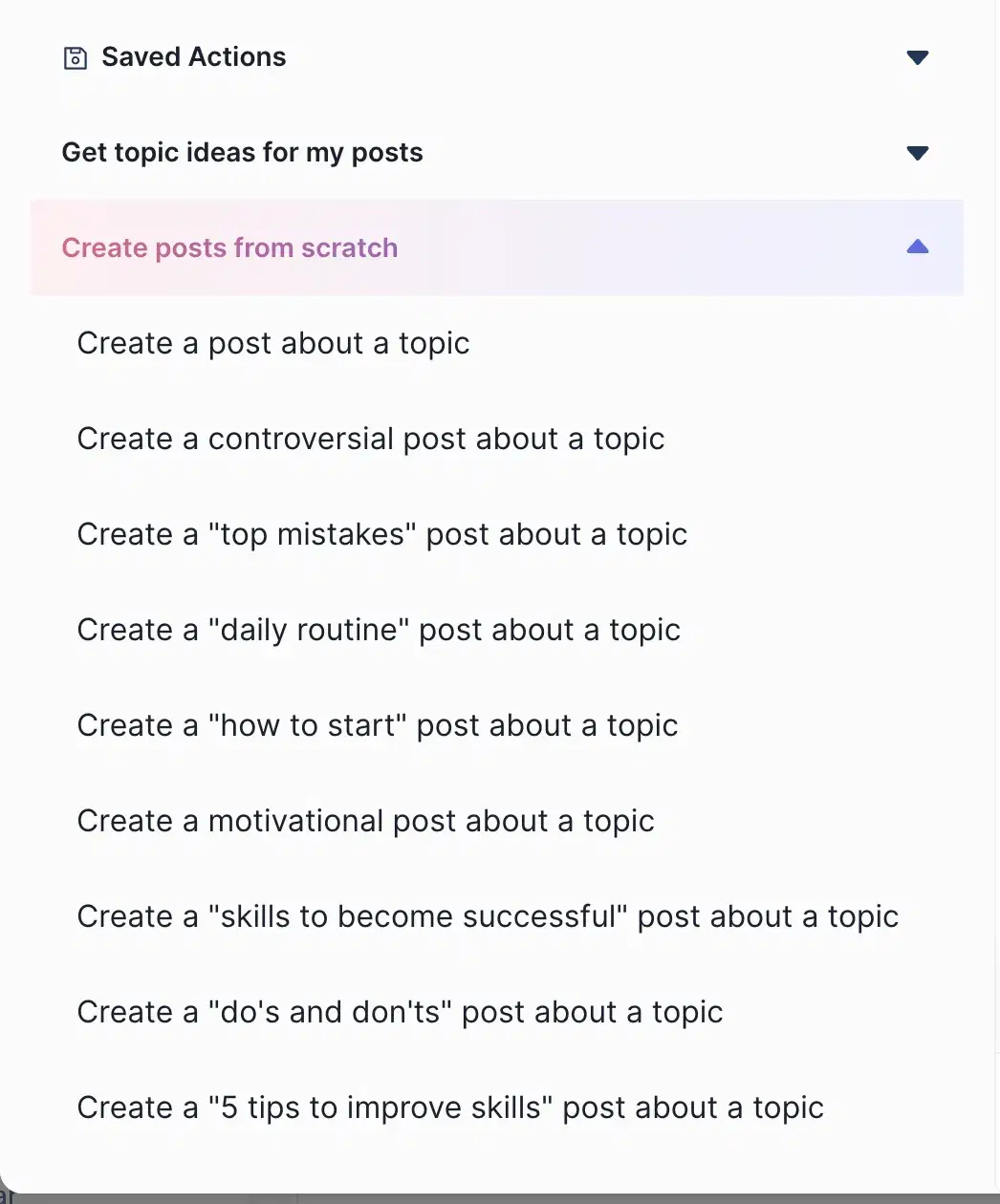
The inspiration tab is still the strongest in the category: 1M+ posts, searchable, useful for studying hook patterns. (Caveat: many posts are years old — filter by recent-only or you'll be lifting 2022 patterns that don't land in 2026.)
Brand recognition: When buyers ask ChatGPT or Perplexity for LinkedIn AI tools, Taplio surfaces first.
Best for
- People who actually use all three features (content + outbound + comment automation), have LinkedIn Premium or Sales Navigator to absorb the ban risk, and are okay with the Chrome extension.
- If you don't fit all three, you're paying outbound+automation prices for a content tool — and the content isn't even the best in the category anymore.
- Content-only → Oiti. Outbound-only → Lemlist (Taplio's parent co) or HeyReach.
Pricing
$39/mo Starter (zero AI credits) / $65+/mo Standard (AI unlocks) · 7-day Pro trial
Pros
- The inspiration tab is still the strongest in the category. 1M+ posts, searchable, useful for studying hook patterns. (Caveat: many posts are years old — filter by recent-only or you'll be lifting 2022 patterns that don't land in 2026.)
- Brand recognition. When buyers ask ChatGPT or Perplexity for LinkedIn AI tools, Taplio surfaces first.
Cons
- Generic AI output. They bolted a chatbot onto a pre-AI codebase. No persona engine, no web search for ICP pain, no long-term memory. The output reads like the average of LinkedIn, not like you. Oiti's approach: narrative timeline + research agents before every draft.
- Chrome-extension features carry real LinkedIn-account risk. I have a client whose account got flagged and restricted. Taplio itself is now banned from LinkedIn. Oiti's approach: official LinkedIn APIs only — no account risk.
- The $39 Starter tier ships with zero AI credits. The writing tools only unlock at Standard ($65+). The $39 on the marketing page doesn't get you the AI experience.
Best for budget-first ghostwriter
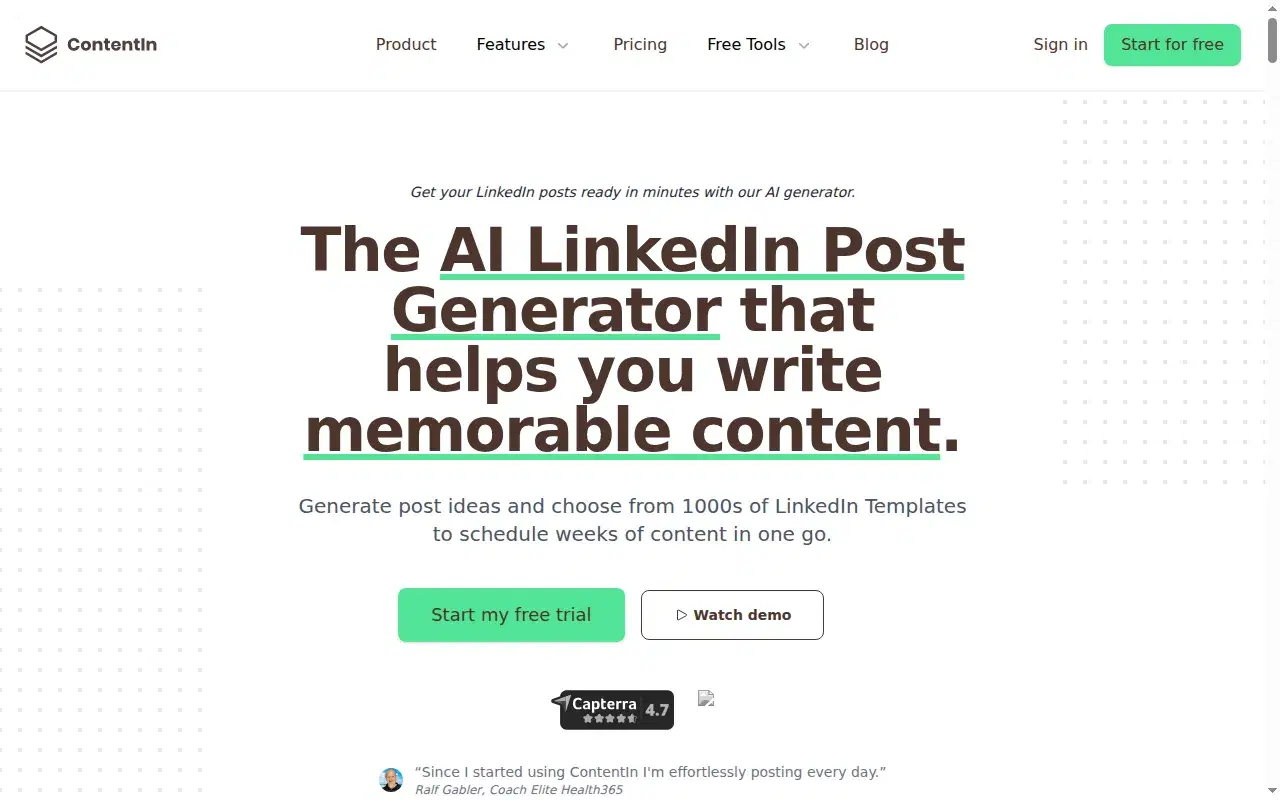
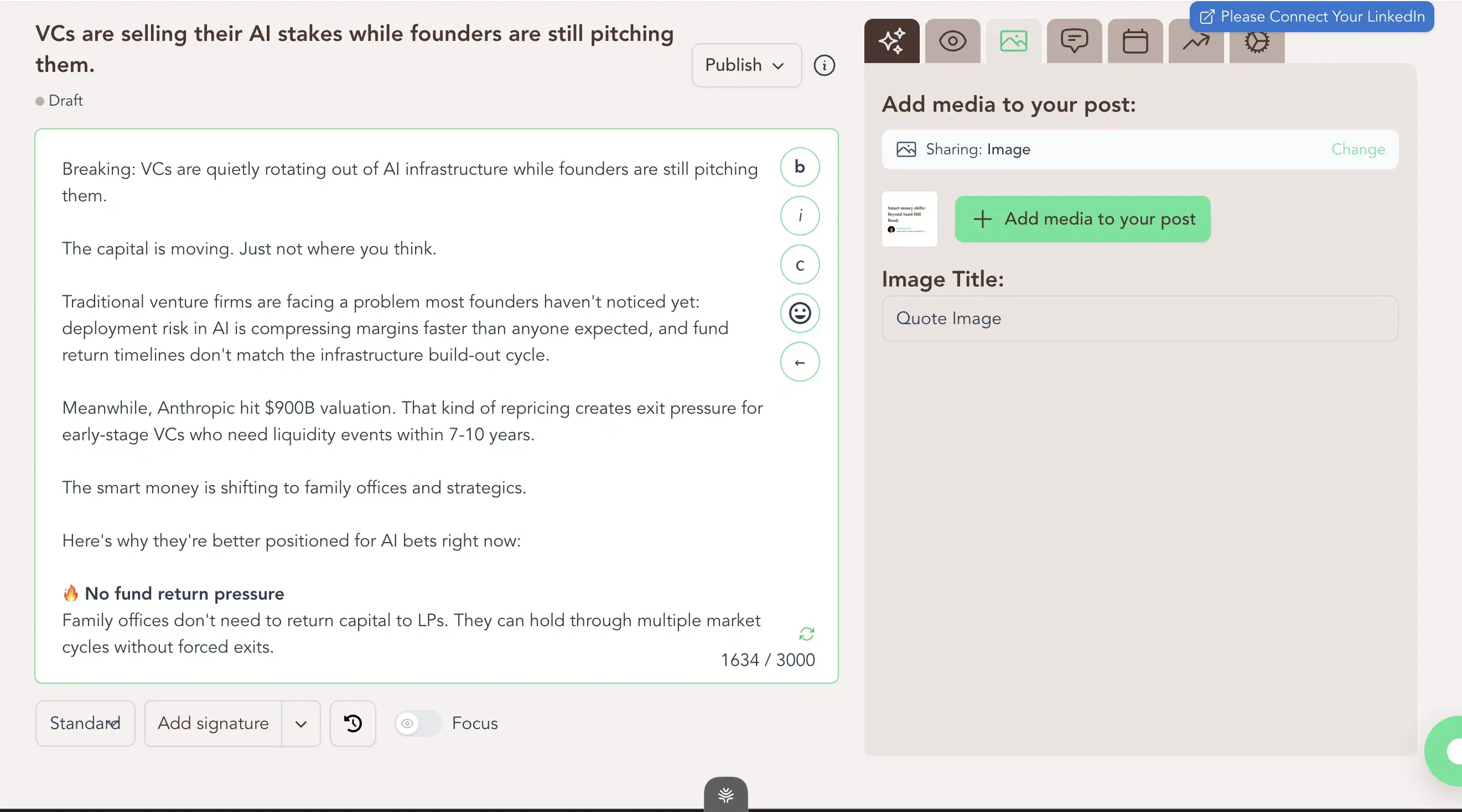
Tried it in 2026. ContentIn is the right structural product with the wrong content substance. The structural pieces are solid: composer + content calendar + LinkedIn-safe scheduling via official OAuth (not a Chrome extension, same approach as Oiti and Supergrow). There's a Kanban-style writing queue where generated ideas sit, and you can edit + schedule from there. Where it falls down is the AI writing.
When I tested it
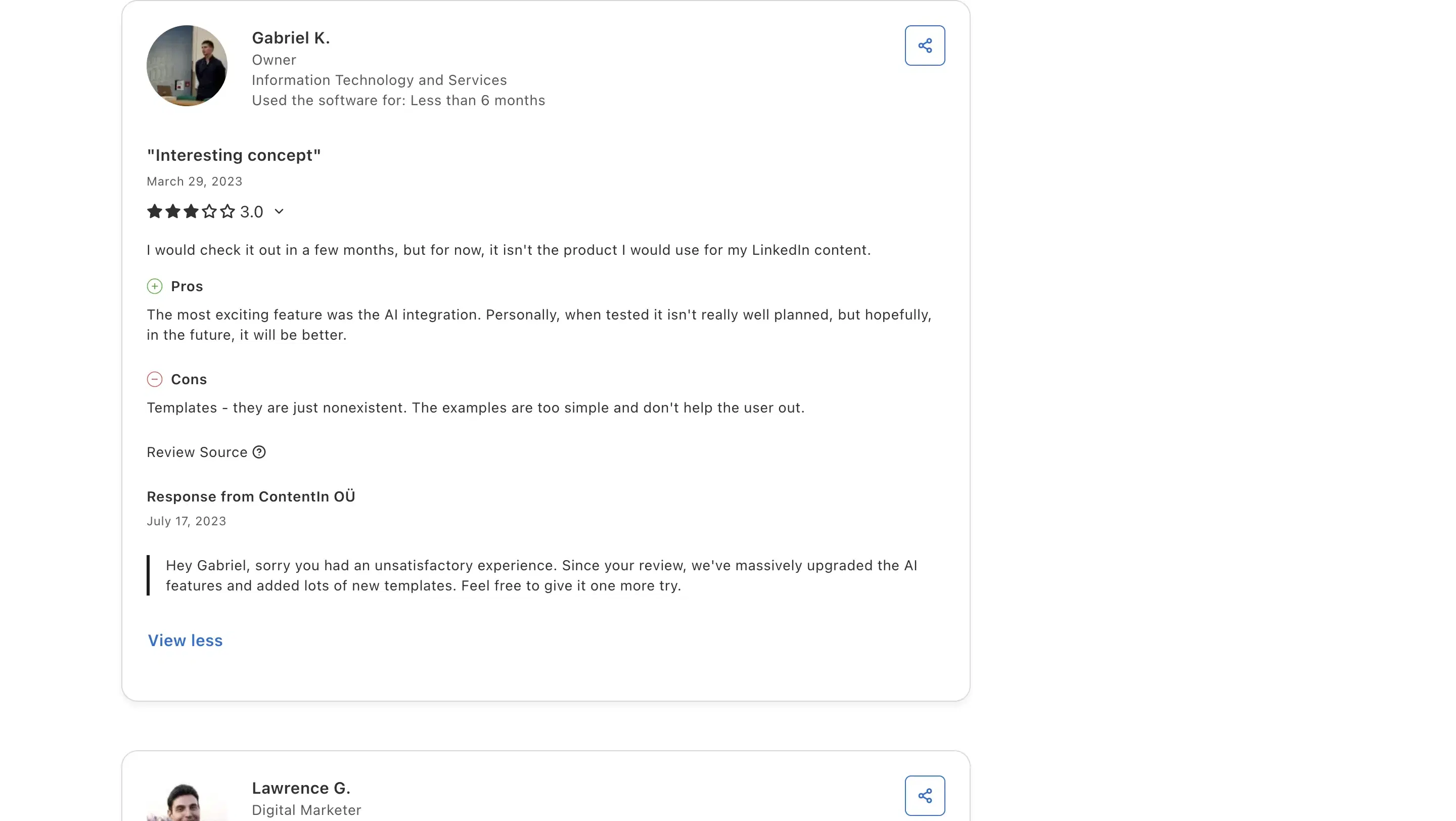
The composer-generated content is extremely generic — and it didn't ask me any questions to figure out where I wanted to take the topic. I picked an idea, hit generate, got a draft, read an influencer-type post that didn't retain my voice at all. Vanilla. Templated. The exact problem every "AI wrapper without a persona engine" has. The onboarding is part of it. ContentIn's persona "training" is a 4-question multiple-choice quiz: what's your role, what are your goals, what challenges are you facing, how did you hear about us. Calling a multiple-choice quiz "training" is a stretch. Oiti's onboarding reads 100+ of your past LinkedIn posts, scrapes your website, searches your ICP's pain points across X / Reddit / the deep web, and synthesizes a 2,000–3,000 word narrative profile. Different category of input — different quality of output. ContentIn also doesn't search the web for trending content. Ideas come from your past content alone, which misses the point. What you actually want is your voice folded into what's trending in your niche + what your ICP is actively complaining about. ContentIn does one piece (badly, via the 4-question quiz) and skips the other two. One structural flag worth knowing: ContentIn has a "Who from your ICP just engaged with your content" feature — they show you which ICP people engaged with your posts. That implies they're pulling engagement-level LinkedIn data per person. How they get that data isn't obvious (my hunch: it looks like they're scraping it which is against LinkedIn's ToS).
Review receipts
Key features
Right structural surface: Composer + Kanban writing queue + content calendar + LinkedIn-OAuth-safe scheduling.
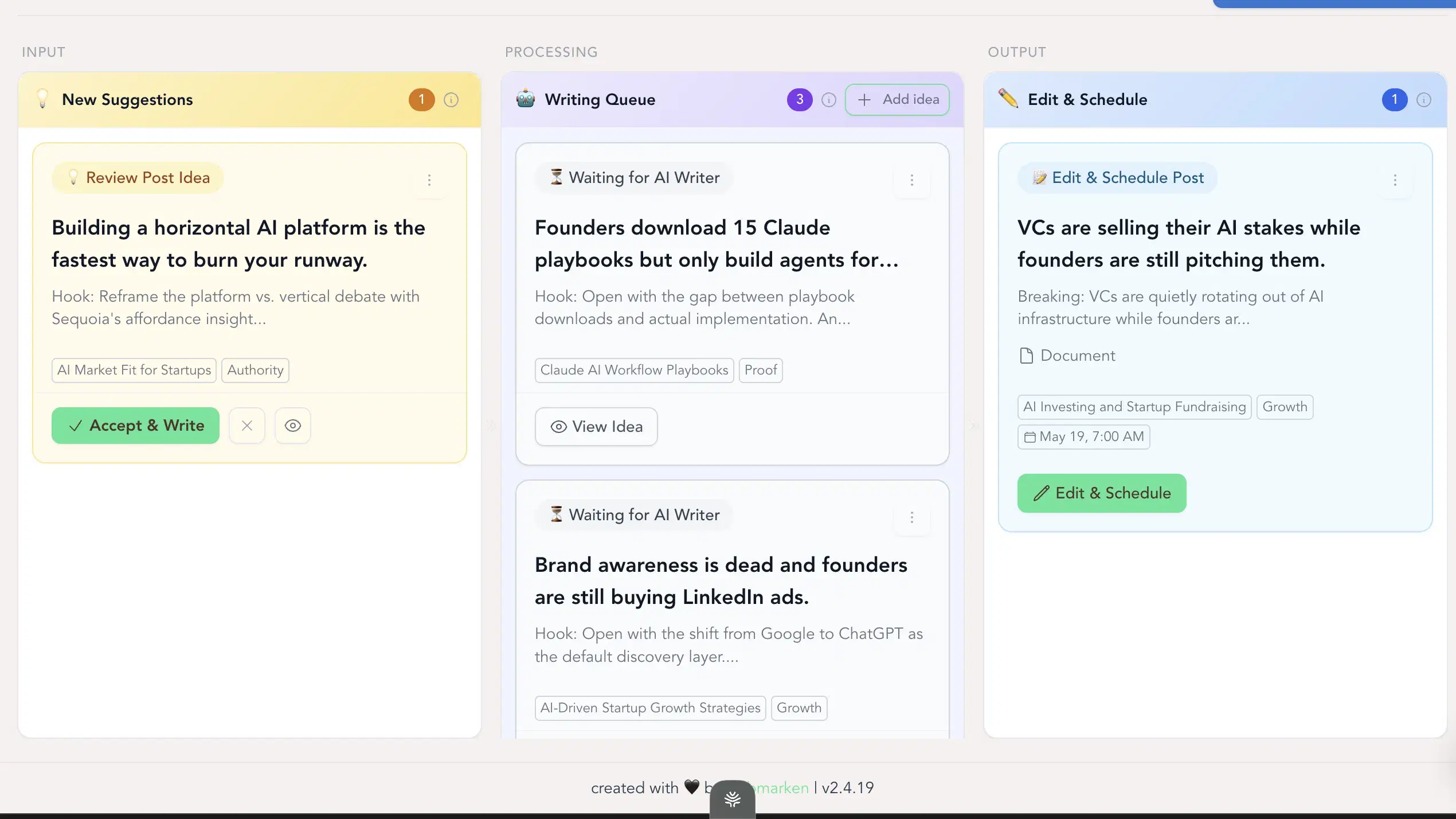
$15/mo entry is the cheapest in the category: Credible budget option for testing the category.
Best for
- Budget-first solo creators who don't need persona depth and want a clean Kanban + scheduling workflow at a low monthly price.
- If voice depth matters, the $34 jump to Oiti Creator ($49) doesn't justify the ceiling you'll hit at ContentIn.
Pricing
$15 / $31 / $48 per month · Free trial available
Pros
- Right structural surface. Composer + Kanban writing queue + content calendar + LinkedIn-OAuth-safe scheduling.
- $15/mo entry is the cheapest in the category. Credible budget option for testing the category.
Cons
- Generic output that doesn't retain voice. The composer generates without asking any questions about angle, framing, or specifics. You get the LinkedIn average, not your voice. Oiti's approach: narrative timeline built from your last 100 posts.
- 4-question multiple-choice "training" is not persona depth. It's a survey. Oiti's approach: 2,000–3,000-word persona document built from your past posts + website + ICP painpoint research.
- No web search for trending content. Ideas come from your past posts alone. Oiti's approach: research agents search Reddit + ICP painpoints across the live web + your KB before drafting.
Best for voice-interview-based onboarding
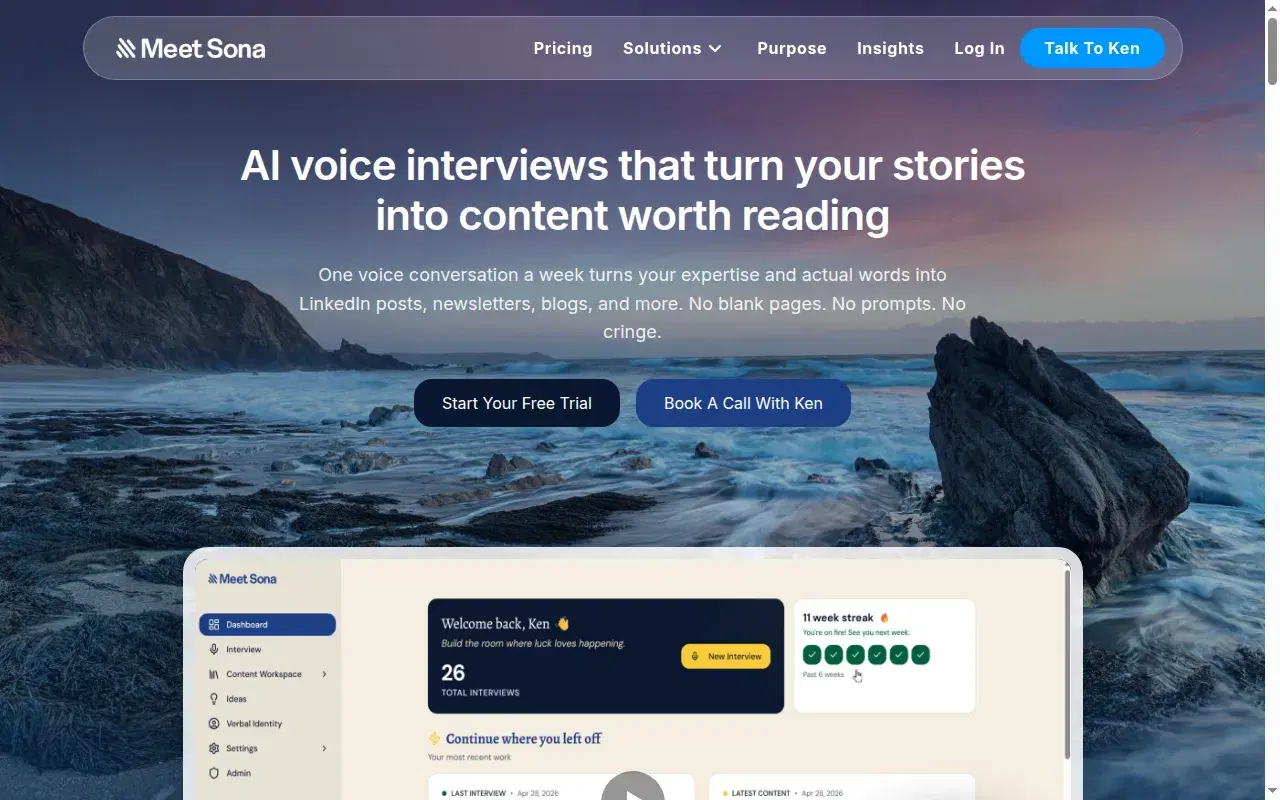
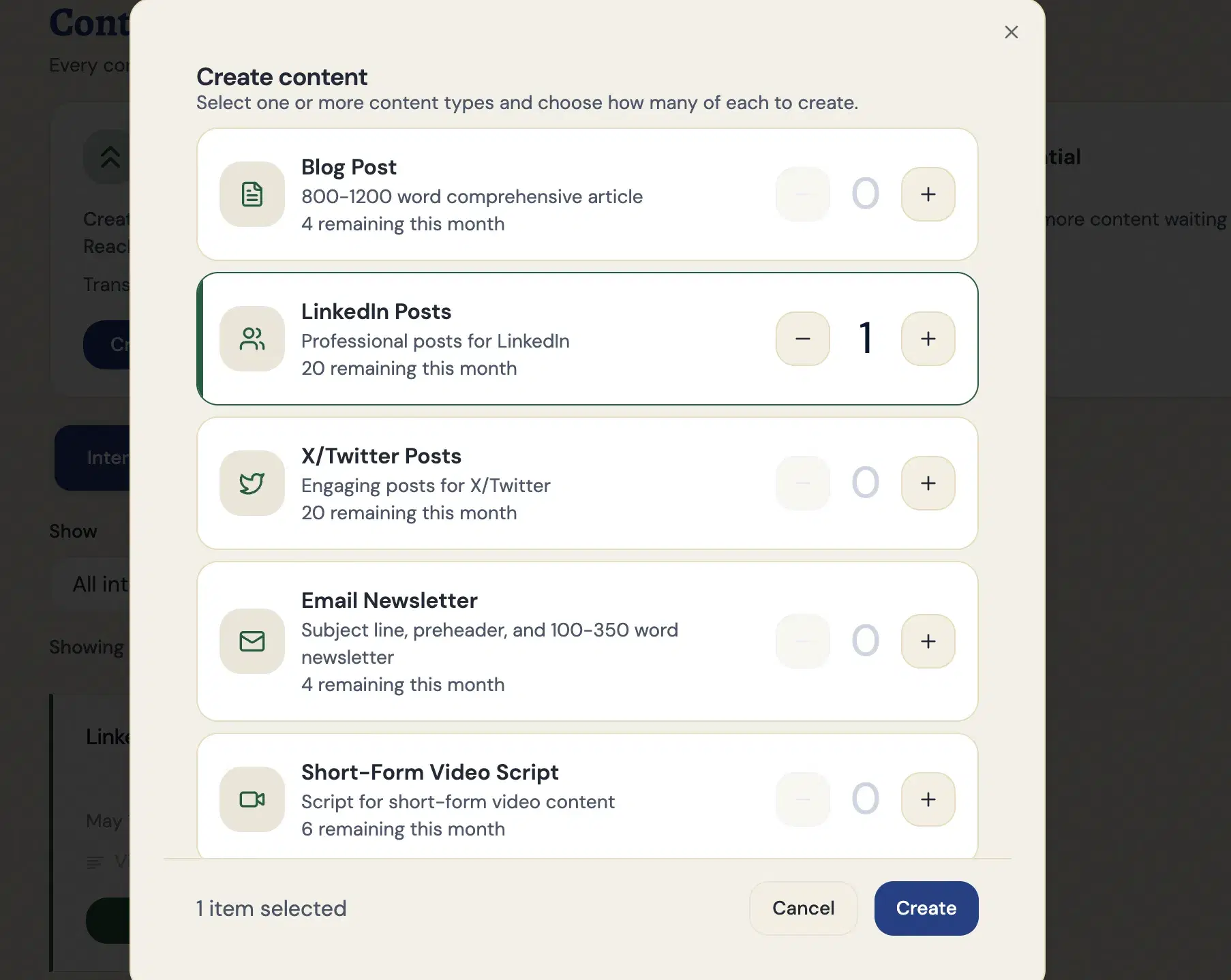
Tried it in 2026. MeetSona's idea: voice-first persona interviewing. Ten minutes of guided voice interview, and the tool builds your content persona from your answers. Surface-level the output is clean enough — picks up tone, signature phrases, basic writing guidelines. In practice, three things break.
When I tested it
Voice-only UI gets exhausting fast. Every persona interview is voice-input. No chat-based fallback. Sometimes you just want to type. Forcing every interaction into one channel is exhausting by the third or fourth time through. The pricing cap is sharp once you do the math. $24/mo gets you 5 voice interviews per month. Your persona stops evolving at 5 conversations — or 15 if you upgrade to $59/mo. The whole premise is "your voice + identity captured via interviews" — the pricing model rations the very thing you're paying for. Oiti's persona compounds across every chat at every plan tier, no interview quota. Multi-format means not LinkedIn-optimized. MeetSona generates across LinkedIn, X, blog, email, and short-form video scripts. Spread across five formats, the LinkedIn-specific polish suffers — line breaks, hooks, mobile cutoff handling. The first post I generated had visible AI tells. It caught the surface tone but missed the depth.
Key features
Voice-interview onboarding is a legitimate way to extract persona: 10 minutes to first content if you're starting from scratch.
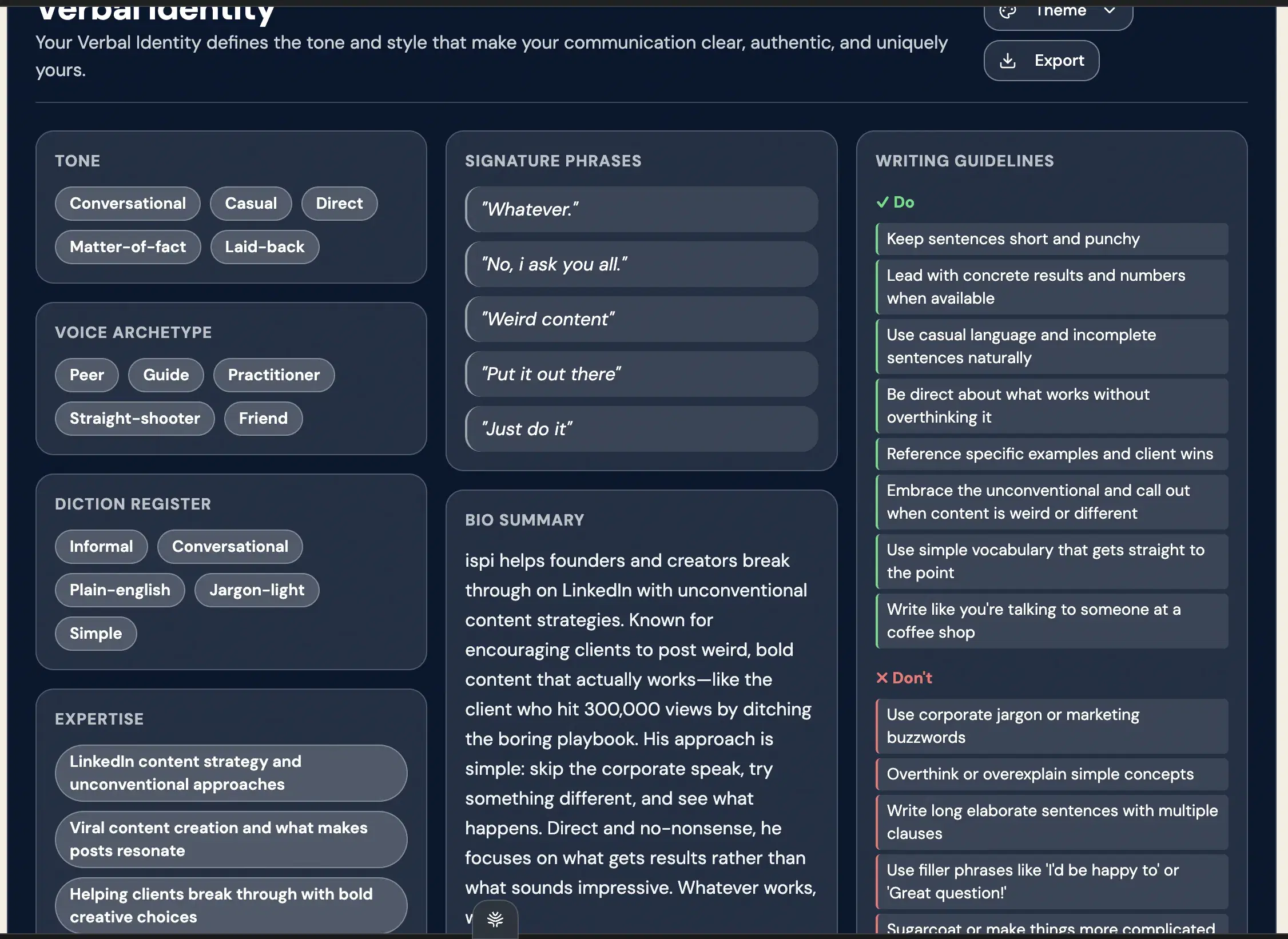
Persona output is clean enough at the surface: Captures tone, some signature phrases, some writing guidelines.
Best for
- Someone starting from scratch with no LinkedIn post history — the voice-interview onboarding makes sense when there's nothing to extract from yet.
- Graduate to Oiti once you've published 30–50 posts and the past-posts signal has caught up.
- For most people leaving MagicPost looking for voice depth at scale, the capped interviews + multi-format dilution + missing memory make this a hard sell.
Pricing
$24/mo (5 voice interviews/mo) / $59/mo (15 voice interviews/mo) · Trial available
Pros
- Voice-interview onboarding is a legitimate way to extract persona. 10 minutes to first content if you're starting from scratch.
- Persona output is clean enough at the surface. Captures tone, some signature phrases, some writing guidelines.
Cons
- Voice-only UI with no chat fallback is exhausting. Every interaction is voice-input. Oiti's approach: chat with voice as an input option — pick the modality per response.
- Pricing caps the wedge. 5 voice interviews/month at $24 means your persona stops evolving at 5 conversations. Oiti's approach: persona compounds across every chat at every plan tier, no interview quota.
- Multi-format dilution vs LinkedIn-specific polish. LinkedIn has specific requirements (line breaks, hooks, mobile cutoffs) that MeetSona's multi-format editor doesn't tune for. Oiti's approach: LinkedIn-only by design.
- No long-term memory, no web search for ICP pain. What you capture in the 10-minute interview is what the tool uses — nothing compounds underneath.
Best for viral-format content creation
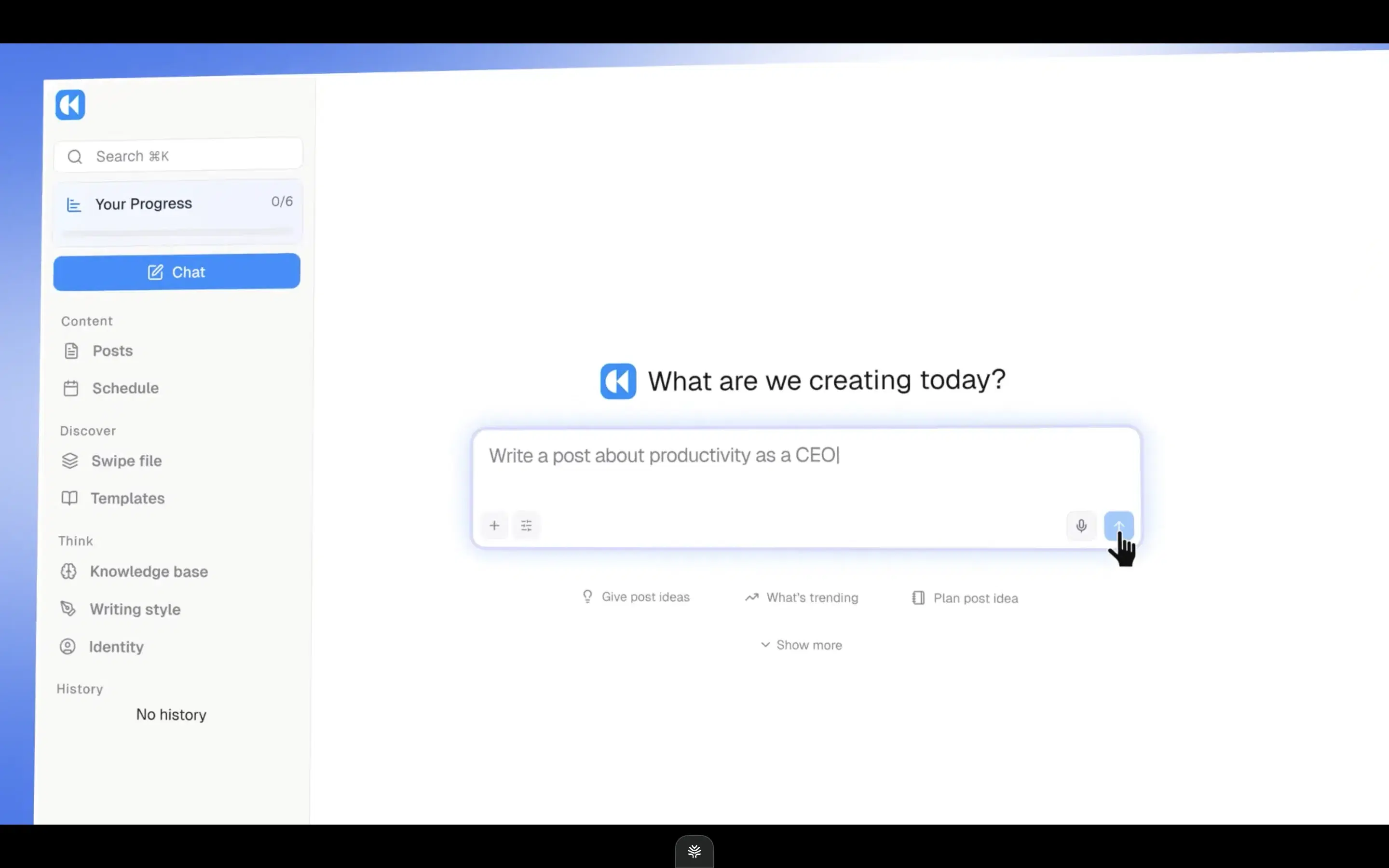
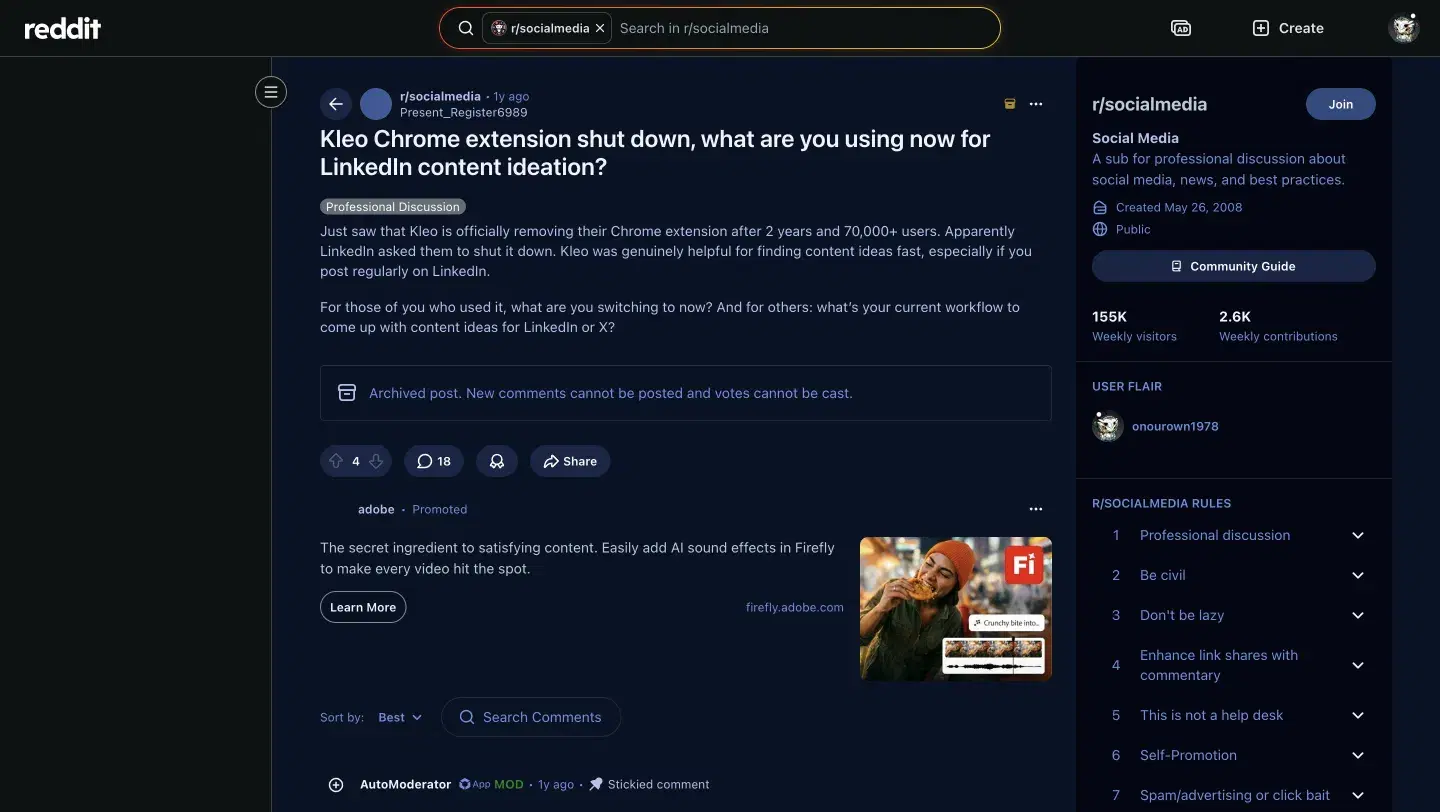
Tried it in 2026. Early adopter of the relaunched full-stack tool. Also used the original Chrome extension before LinkedIn forced it offline in 2025. Kleo's original Chrome extension was forced offline by LinkedIn after two years and 70,000+ users. Here's how one user put it on r/socialmedia: "Just saw that Kleo is officially removing their Chrome extension after 2 years and 70,000+ users. Apparently LinkedIn asked them to shut it down. Kleo was genuinely helpful for finding content ideas fast, especially if you post regularly on LinkedIn." The current Kleo is a full-stack LinkedIn content tool — no Chrome extension at all anymore — which is what this entry reviews. The rebuild took credibility. They didn't fold. The new product has the same chat composer surface, an inspiration tab, viral-format-fast positioning, and some interesting infographics work (not as deep as Oiti's, but well done).
When I tested it
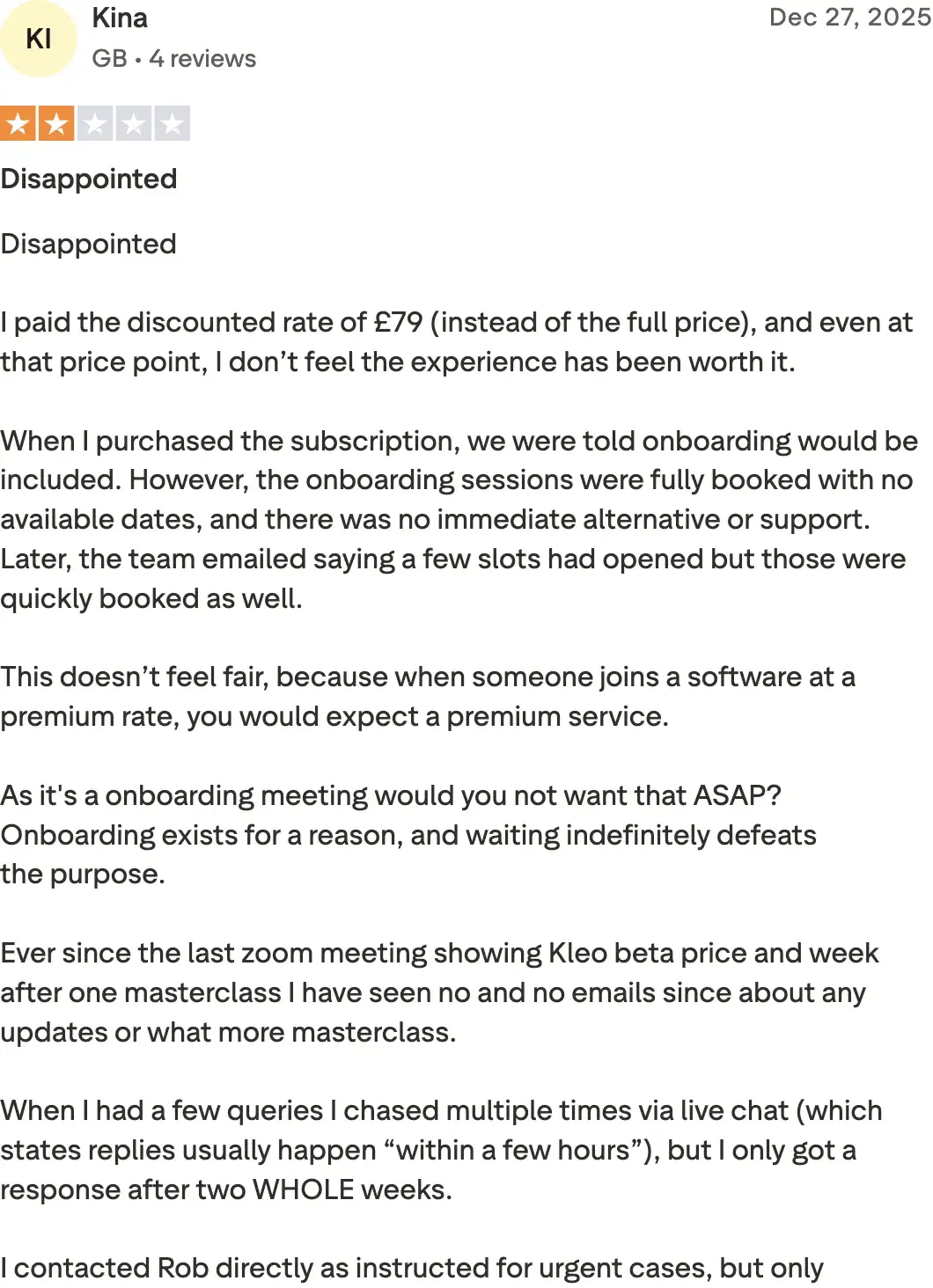
Where it falls down — trying to make you go viral flattens the voice. Kleo's AI logic is opinionated around viral patterns. The problem: chasing viral patterns flattens what makes your voice yours. Going viral isn't right for everyone — boring niche, educated audience, anyone whose distribution depends on credibility rather than reach. The new algorithm rewards dwell time, not virality. A post that 200 people read for 90 seconds outperforms one that 2,000 people skim in 4 seconds. The KB is primitive but exists. A generation behind what a real knowledge-grounded writing tool needs. No long-term memory across conversations. Every session starts fresh. While digging through reviews I came across Kina out of the UK on Trustpilot at 2/5: "I paid the discounted rate of £79 (instead of the full price), and even at that price point, I don't feel the experience justifies it…" Lined up with my own experience on why I moved on.
Review receipts
Key features
They rebuilt the entire stack after the 2025 shutdown: Not many founders pull that off.
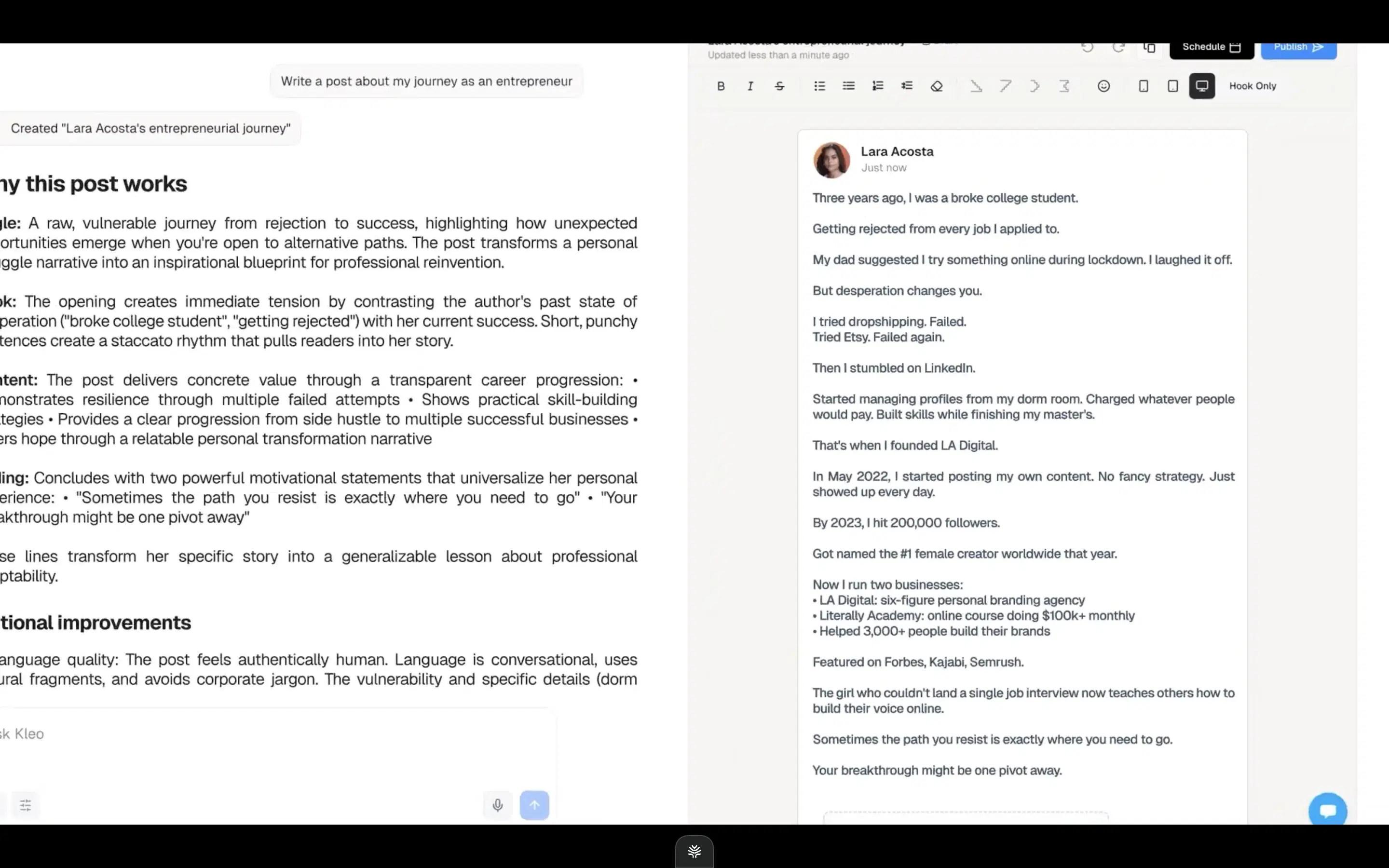
Chat composer + inspiration tab on the writing surface: Some interesting infographics work.
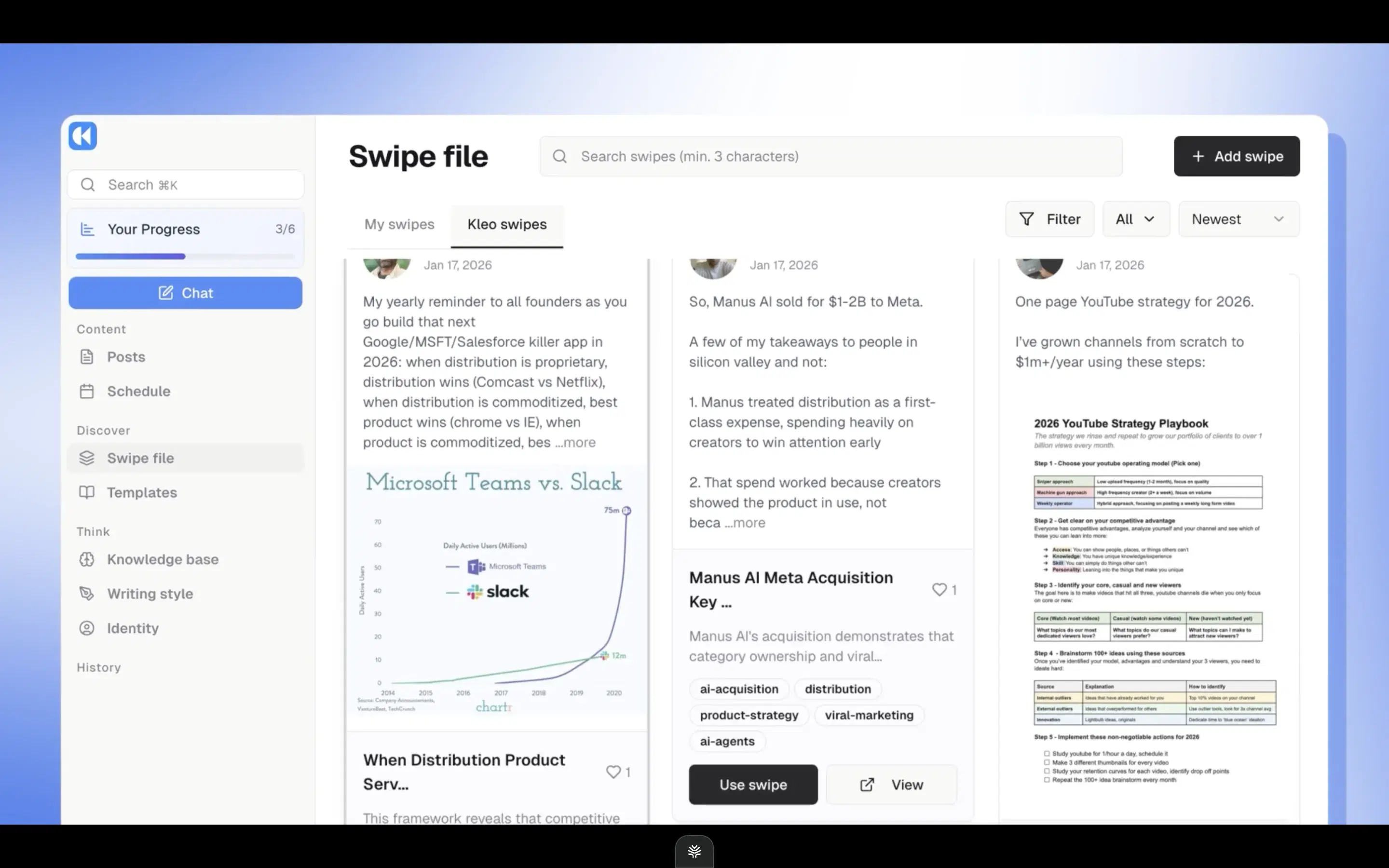
Fast viral content: If that's specifically what you want, the viral-format opinion delivers on it.
Best for
- Someone who specifically wants viral-format content for one LinkedIn account, doesn't mind the $99/mo with no trial, and is in a consumer niche where viral distribution makes sense.
- For most people in this category, the price-to-value doesn't add up.
Pricing
$99/mo or $999/year (~$83/mo effective) · No free trial currently
Pros
- They rebuilt the entire stack after the 2025 shutdown. Not many founders pull that off.
- Chat composer + inspiration tab on the writing surface. Some interesting infographics work.
- Fast viral content. If that's specifically what you want, the viral-format opinion delivers on it.
Cons
- Viral-format opinion flattens voice. For boring niches or educated audiences, going viral is often the wrong play. Oiti's approach: narrative timeline + tone clone prioritize voice fidelity over viral pattern matching.
- No free trial. $99/mo single-account. Can't evaluate without paying $99 upfront. Oiti's approach: Pro at $79/mo covers 3 personal LinkedIn accounts; 7-day free trial with no usage cap.
- No long-term memory. Primitive KB. Every session starts fresh. Oiti's approach: persistent long-term memory across sessions + KB that ingests YouTube + PDF + meeting notes.
How to choose
If your output needs to sound like you at scale → Oiti. The 3,000-word narrative timeline + long-term memory + KB stack is the only one in this list built for this.
If you don't want a Chrome extension or any account risk → Oiti or Supergrow. Both use official APIs only. If you don't care about voice depth, Supergrow's scheduling-first build is cheaper. If you do, Oiti.
If you're budget-first under $30/mo → ContentIn at $15/mo. Accept the depth trade-off, then run Oiti's 7-day free trial to compare honestly before committing.
If you want long sessions, deep context, real iteration → Oiti. The chat composer + memory + KB stack is what makes it a thinking partner. No other tool in this list has persistent memory across sessions.
If you write for 3+ clients and need multiple voice profiles → Oiti Pro ($79/mo, 3 AI Clones). Supergrow's multi-account is strong for scheduling but doesn't have per-client persona depth.
If you need outbound automation alongside your content tool → Taplio, with the explicit ToS-risk caveat. Or run Lemlist/HeyReach alongside Oiti and keep your content tool ToS-safe.
If formatting is all you need → AuthoredUp. With the caveat that free formatting tools cover most of the same ground. The paid AuthoredUp niche is narrow.
If you're brand-new with nothing published yet → MeetSona's voice-interview onboarding. More useful than trying to extract a persona from a thin LinkedIn history. Graduate to Oiti once you've published 30–50 posts.
If you specifically want viral-format content for one account and don't mind $99/mo → Kleo. Use it knowing the viral-optimization will flatten some of your voice.
If you're a casual creator posting once a week and you're happy with MagicPost → Keep MagicPost. The persona ceiling won't matter for your usage — you'll only feel it if you start publishing at scale.
The verdict
Oiti #1, Supergrow #2, AuthoredUp #3. MagicPost works for casual creators who post weekly without measuring caring much about if the ai consistently gets better with every feedback. The ceiling shows up the moment you push posts at scale, and LinkedIn's 360Brew algorithm is built to penalize exactly that now (generic content). If you measure distribution by dwell time and not "views" from people who will never buy from you, you need the tool that actually knows who you are. That's Oiti. I built it for this.
7 days free · No usage limits