I Tried EasyGen vs Scripe: Features, Pricing, Cons, Which Is Better (2026)?
One's a one-shot form that hands you 2020 broetry. The other's a team platform with a knowledge base bolted on. Push either one at volume and you get the same result: AI slop that LinkedIn now buries.

I've spent close to six years ghostwriting LinkedIn content for 50 to 60 founders, coaches, consultants, and CXOs, with over 100M organic views across those accounts. So when a tool promises to write posts that pull their weight, I've usually already run it on a live client account to find out.
I did that with both of these. Between EasyGen and Scripe, Scripe is the better LinkedIn tool in 2026 for almost everyone. You get a back-and-forth chat editor, a knowledge base it pulls from, a tone-of-voice setup, readability and reach stats, and real team workflows. EasyGen is a single form that hands you 2020-era broetry you can't iterate on. EasyGen keeps one advantage: it's cheaper month to month ($59.99 against Scripe's roughly $76 entry tier) and it never touches your LinkedIn account, so if a cheap one-shot post generator is all you're after, it's defensible.
Even then, ChatGPT does the same job for less and lets you argue with it.
Both share the same ceiling, though. Scripe's knowledge base stores your files but starts every session cold, and EasyGen keeps nothing at all, so at volume the output drifts into the same templated slop either way. If you want posts grounded in your unique POV and voice instead, the tool I'd point you to is Oiti, the AI clone for LinkedIn content, which pairs long-term memory with a knowledge base so it works out who you are before it writes.
EasyGen vs Scripe at a glance
| EasyGen | Scripe | Oiti — AI clone for LinkedIn contentMy pick | |
|---|---|---|---|
| Best for | the cheaper of the two, if a one-shot post generator is all you need | 5-plus person LinkedIn content teams that need workflow discipline | anyone who wants posts grounded in their POV, not templated AI slop |
| Starting price | $59.99/mo (login-gated) | €69/mo Solo (~$76) · €99 Advanced (~$108) · €149 Business (~$164) | $49/mo Creator · $79/mo Pro |
| Real price after trial | $59.99 (or $599.88/yr, ≈ $50/mo) | €69–€149 + €45/mo per extra LinkedIn account | $49 / $79 |
| Free trial | 7-day trial | 14-day free trial | 7-day |
| LinkedIn's terms of service | Safe — plain web app, no extension, never connects to your account | Publishes via official LinkedIn APIs; a read-only extension syncs your posts, Amplifier auto-engagement is opt-in | Safe — official LinkedIn Marketing Developer APIs, no extension |
| Standout strength | cheaper month to month than Scripe, single-platform focus | team workflows plus a broad multi-source knowledge base | long-term memory + Knowledge Base |
| Biggest weakness | one-shot form, expired broetry, no iteration, no memory | generic content at scale, no memory, billing-after-cancel reports | no native mobile app; LinkedIn only |
| Overall winner | — | ✓ | — (parallel pick, not the referee) |
EasyGen's price is captured from inside the app, Scripe's from its public pricing page, both May 2026.
How I Tested EasyGen v/s Scripe – My Testing Methodology
I tried both tools on both client and my own accounts, not from a spec sheet. EasyGen I tried in 2025: I onboarded, generated posts against a live topic, and read what came back. Scripe I ran through its full 14-day free trial in 2026, sat through a vendor demo, and cross-checked it against an agency user running Scripe for a finance-founder client who was looking to switch. I spent more time inside Scripe than EasyGen.
Four axes separate this pair, and I weighted content quality and iteration highest:
AI content & iteration
Is the writing worth posting, and can you push back on a draft or are you stuck with what it hands you?
Real cost
What you actually pay after the trial, converted to USD, add-ons included.
Product depth
Knowledge base, team workflows, analytics: platform or feature?
Trust & safety
Billing behaviour, account safety, and how the thing behaves on the way in.
What Is EasyGen – and Can It Really Write LinkedIn Posts Like Creators With 100M+ Views?
EasyGen is a LinkedIn-only, solo-focused post generator built by Ruben Hassid, the LinkedIn influencer whose growth playbook it packages. The homepage title tag it hooks on is "Write LinkedIn posts like creators with 100M+ views," with a subhead promising "real data from top 1% creators plus trending topic intelligence."
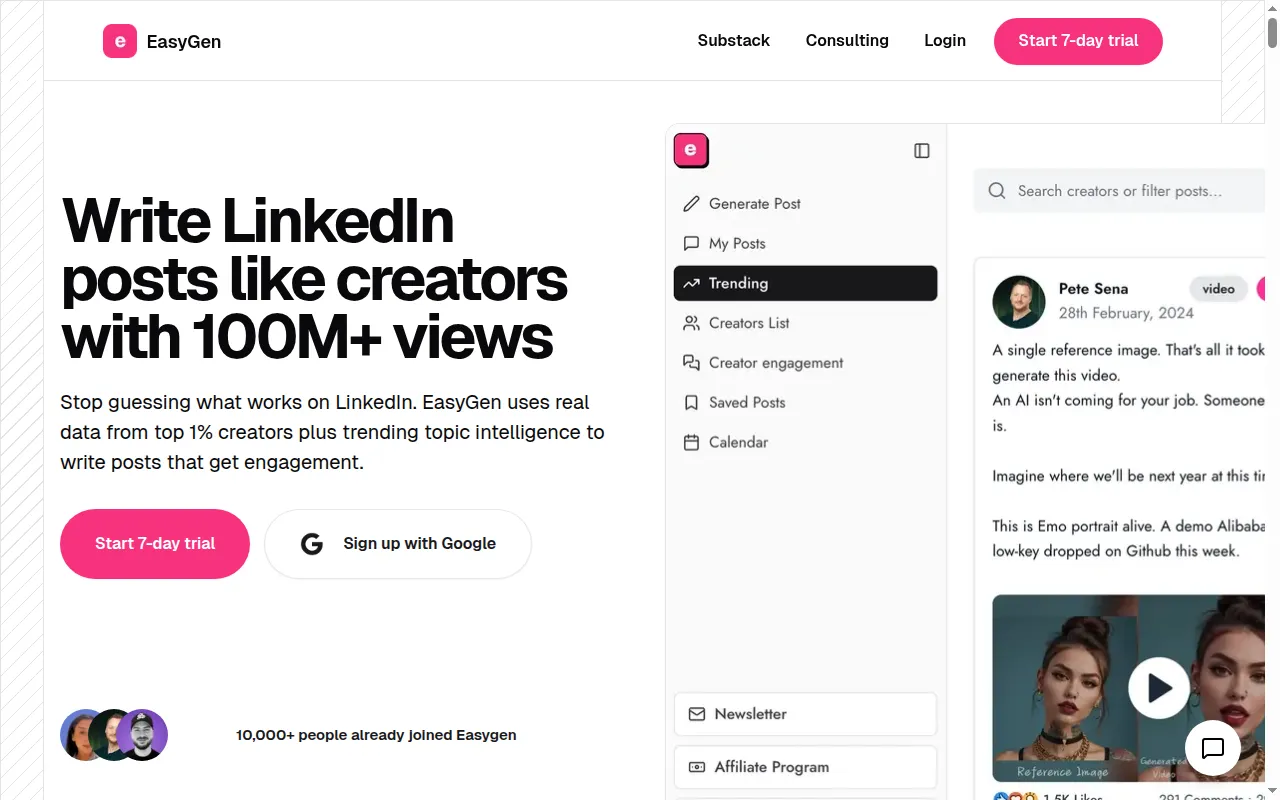
When I jumped in, the whole thing turned out to be a form, an output, and a live preview. Around that sits a "Trending" feed, a "Creators List" that tracks people whose posts perform, a My Posts library, and a scheduler. No X, no Instagram. LinkedIn only. I went in hoping it had encoded how Ruben and his team grew so fast. It hadn’t. It just force-feeds their playbook onto everyone else.
What Is Scripe – and Does It Turn LinkedIn Posts Into Revenue?
Scripe is a European-founded, LinkedIn-only content platform aimed at sales and marketing teams rather than solo creators. Its homepage title tag reads "Turn LinkedIn posts into revenue without wondering what to write," with a "Scripe 4.0 is here" banner above it and a customer logo wall running Qonto, SNOCKS, Mindspace, Framen, OMR, and WeWork.
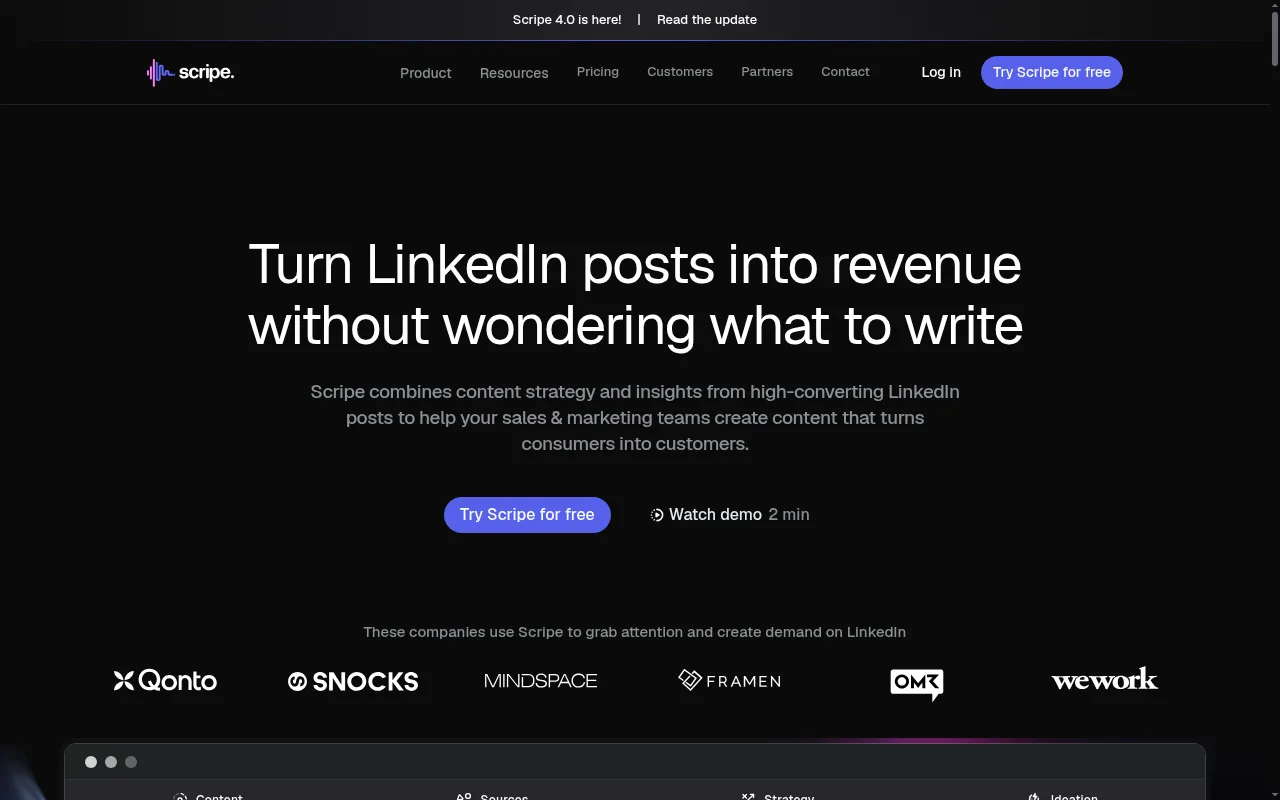
Once I was inside, it read as a conversational chat editor, a multi-source knowledge base, a tone-of-voice setup, and analytics, with a team layer sitting over all of it.
It's built for a marketing team with a process, not really for solo creators…. at least that was my initial impression.
So that's the two of them on paper. Now let's see what you're actually paying for.
1. EasyGen vs Scripe Pricing: What's the Best Value for Money?
EasyGen wins on just price alone. $59.99 a month against Scripe's €69 Solo, which is roughly $76 once you convert. Annual is $599.88, about $50 a month.
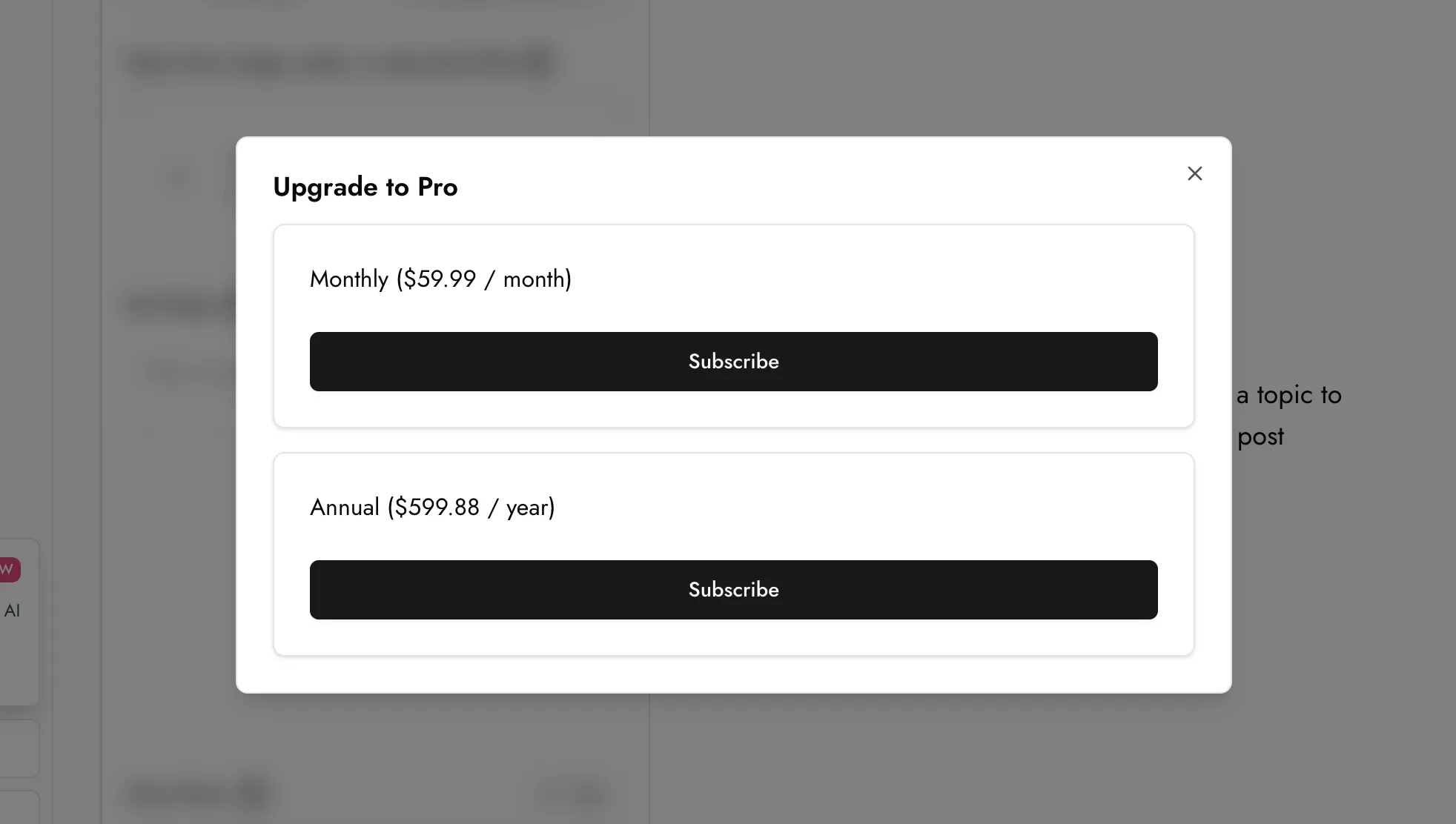
But EasyGen has no public pricing page. /pricing redirects to sign-in, and the figures above only surfaced for me in an "Upgrade to Pro" modal once I was already inside the app. There’s a 7-day trial, so you can look before you pay, but only after you’ve handed over an email.
Scripe runs €69 Solo, €99 Advanced, and €149 Business, all published openly, with a 14-day free trial. The add-ons are where it gets expensive: €45 a month per additional LinkedIn account and €20 a month per extra Amplifier seat.
Three LinkedIn accounts on Solo lands you around €159 a month, roughly $175.
So the money buys very different things. EasyGen's $59.99 gets you a generator, a trend feed, and a content form. Scripe's €69 gets you a knowledge base, a tone-of-voice profile, scheduling, a Kanban, content interviews, and full historical LinkedIn analytics on the entry tier. Cheaper per month, yes. Better value, no. And if the cheapest possible one-shot generator is the goal, the answer isn't EasyGen at $59.99 either. For reference, Oiti's Creator plan is $49, undercuts both, while being 10X better with content.
Winner: EasyGen on raw monthly price. But cheaper per month isn’t better value — Scripe’s €69 buys a platform, EasyGen’s $59.99 buys a form.
Stop overpaying for generic AI
At $49, Oiti writes in your POV and remembers your feedback — not templated slop you'll pay $60 a month to rewrite by hand. Try Oiti free for 7 days.
7 days free · No usage limits
2. EasyGen vs Scripe Content: Which Tool's AI Writing Is Better in 2026?
Price sorted. Now the big one — which of them actually writes something worth posting?
Scripe wins this one, because you can argue with it. The writing isn't brilliant, but there's a chat window, a knowledge base to ground a draft in, a tone-of-voice profile, and a stats panel that reads back what you've written. EasyGen gives you a topic box and a result, full stop.
I tested EasyGen on a real subject: AI taking away jobs. Here’s what came back, verbatim, in the editor.
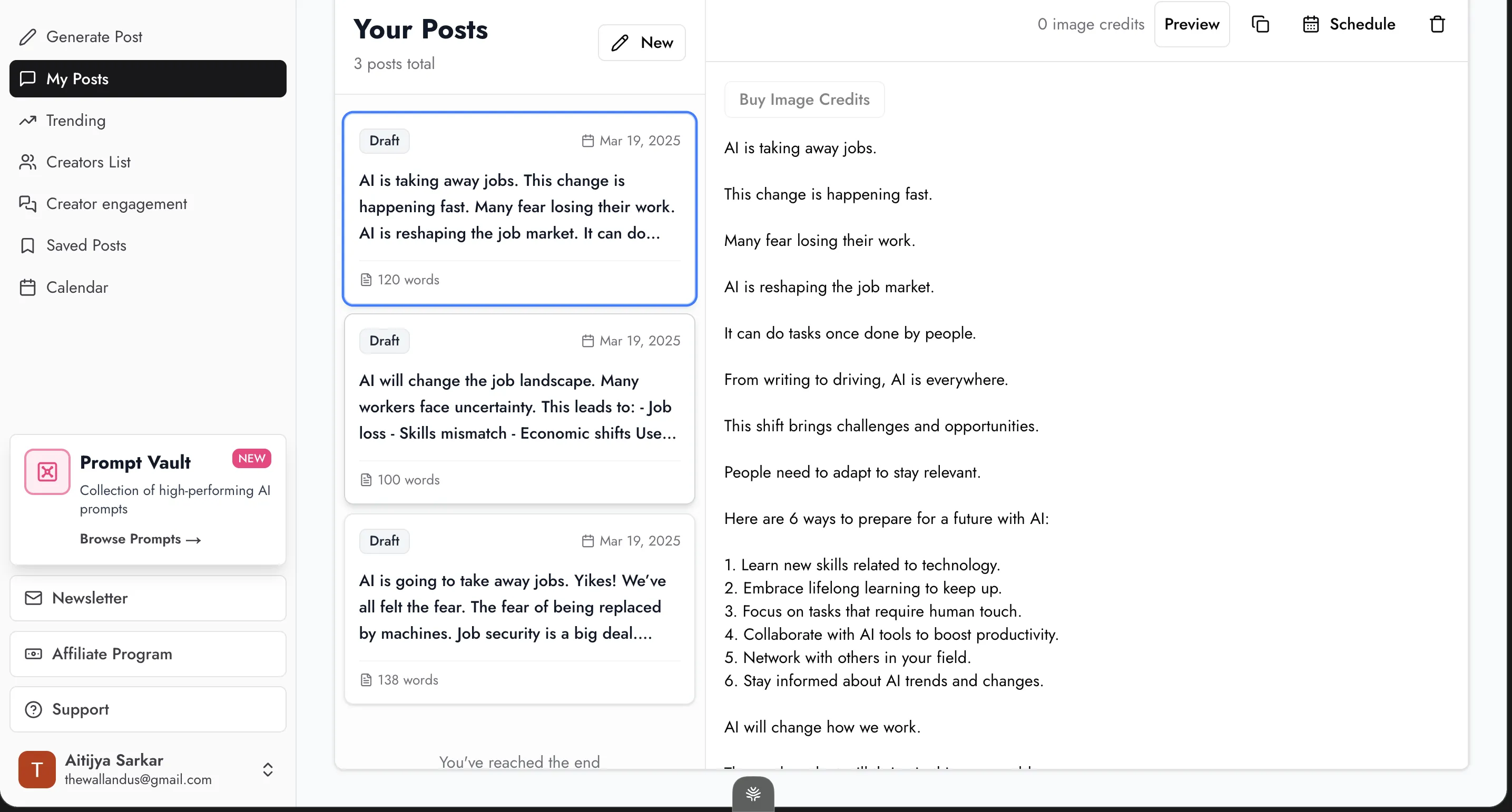
“AI is taking away jobs. This change is happening fast. Many fear losing their work. AI is reshaping the job market. Here are 6 ways to prepare for a future with AI: 1. Learn new skills related to technology. 2. Embrace lifelong learning to keep up.”
One sentence per line, every line a flat declarative, a numbered list bolted into the middle. That's broetry, the format that printed engagement in 2019 and 2020 and that LinkedIn now buries. No argument in it, no person behind it. And because EasyGen is a form, there's no second pass. You can regenerate, but you can't tell it “no, not like that.” Even ChatGPT does better here, purely because it lets you go back and forth.
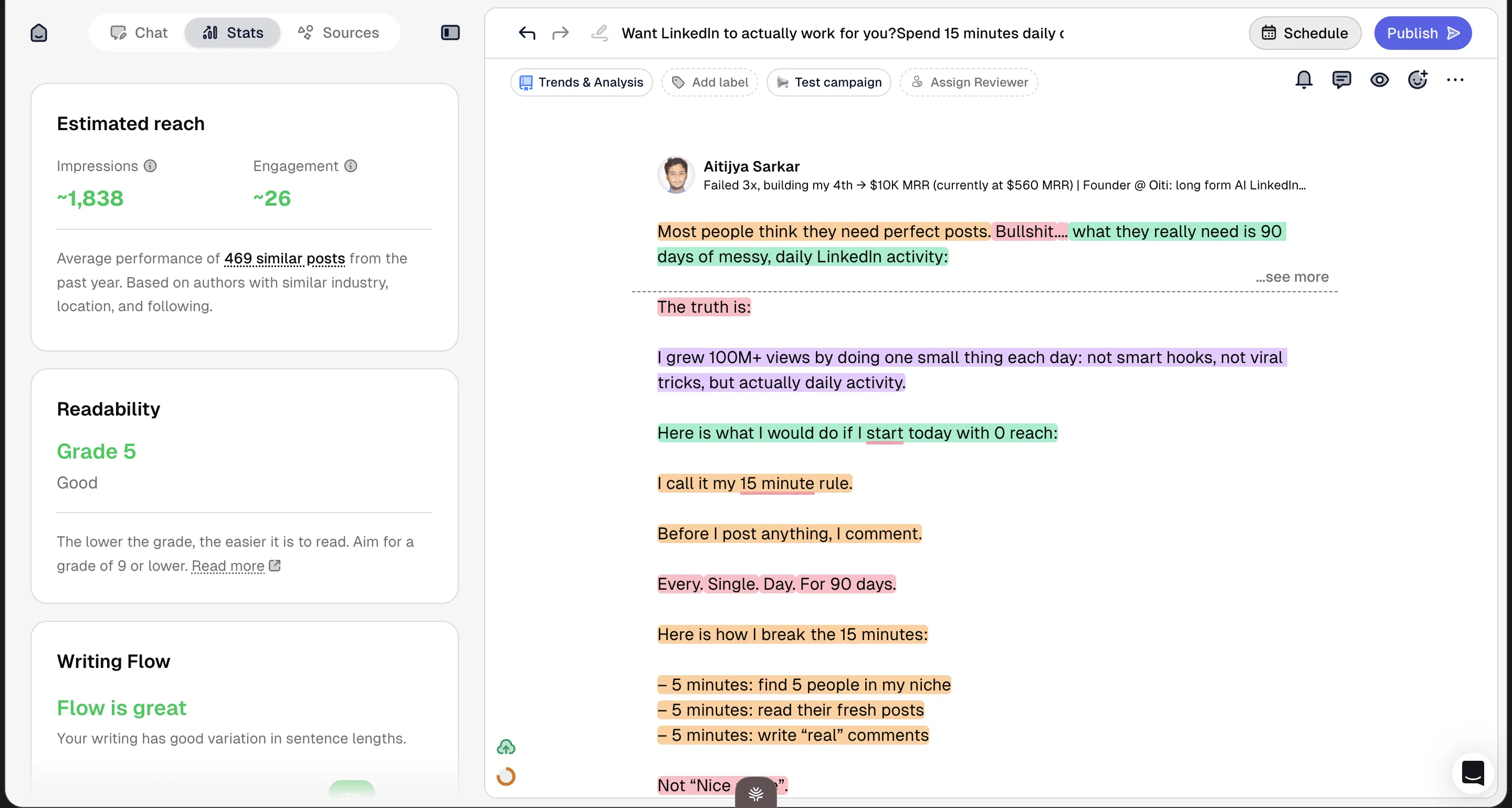
Scripe's editor is a different thing. Alongside the draft I wrote, it showed estimated reach (~1,838 impressions, benchmarked against 469 similar posts), a readability grade (Grade 5, “Good”), a writing-flow meter, plus Trends & Analysis, labels, and an Assign Reviewer button.
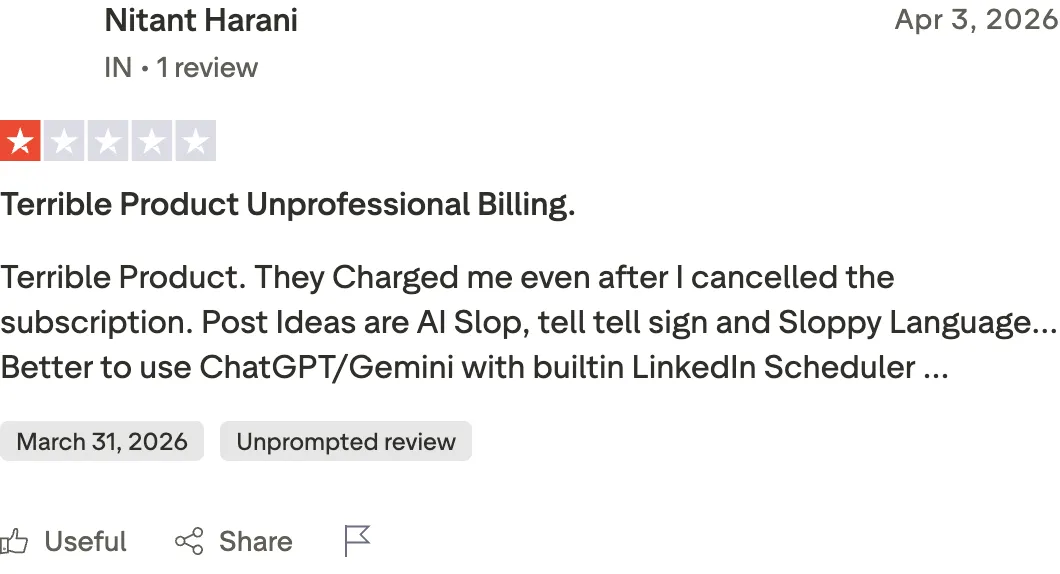
The ideas themselves are the weak part. Its weekly post ideas and the Inspiration wall are a snapshot of what went viral recently, not a system that learns you, so at volume the drafts converge on the same handful of shapes. A paying customer put it more bluntly than I would:
“Post Ideas are AI Slop, tell tell sign and Sloppy Language… Better to use ChatGPT/Gemini with builtin LinkedIn Scheduler”
Winner: Scripe — on the tooling around the draft, not on the draft itself. And that's the shared gap: neither one reads who you are before it writes.
Oiti grounds every draft in your knowledge base and long-term memory, working out what you believe and the way you actually talk first, and it holds your corrections across sessions instead of resetting. Try Oiti free for 7 days.
Want a week of LinkedIn posts that aren't AI slop?
Oiti's voice clone reads your last 100 posts, your website, and your POV, then keeps every correction in long-term memory — so draft two is closer than draft one. Try Oiti free for 7 days.
7 days free · No usage limits
3. EasyGen vs Scripe Features & Depth: Which Does More?
The draft's one thing. What's sitting behind it is another. Let's talk depth.
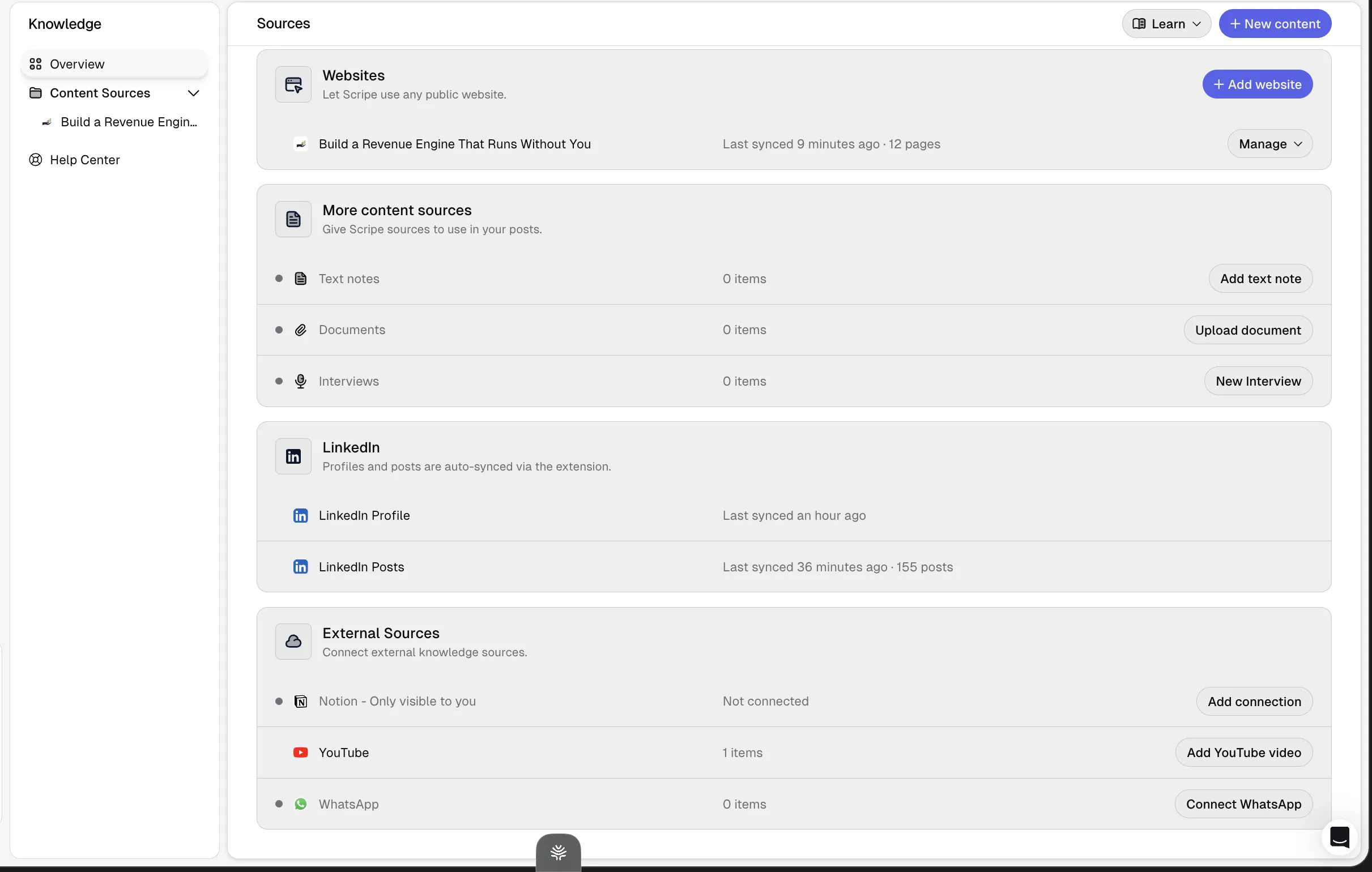
Scripe wins decisively here, and it's the widest gap on the page. Its Sources panel ingested public websites (mine synced 12 pages), text notes, uploaded documents, recorded interviews, an auto-synced LinkedIn profile and post history (155 of my posts), plus external connectors for Notion, YouTube, and WhatsApp.
On top of that sits the team layer, which is Scripe's real wedge: approval flows, a shared content Kanban, a workspace-wide knowledge base, roles and permissions on Business, and Amplifier seats that split auto-engagement accounts from your posting account. Fabio in Italy, a 4/5 reviewer on Trustpilot in July 2025, rates the analytics above LinkedIn's own, and that tracks. A lot of this product is measurement, not generation.
EasyGen's answer to all of this is a feed. “Creators List” lets you track people whose posts perform, and clicking into one gives you their outlier posts ranked by how far each beat that creator's own baseline.
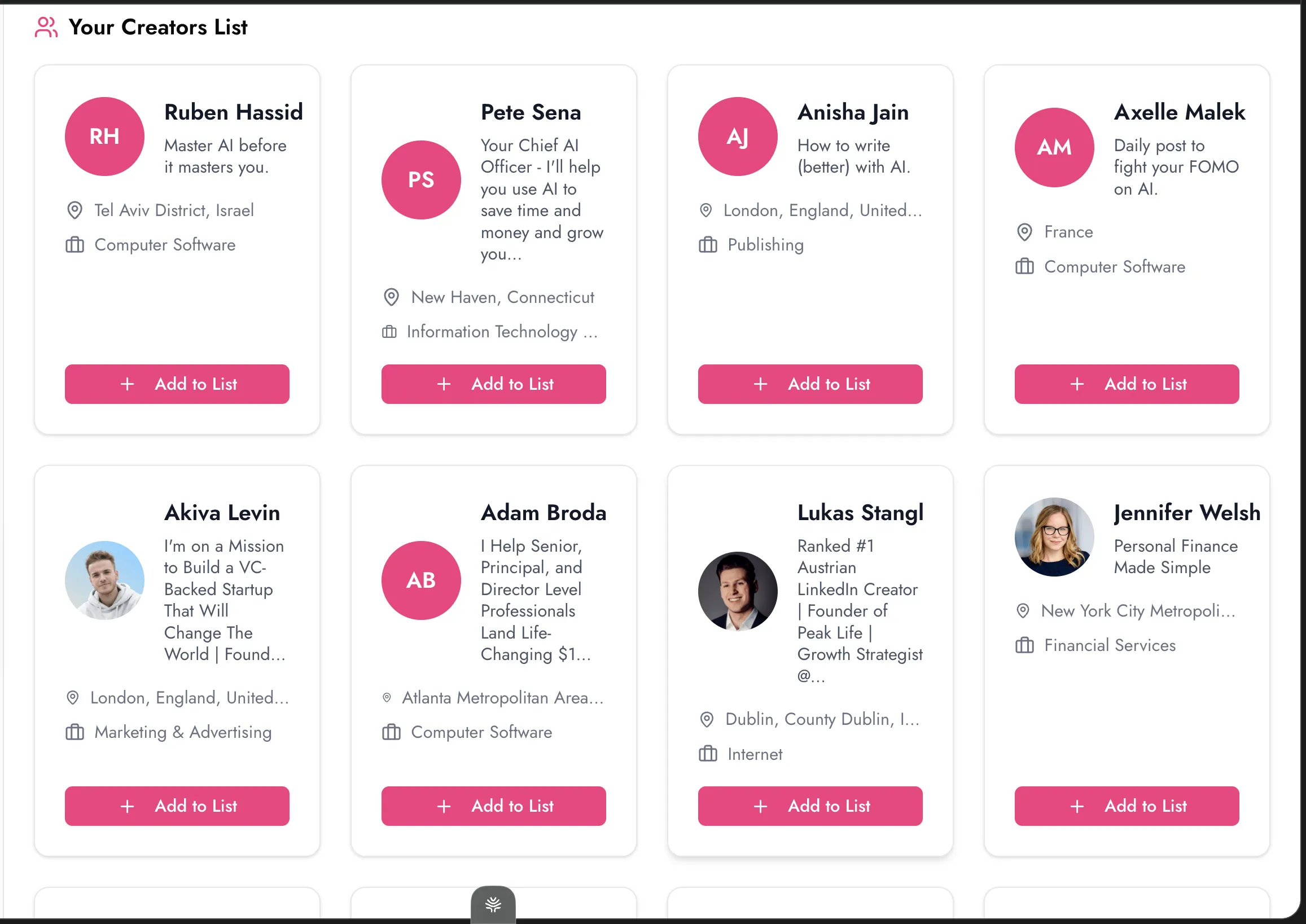
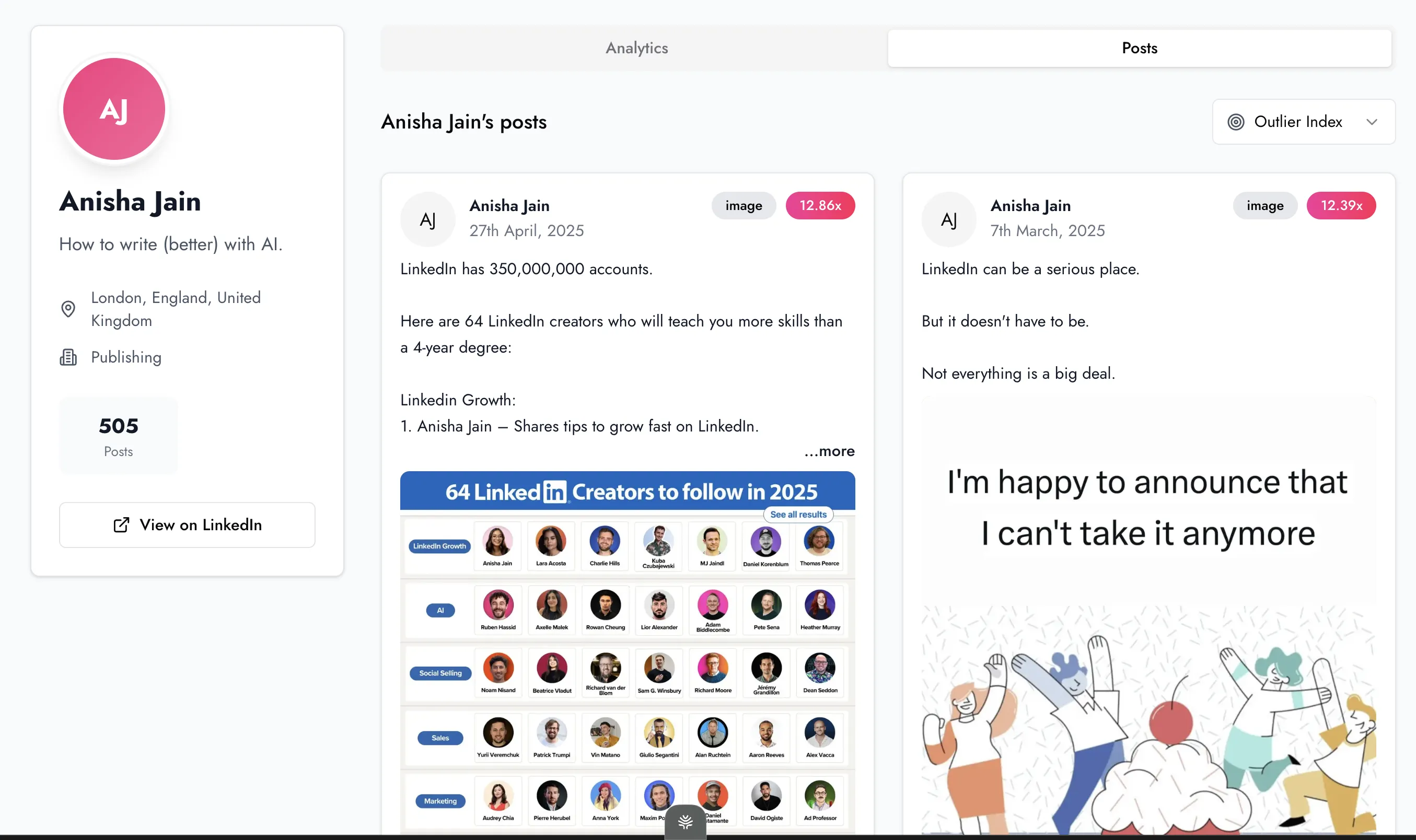
The idea's good. It just stops early. EasyGen shows you the viral post and leaves you there. It never breaks the post down into a reusable template you could apply to your own topic, and there's no knowledge base underneath to fill that template with anything of yours. You do the translation by hand.
Winner: Scripe, decisively — the widest gap on the page.
Scripe's depth is where it pulls furthest ahead, but there's a ceiling even here. The knowledge base is storage, not memory: it holds your files and still starts every chat from zero. And the tone-of-voice step is a “describe how you sound” form, not a structural read of how you've already written on LinkedIn. Bigger filing cabinet, same missing layer. That layer, a KB with long-term memory sitting on top of it so every chat makes the next one better, is exactly what Oiti was built to add. Try Oiti free for 7 days.
4. EasyGen vs Scripe Trust & Safety: Billing, Bans, and First Impressions
Feature depth won't matter much if the thing bills you after you cancel. So let's talk trust.
Neither one earns this point, and EasyGen's onboarding broke on the way in. On the setup step where you hand over your LinkedIn profile URL, I hit “Setup failed: Unexpected end of JSON input.” I retried three or four times before it let me through.
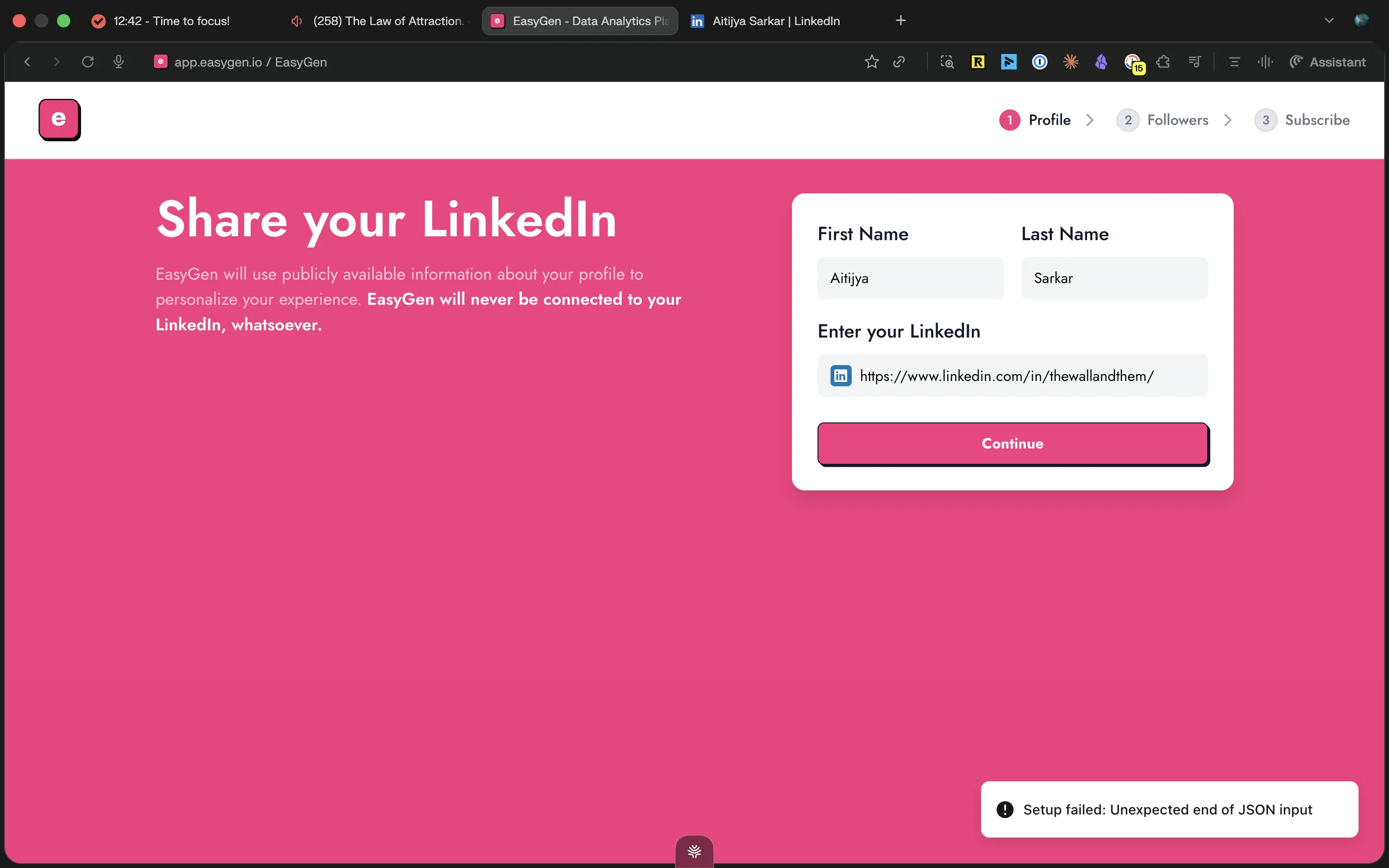
A JSON parse error on the most important onboarding step, in a product about to charge $59.99 a month, sets the tone. EasyGen sits at 3.0/5 on Trustpilot across three reviews, two of them warnings: Felix Hofmann in Switzerland left a 1/5 in August 2025 saying it wasn’t worth the money, and a second reviewer hit an unexpected renewal and was told all purchases are final and non-refundable.
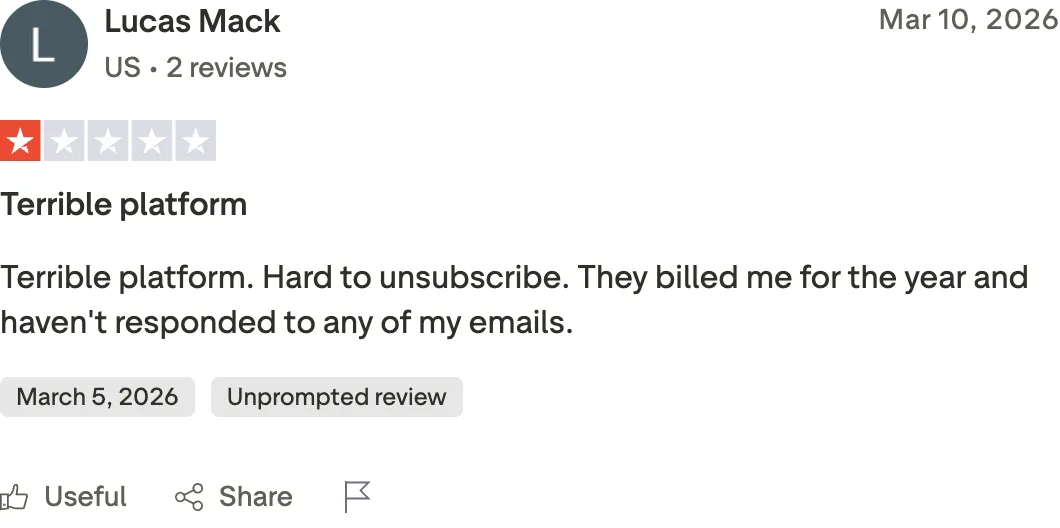
Scripe's trust problem sits elsewhere. On account safety, it's fine: publishing runs through LinkedIn's official APIs, the extension is read-only sync, and Amplifier auto-engagement is opt-in and isolated on separate seats. The risk with Scripe according to some users could be users being charged after cancelling.
“Terrible platform. Hard to unsubscribe. They billed me for the year and haven't responded to any of my emails.”
Winner: Neither — buy either one with your renewal date written down.
On safety, both are fine, and Oiti sits in the same lane, publishing and analytics through LinkedIn's official Marketing Developer APIs with no extension in the loop.
Want the safety without the AI slop?
Oiti publishes through LinkedIn's official APIs — no extension, no cookie automation — and grounds every draft in your POV instead of recycled viral templates. Try Oiti free for 7 days.
7 days free · No usage limits
Which Should You Pick – EasyGen or Scripe?
Pick Scripe if you run a 5-plus person LinkedIn content team and deep team workflows matters more to you than unique original linkedin posts. Almost nothing else in this category does approval flows, a shared content calendar, a workspace-wide knowledge base, and split Amplifier seats properly. Price it honestly, though: that team layer starts at €99 Advanced, not the €69 Solo tier, and every extra LinkedIn account is another €45 a month on top.
Pick EasyGen if you want the cheaper of these two, you plan to heavily rewrite every draft yourself, and you specifically want a tool that never touches your LinkedIn account. Even then, ChatGPT costs less and lets you refine a draft instead of re-rolling the dice.
Pick neither if what you want is writing grounded in your own POV that holds onto your feedback. Scripe starts every session cold, and EasyGen never had a memory to start with.
When Neither EasyGen nor Scripe Is the Answer: Try Oiti, the AI Clone for LinkedIn Content
Both tools write LinkedIn posts. Neither works out who you are before it drafts, and neither remembers what you told it last week. Scripe's knowledge base holds your files, but the chat in front of it starts from zero every time, and its voice step asks you to describe how you sound rather than reading how you've already written. EasyGen has no memory layer at all.
Both also lean on snapshot-in-time viral patterns, so the more you publish, the more your feed converges on everybody else running the same tool. The agency user I spoke to had a finance-founder client whose Scripe drafts were generic enough to dent his credibility in a serious niche, and they moved off it.
That specific gap is what Oiti, the AI clone for LinkedIn content, was built to close. Every time you write, Oiti fires parallel fetches across your knowledge base and long-term memory, working out who you are, what you believe, and the way you actually talk before a word hits the page. The memory compounds: tell it to stop opening every post with “I” and it holds across sessions instead of resetting.
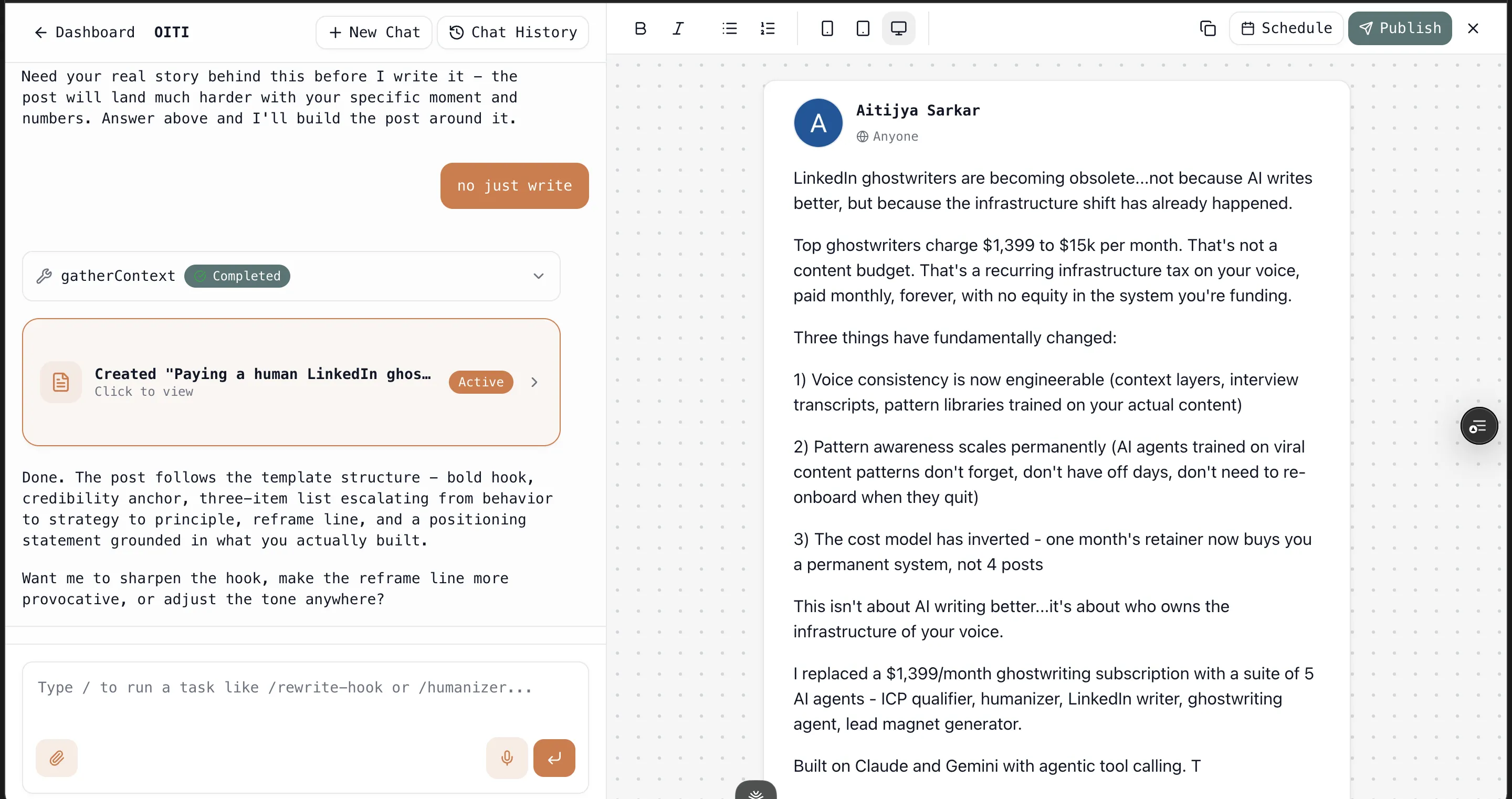
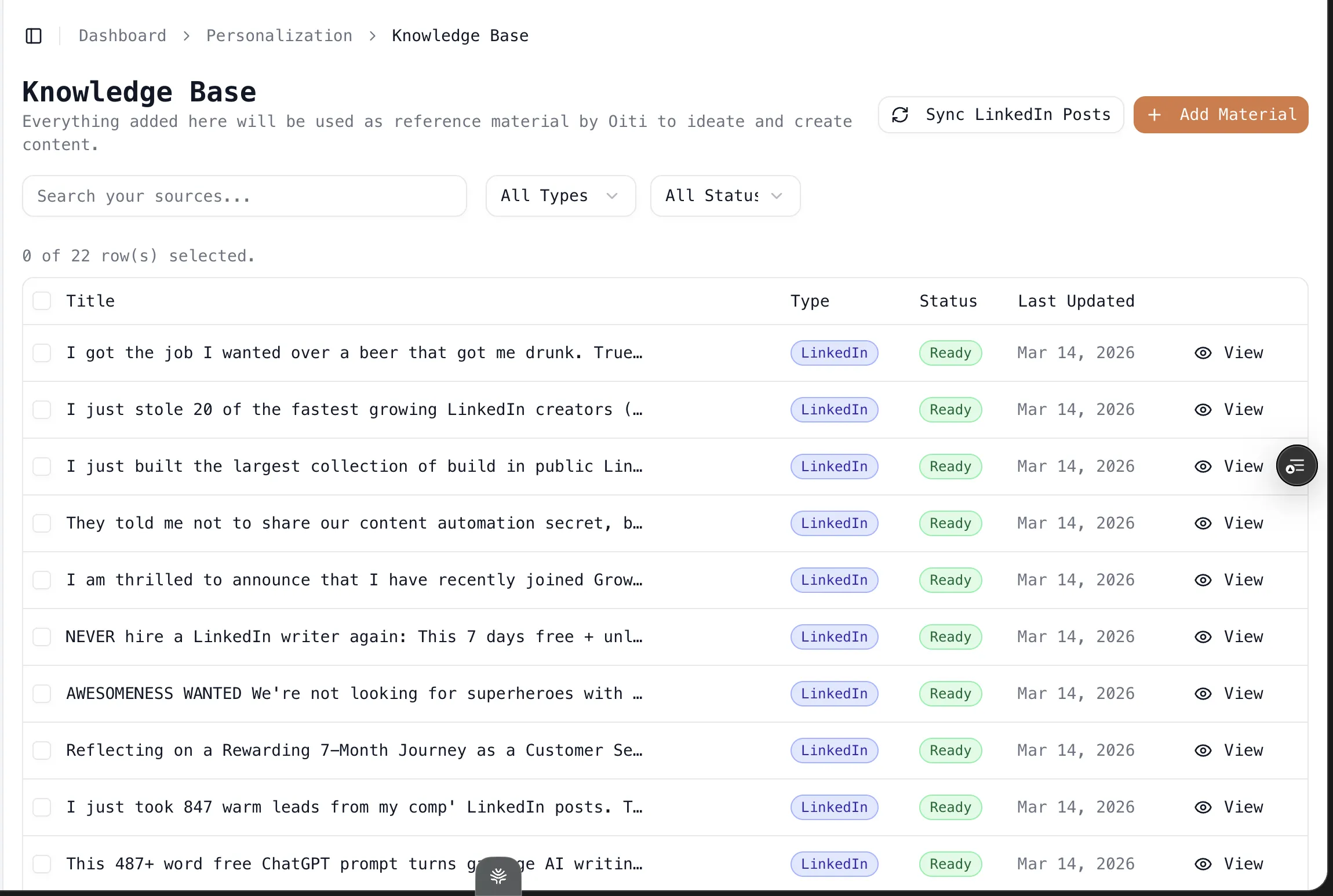
On top of that base it builds a 3,000 to 5,000-word narrative timeline from your last hundred or so posts, your website, and a deep search of your topic across X and Reddit. It also turns saved inspiration into one-click structural template breakdowns, which is exactly where EasyGen's Creators List stops. It publishes through LinkedIn's official Marketing Developer APIs, so there's no extension in the loop.
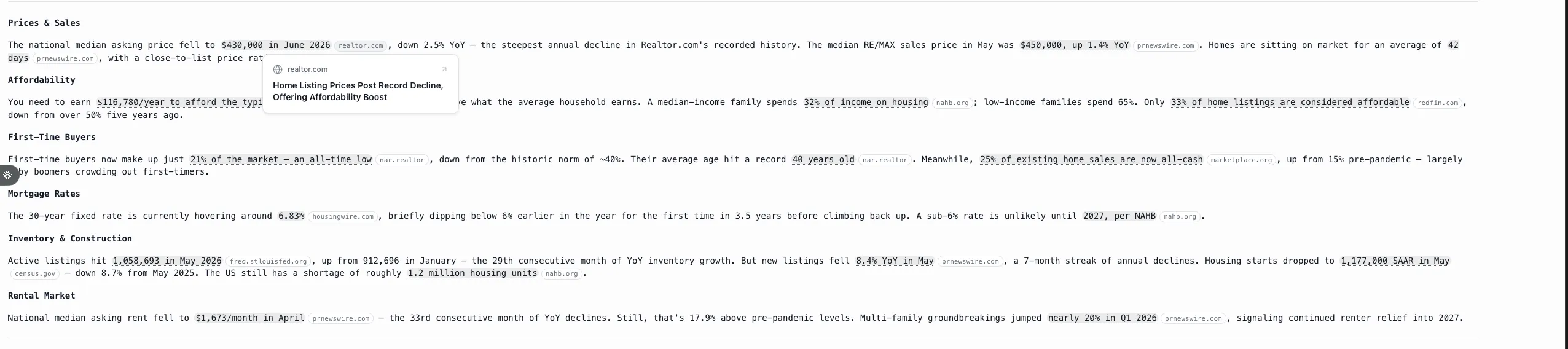
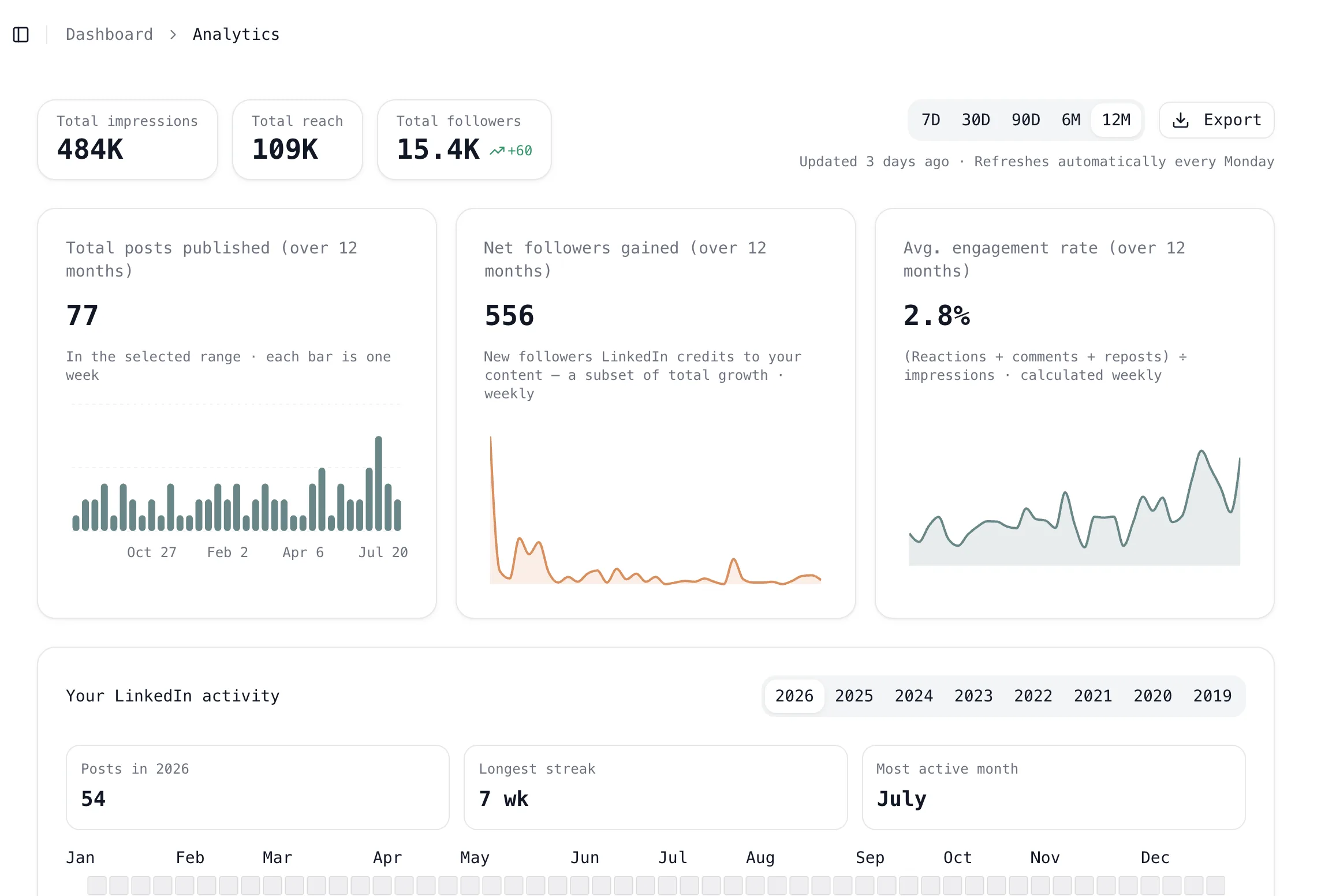
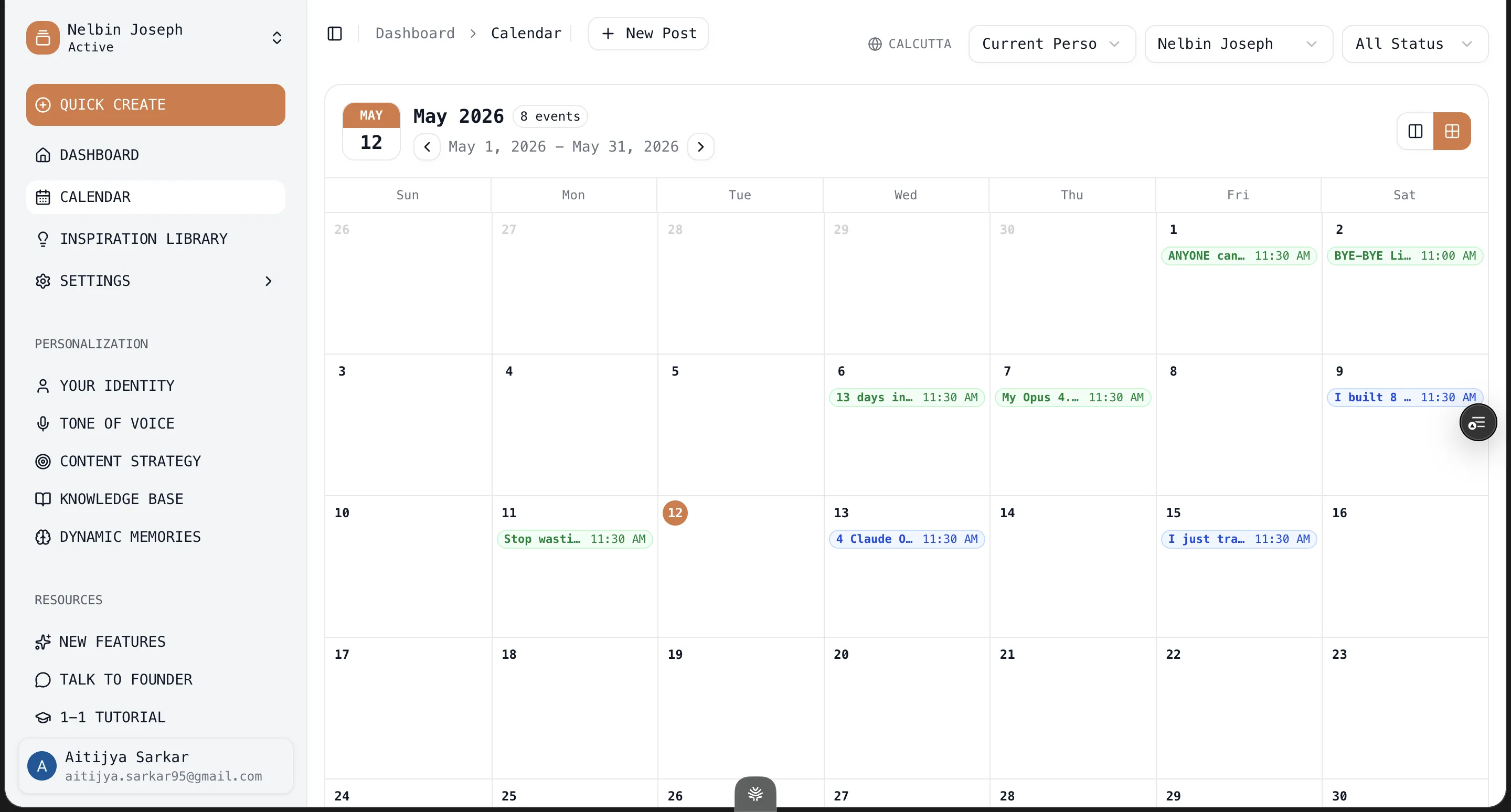
Two cases where I'd skip it. If you want the cheapest one-shot generator and you'll rewrite everything by hand, EasyGen (or ChatGPT) is fine and Oiti is overkill. If you need team plumbing for a large content operation, Scripe's structure is worth paying for and Oiti doesn't try to match it. Oiti is for the originality problem both of them share. There's a 7-day free trial, no usage caps, and the AI Clone builds in about 30 seconds.
Frequently asked questions
Is EasyGen cheaper than Scripe?
Is Scripe better than EasyGen for teams?
Can I use EasyGen and Scripe together?
Which produces less generic content, EasyGen or Scripe?
Is there a better alternative to both EasyGen and Scripe?
The verdict
Scripe is the better tool of the two for almost everyone. A chat editor that answers back, a broad knowledge base, tone-of-voice setup, analytics, and team workflows beat a one-shot form that hands you 2020 broetry and forgets you the moment you close the tab. If you run a content team, it's the clear pick, though budget for the €99 Advanced tier rather than €69 Solo and cancel deliberately if you ever leave. EasyGen only makes sense in one narrow case: you want the cheaper of the two, you'll rewrite every draft yourself, and you want a tool that never touches your LinkedIn account. Even there, ChatGPT is the smarter cheap buy, because it lets you push back on a draft.
Neither one solves the thing that decides whether any of this is worth publishing. Both start cold every session, and both pull your writing toward whatever went viral this week, which is how you end up sounding like everyone else running the same tool. That's the gap Oiti's long-term memory and Knowledge Base close.
If you want to see what that looks like, the AI Clone builds in about 30 seconds, and you can run the same topic through all three before you decide.
7 days free · No usage limits