I Tried Easygen for 7 Days: Honest Review of Features, Pricing, and Cons in 2026
Expired 2020 broetry, a one-shot form to learn who you are, and a bad writing experience / form. Even ChatGPT iterates better.

The scorecard
The scorecard (my honest verdict, up top)
EasyGen is a LinkedIn content generator that sells a viral-post "system," but in practice it's a one-shot form that spits out generic, templated broetry — the short, wavy one-sentence-per-line content that worked in 2019 and 2020 and that LinkedIn now quietly buries. It costs $59.99/mo — there's a 7-day free trial. But what you find when you look is output that doesn't sound like you and is ai slop. For anyone who wants content in their own voice, it isn't worth it. Even ChatGPT does better, because ChatGPT at least lets you iterate with feedback.
- Narrative timeline (does it know who you are over time?)1.5 / 5
It force-feeds an influencer's viral playbook onto everyone. There's no personal arc — it optimizes for the format, not your story.
- Tone-of-voice clone (does it write in your patterns?)1.5 / 5
I tested it on "AI taking away jobs" and got generic templated broetry ("This change is happening fast"). It doesn't sound like you. This is the lead pain.
- Long-term memory (does your feedback stick?)1.5 / 5
A one-shot form to output, no conversational second pass, nothing persists between sessions. Even ChatGPT does better, because ChatGPT lets you go back and forth.
- Research grounding / knowledge base (does it pull from your world?)2.5 / 5
"Track Creators" surfaces high-performing posts, which is real raw material. But there's no knowledge base underneath, and it never turns those posts into anything reusable. A feed, not a research engine.
- Built for the 2026 algorithm (original depth vs old viral patterns)2 / 5
It bottles the 2019 to 2020 broetry format the new algorithm structurally suppresses. Optimized for an era that's over.
- LinkedIn safety (official APIs or browser hacks?)4 / 5
It's a generate-only web tool. I saw no Chrome extension and nothing that scrapes or automates your account, so the ToS risk here is genuinely low.
I weight sounding like you, memory, and knowledge grounding highest, because that's what matters if you want posts that have a unique POV and isn't AI slop. EasyGen lands at ≈2.1 because it's weakest exactly there and only really strong on account safety, which it earns by being a plain web tool that doesn't touch your login.
Worth saying plainly: the gap is the writing. Oiti drafts from a long-term memory of you and a Knowledge Base of your posts, PDFs, and transcripts, remembers every correction across sessions, and lets you refine a draft in chat instead of re-submitting a form — the layers EasyGen's one-shot form doesn't have. Both are ToS-safe. If you want posts that sound like you, try Oiti free for 7 days and score it on the same axes.
Who I am, and how I actually used EasyGen
I first heard about EasyGen from Ruben Hassid, a LinkedIn influencer with hundreds of thousands of followers, and from Anisha Jain, who appears to be on his team. They'd posted about it together, and given my background I jumped into the app genuinely excited, hoping it had intelligently solved some of the problems I'd hit with every other LinkedIn ghostwriting tool.
For context on where I'm coming from: I've spent close to six years ghostwriting LinkedIn content for 50 to 60 founders, coaches, consultants, and CXOs across SaaS, crypto, insure-tech, and deep tech, and something north of 100 million organic views between them. In that time, I've paid for and tested most of the LinkedIn AI content tools that exist.
I tried EasyGen last year, in 2025. There's a 7-day free trial today. I got in, generated real posts against a live topic, and evaluated the output.
The onboarding broke on the way in. That's not a figure of speech.
Lets jump in.
What EasyGen actually is
EasyGen's pitch is right on the homepage: "Write LinkedIn posts like creators with 100M+ views." The subhead spells out the system it's selling: "Stop guessing what works on LinkedIn. EasyGen uses real data from top 1% creators plus trending topic intelligence to write posts that get engagement."
It claims 10,000+ people have joined.
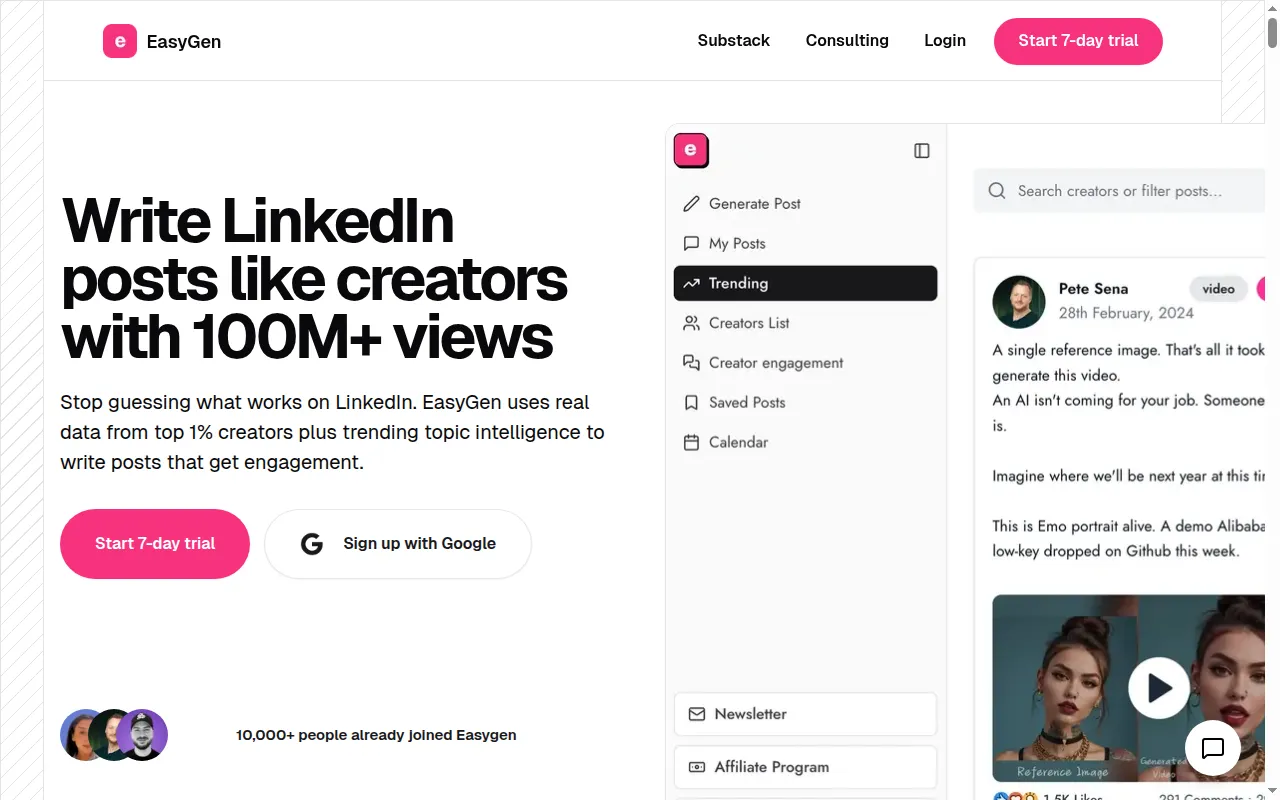
Under the hood it's a LinkedIn-only web app: a form-driven writing surface (not a chat) where you feed it a topic and it generates a post, a "Trending" and "Track Creators" feed that surfaces high-performing posts from people you follow, a My Posts library, and a scheduler.
The through-line of all of it is a strong opinion about viral formats. EasyGen is built to reproduce the content that made a handful of influencers big, and it doesn't hide that. That's the pitch. Here's what it's like to actually live in.
Step-by-step walkthrough of EasyGen: onboarding, the generator, the trend feed, and pricing
Getting in
The first real screen asks you to share your LinkedIn so it can, in its words, "use publicly available information about your profile to personalize your experience," with a reassuring line underneath: "EasyGen will never be connected to your LinkedIn, whatsoever." Fine. I typed in my name and my profile URL and hit Continue.
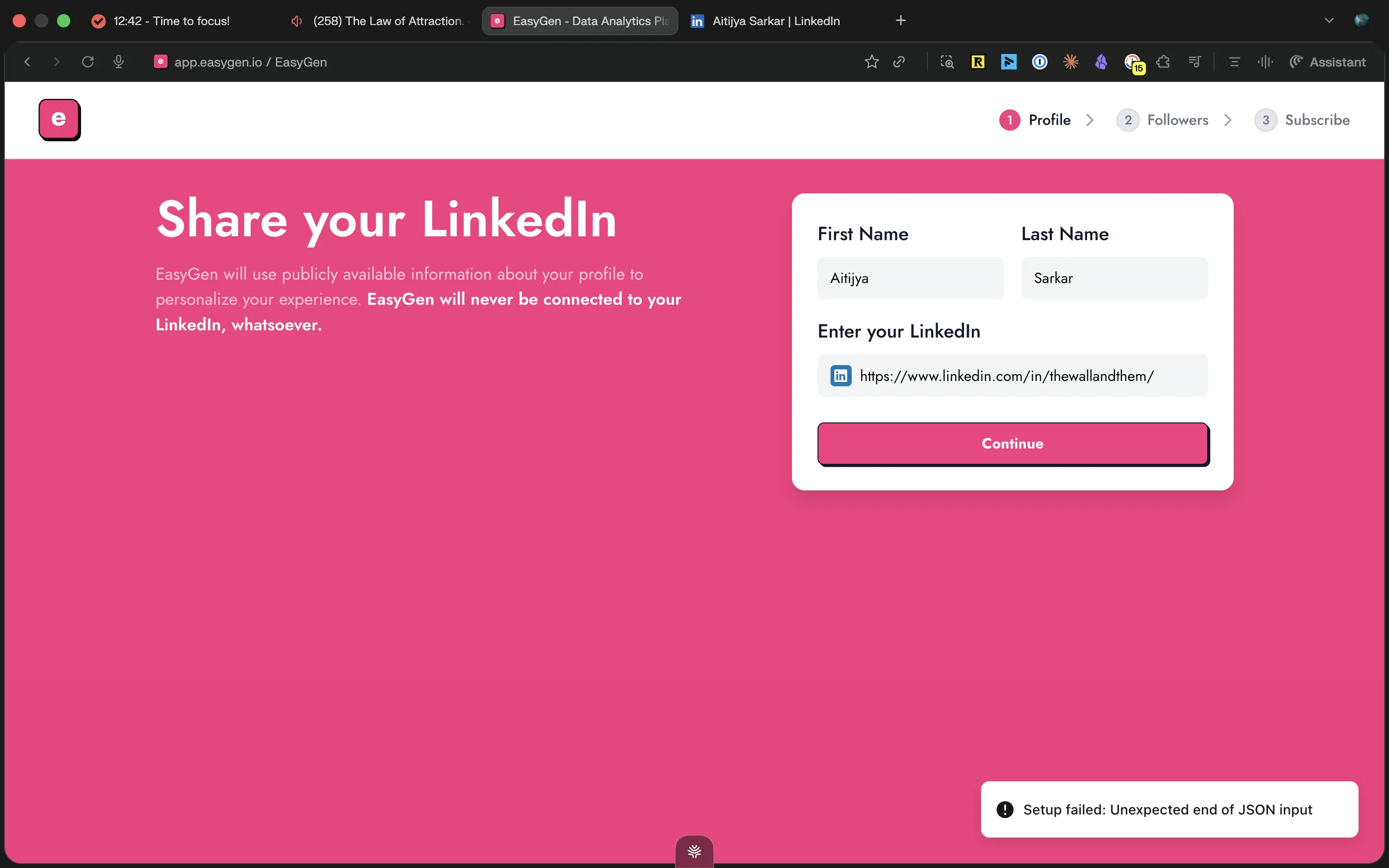
It failed. "Setup failed: Unexpected end of JSON input." I tried three or four times before it finally let me through.
That's a bad first impression for a tool you're evaluating for a $59.99/mo subscription. A JSON parse error on the single most important onboarding step, where you hand over your LinkedIn profile, is the kind of thing you fix before you charge people. I got past it, but the taste stayed.
The content generator, and what it writes
This is the part that matters, so I spent the most time here, and it's where I tested EasyGen on a real topic: AI taking away jobs. You give it the subject, it produces a post, and you land in an editor with the draft on the right and your saved drafts on the left. It generated three variations, all a one-shot form to output, no chat, no back-and-forth.
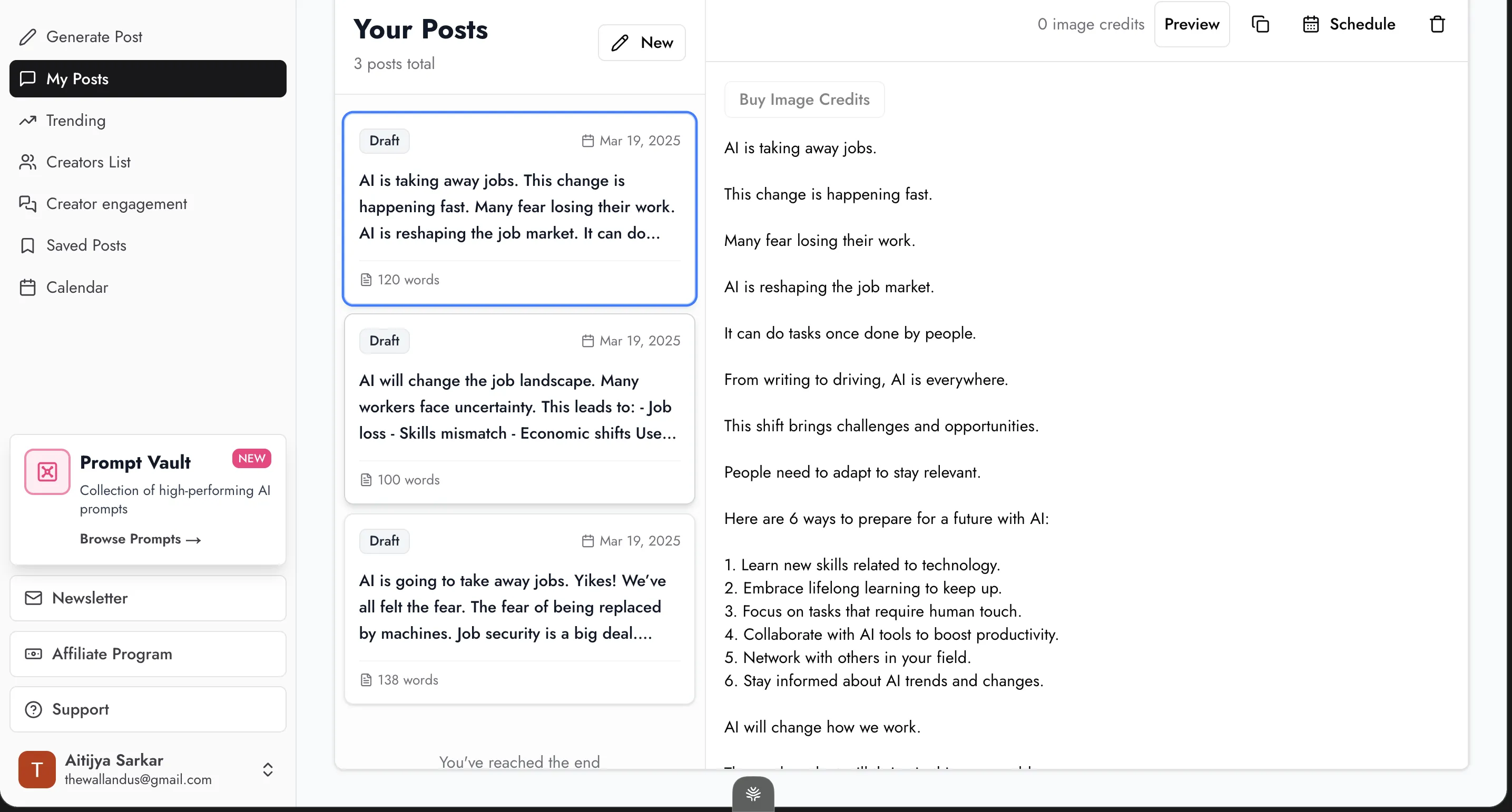
Here's exactly what came back.
The generated post, verbatim:
AI is taking away jobs.
This change is happening fast.
Many fear losing their work.
AI is reshaping the job market.
It can do tasks once done by people.
From writing to driving, AI is everywhere.
This shift brings challenges and opportunities.
People need to adapt to stay relevant.
Here are 6 ways to prepare for a future with AI:
1. Learn new skills related to technology.
2. Embrace lifelong learning to keep up.
3. Focus on tasks that require human touch.
4. Collaborate with AI tools to boost productivity.
5. Network with others in your field.
6. Stay informed about AI trends and changes.
AI will change how we work.
Read it out loud. One sentence per line, every line a flat declarative, a numbered listicle in the middle, and a cringe sentence at the end. This is broetry. It's the exact template that printed engagement in 2019 and 2020, when LinkedIn rewarded easy, skimmable, one-line-per-thought content. But now, its basically ai slop.
It reads like a person who has never had a specific thought about AI and jobs. There's no argument, no story, no you.
And it isn't just dated aesthetically. LinkedIn's 2026 algorithm actively suppresses this kind of vanilla, templated content. So the output is worse than generic — it's generic in the exact register the platform now buries. The tool is optimized for an era that's gone.
I went in hoping EasyGen would encode how Ruben Hassid and his team actually grew, so I could understand the mechanics. It doesn't. It force-feeds the playbook that worked for them onto everyone else. A lot of those influencers grew during the 2020 content boom, when consumption was unusually high and this format worked. EasyGen bottles that expired playbook and sells it as a system.
Track Creators, and what the trend feed actually is
EasyGen's other half is discovery. You build a "Creators List" of people whose content performs, and the tool surfaces their high-performing posts so you can model them.
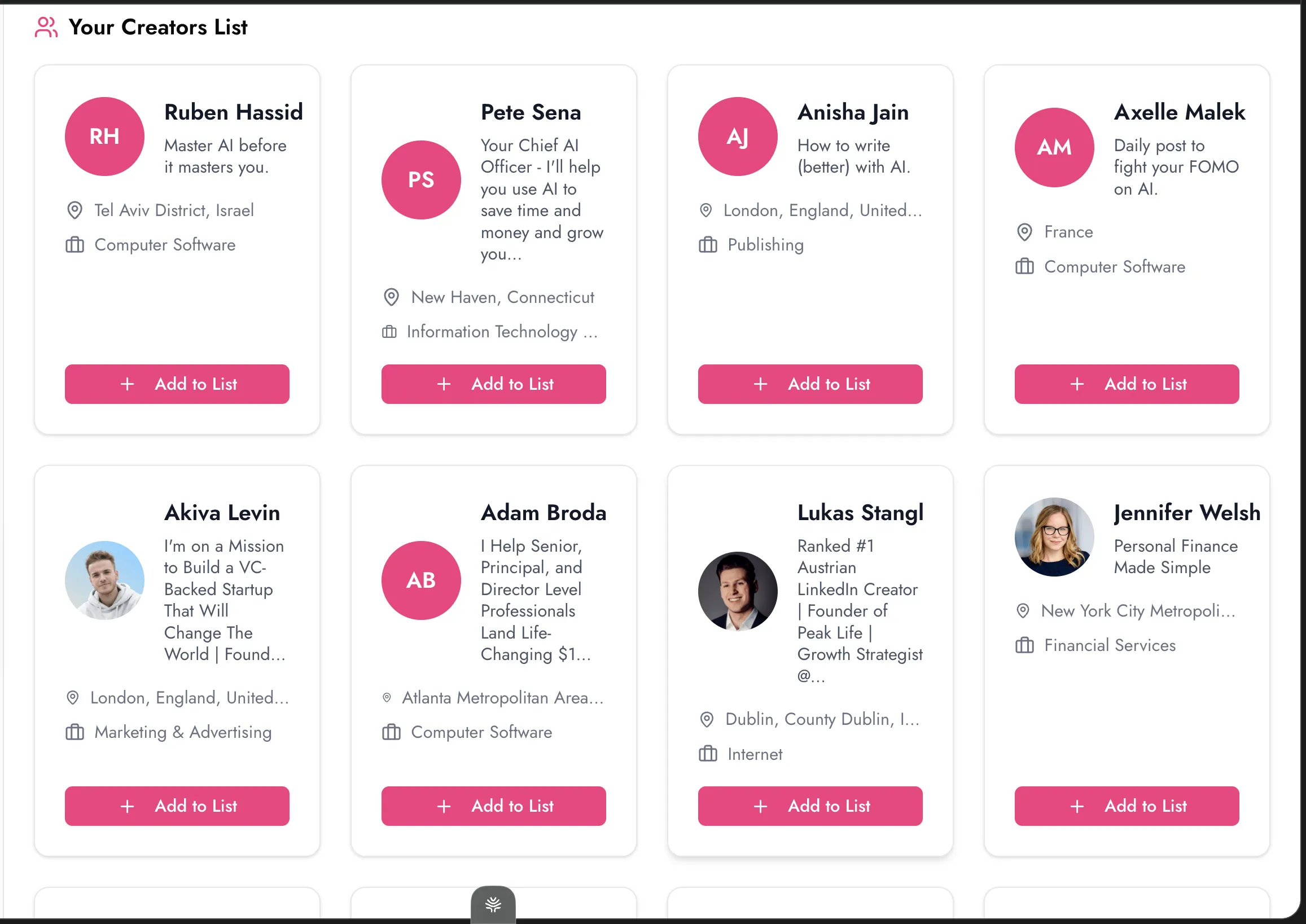
Click into a creator and you get their outlier posts, ranked by how far they beat that creator's own baseline.
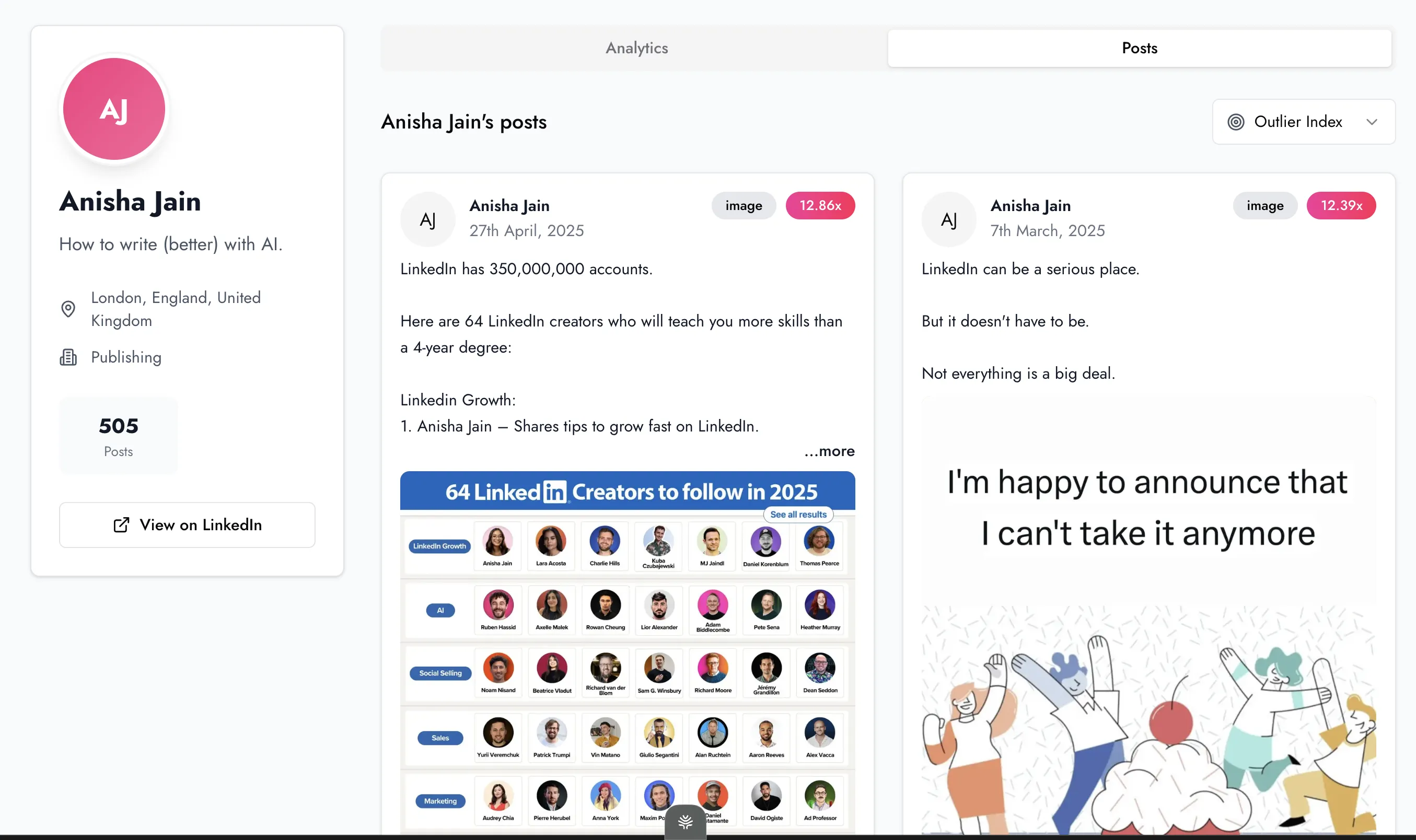
The idea is good. But notice where it stops. It shows you the viral post. That's it. The thing that would actually matter is turning that post into something reusable: a line-by-line teardown of why it worked, converted into a one-click template you could apply to your own topic, filled by a layer that already knows who you are. EasyGen doesn't do that. It surfaces the post and leaves you to reverse-engineer it by eye, which for most people means copying the shape and producing more broetry.
Pricing
To find the actual price, you have to be inside the app. There's no public pricing page. When you go to upgrade, this modal appears.
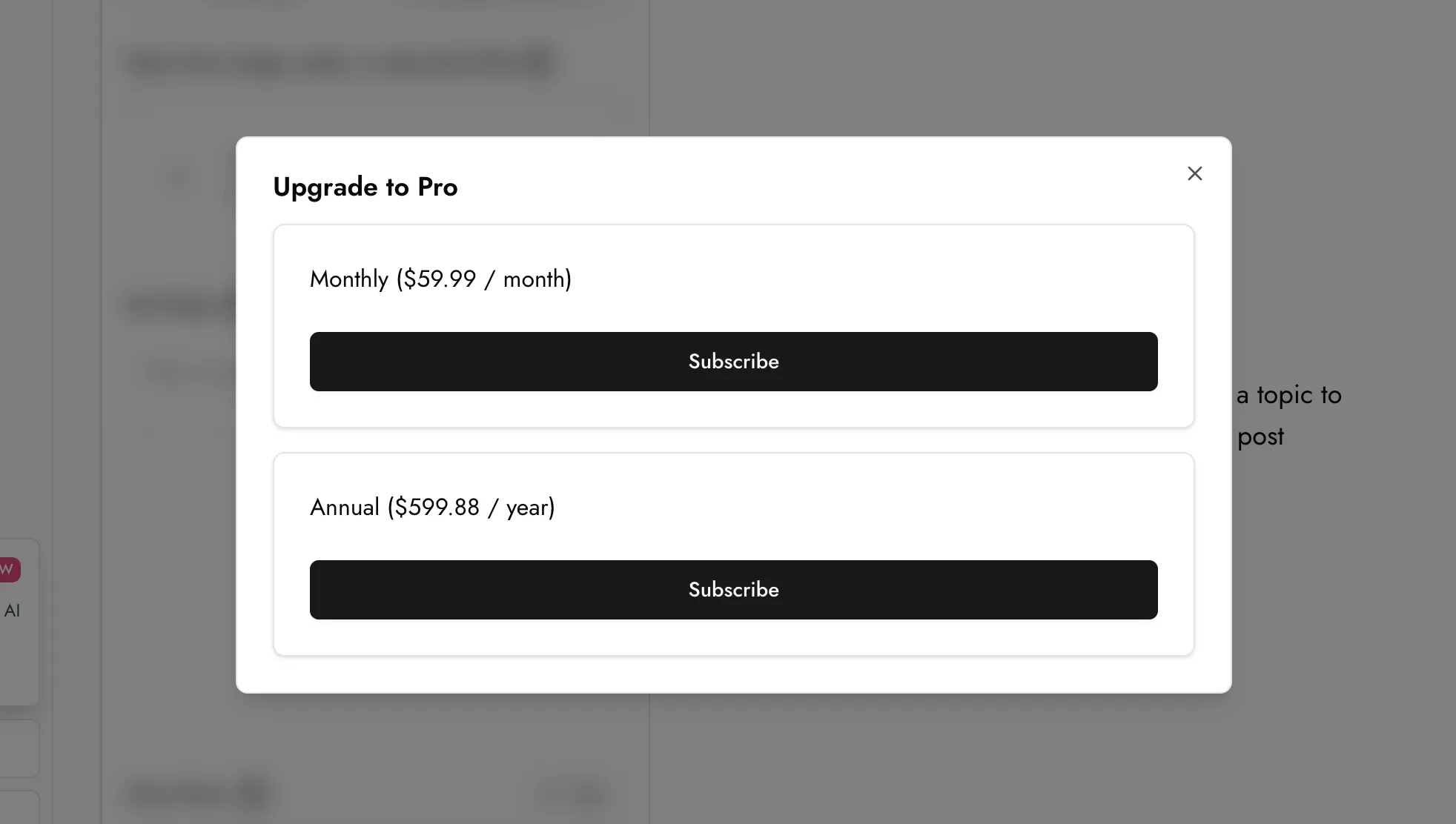
$59.99 a month, or $599.88 a year. No public number until you're logged in and hitting the paywall. I'll break that down properly below.
Want a week of LinkedIn posts that aren't AI slop?
Oiti builds a clone of your voice from your own posts — then gets sharper with every edit, grounded in your own Knowledge Base.
7 days free · No usage limits
Where EasyGen genuinely earns it
Three things EasyGen does well, each with the catch named in the same breath.
1. The Track Creators trend feed is a genuinely good idea.
Surfacing high-performing posts from creators you actually follow, ranked by how far they outperformed that creator's baseline, is genuinely useful raw material. If you're staring at a blank page, seeing what's working right now in your niche beats guessing. The concept is sound.
The catch: it stops at the feed.
It surfaces the post but never breaks it down or turns it into something you can reuse, so the value ends the moment you close the tab.
2. It's fast, and speed is a legitimate reason someone likes it.
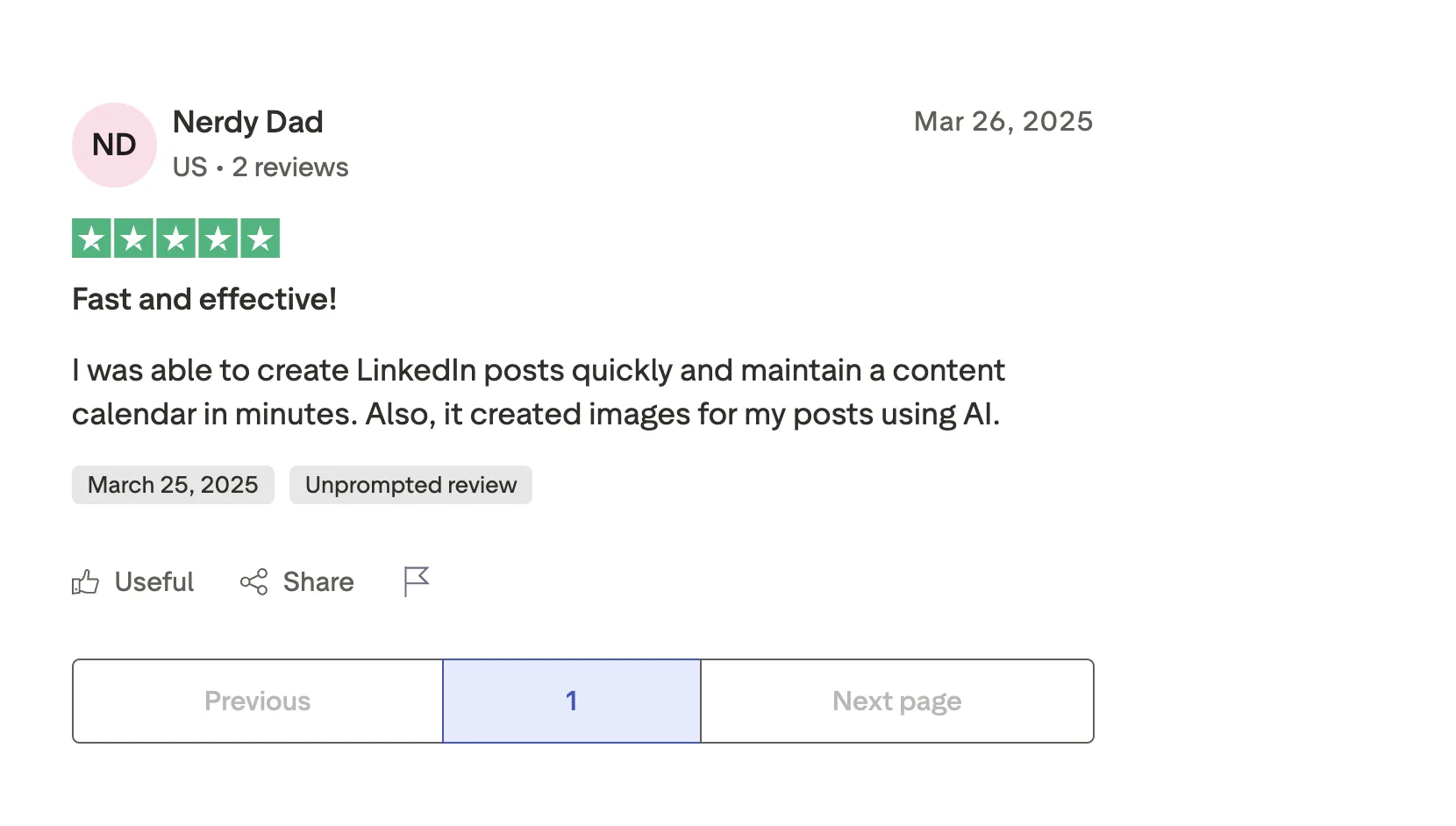
For someone who just wants a viral-format skeleton in one click and plans to heavily rewrite it themselves, the one-shot form does produce something quickly. That's honest credit for speed, not quality. One Trustpilot reviewer, Nerdy Dad in the US, gave it 5/5 back in March 2025 and put it plainly: he was "able to create LinkedIn posts quickly and maintain a content calendar in minutes," and it made images for him too. If your bar is "give me a fast starting scaffold," EasyGen clears it.
The catch is baked into the strength: fast is only good if the output is worth editing, and mostly it isn't.
3. It's LinkedIn-only, and it's a plain web tool.
EasyGen doesn't pretend to do X, Instagram, and blogs at once. The single-platform focus is a legitimate positioning choice for a LinkedIn-only buyer. And on account safety it's genuinely low-risk: I saw no Chrome extension and nothing that scrapes or automates your LinkedIn. It generates text in a web app and gets out of the way. In a category where half the tools run automation through your login and quietly risk your account, "it can't get you flagged because it doesn't touch your account" is a genuine, if quiet, advantage.
The problem with EasyGen — where it breaks down
Three frictions, worst first.
1. Generic, templated broetry. This is the dealbreaker.
I've shown you the screenshot already: a real topic in, and out came "AI is taking away jobs. This change is happening fast." one line at a time. That's the expired 2020 influencer playbook, and it's the thing the tool is for — it doesn't sound like you, and the 2026 algorithm suppresses it. For a tool whose entire promise is content that performs, producing content the platform now buries is the whole ballgame.
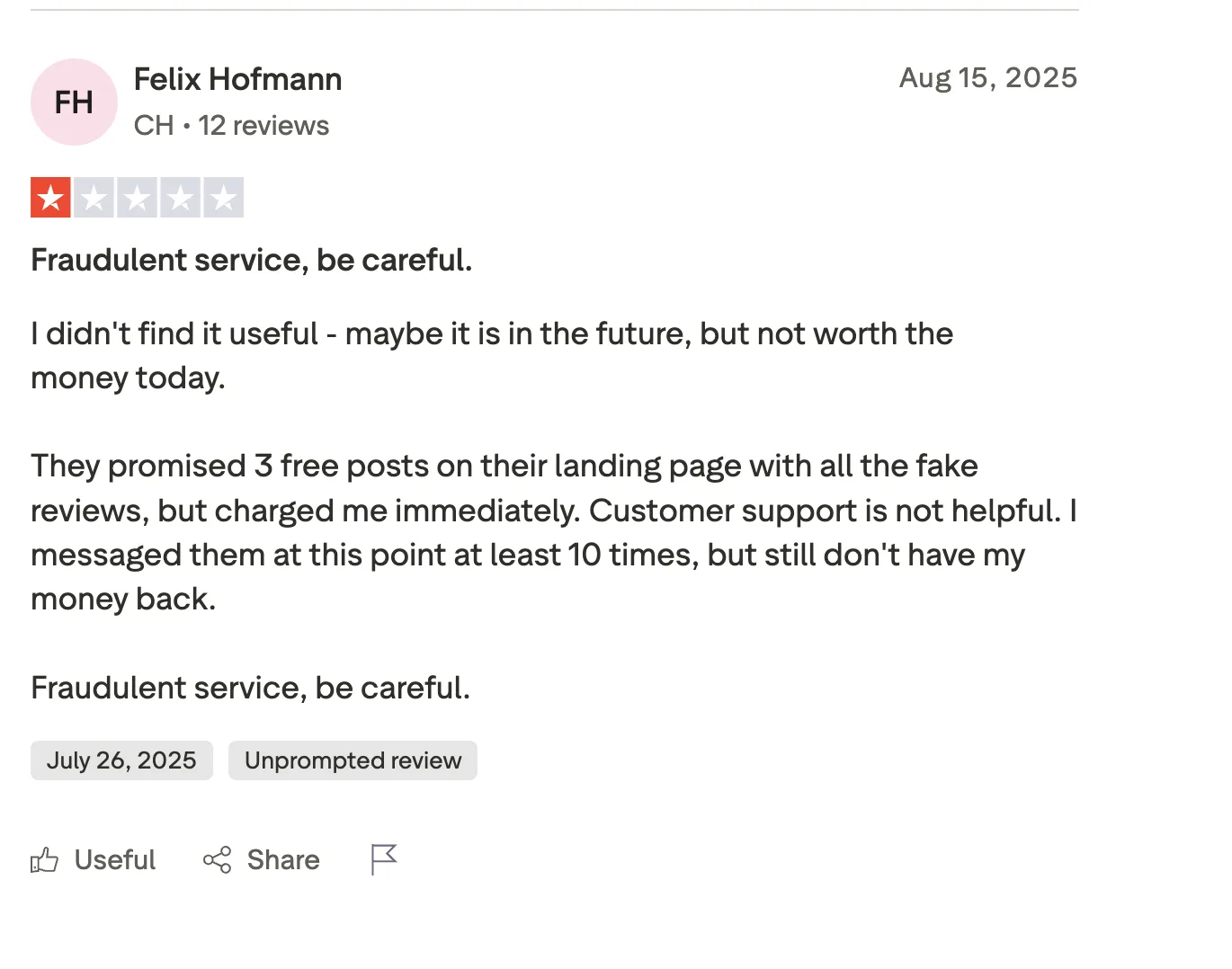
I'm not the only one who didn't think it was worth it. Felix Hofmann, in Switzerland, left a 1/5 on Trustpilot in August 2025 titled "Fraudulent service, be careful": "I didn't find it useful, maybe it is in the future, but not worth the money today."
2. A one-shot form, no iteration, no memory.
You give EasyGen a topic, it gives you a post, and that's it. There's no conversational second pass, and nothing carries between sessions, so you can't refine, you can only regenerate and hope. This is the comparison that stuck with me: even ChatGPT does better, because ChatGPT lets you go back and forth, tell it what's wrong, and watch it fix the thing. A static form to output pipeline can't.
You're stuck with what the slot machine gives you.
3. Track Creators is a feed, not a system.
The discovery feature surfaces other people's viral posts and stops there. It won't break them into reusable one-click templates, it won't teach you why a post worked in a way you can apply, and there's no knowledge base underneath to fill a template in your voice. So the "system" you're paying for is really a curated scroll of other people's greatest hits, which you then have to imitate by hand, which is how you end up back at broetry.
See the difference in a week.
Write the same post in EasyGen and Oiti, side by side. Unlimited usage on the 7-day trial — you'll know which one sounds like you.
7 days free · No usage limits
EasyGen pricing — does it make sense in 2026?
Here's the full picture of what EasyGen costs and how you get to the number.
| Plan | Price | What you get | The catch |
|---|---|---|---|
| Free trial | 7 days free | Onboard, generate posts, use the Track Creators feed | You're evaluating the output, which is where it's weakest |
| Pro (Monthly) | $59.99/mo | Full generator, Track Creators, scheduler, My Posts library | The price is login-gated — you can't see it until you're inside the app |
| Pro (Annual) | $599.88/yr (≈$50/mo) | Everything in Pro, billed yearly | You commit for a year to get the effective discount |
The honest read: $59.99/mo is at the premium end of this category, and there's no public pricing page, so you have to sign up and reach the "Upgrade to Pro" modal before you can even see what it costs. The 7-day free trial genuinely helps here, and I'll give it that, so you can look before you pay. But when the core thing you're evaluating is whether the output sounds like you, and the answer is no, a free trial mostly just means you find that out for free instead of for $59.99.
Who should buy EasyGen — and who should skip it
Buy it if
you want a fast source of viral-format LinkedIn skeletons that you'll heavily rewrite yourself, you genuinely don't care that the raw output is generic, and $59.99/mo for a one-click starting scaffold is fine by you.
Skip it if
- You want output that sounds like you,
- You want to iterate conversationally instead of re-submitting a form and praying,
- You write for a niche or a senior, educated audience where broetry backfires,
- You want a tool that gets better at your voice over time instead of forgetting you between sessions.
- If you're a solo founder, coach, or consultant whose whole edge is that your writing sounds like a specific human, EasyGen's expired-playbook, one-shot form is the exact opposite of what you need, and it's why I wouldn't pay for it.
Maybe, if
you're comparing EasyGen against a more voice-faithful tool and want to see the gap for yourself. Both EasyGen and Oiti have a 7-day free trial, so you can run the same topic through both and read the two outputs side by side. That comparison is the fastest way to settle it.
What I'd actually use — and what I built Oiti to do differently
Three problems above, three answers, and I'm only pulling from pains EasyGen actually has.
On generic, templated broetry → Oiti drafts from your long-term memory and knowledge base. Every time you write, it runs several parallel fetches across what it knows about you (your beliefs, your stories, the way you actually talk) plus a live web search on your ICP, before drafting a line. The per-inspiration template loop sits on top of that. It's built to write you, not the format that printed engagement for someone else five years ago.
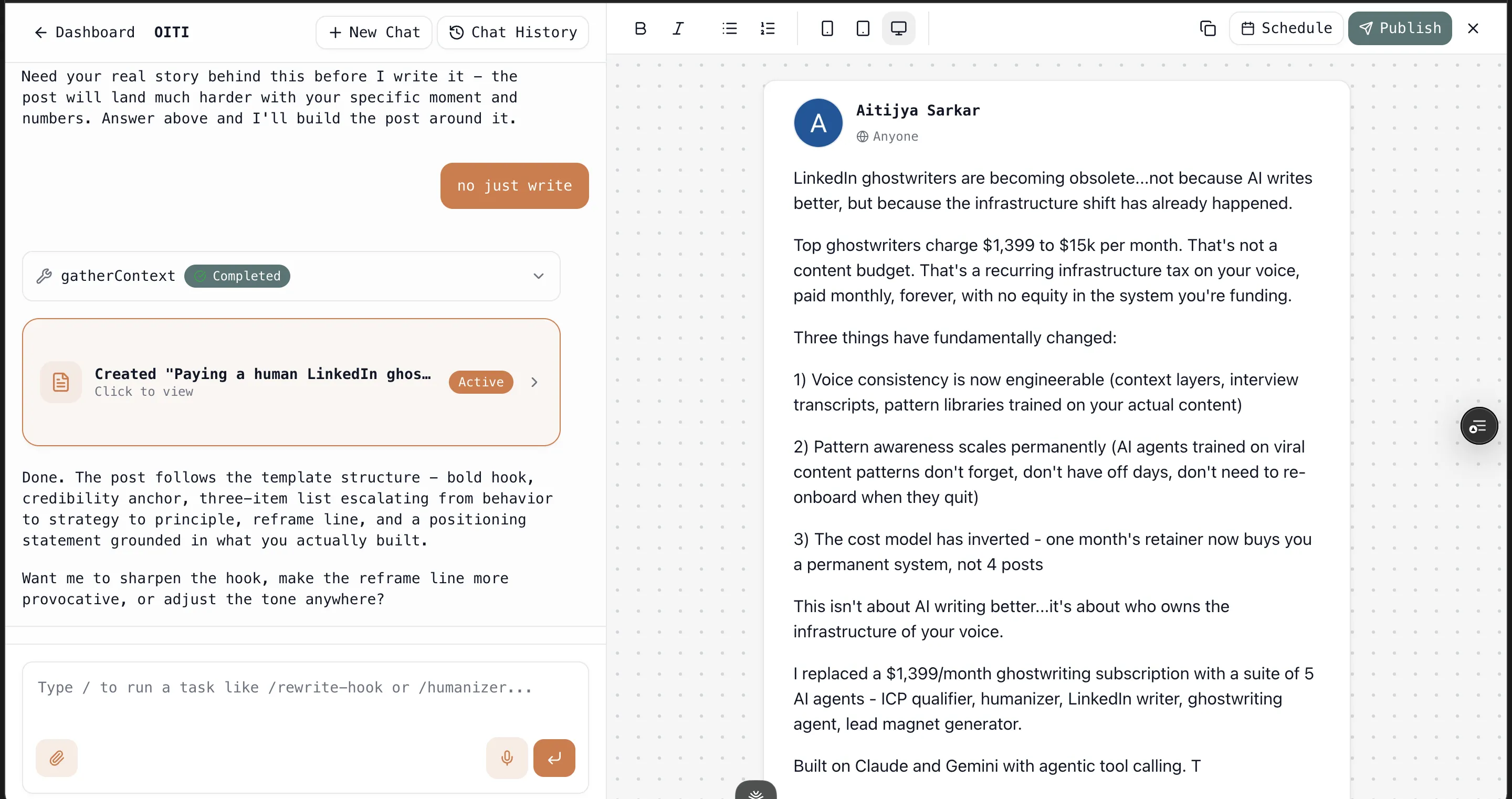
On the one-shot form with no memory → Oiti keeps a memory that compounds. It's a chat composer, so the back-and-forth is native, and it absorbs every edit and instruction across sessions, so the persona sharpens the more you use it instead of resetting each time.
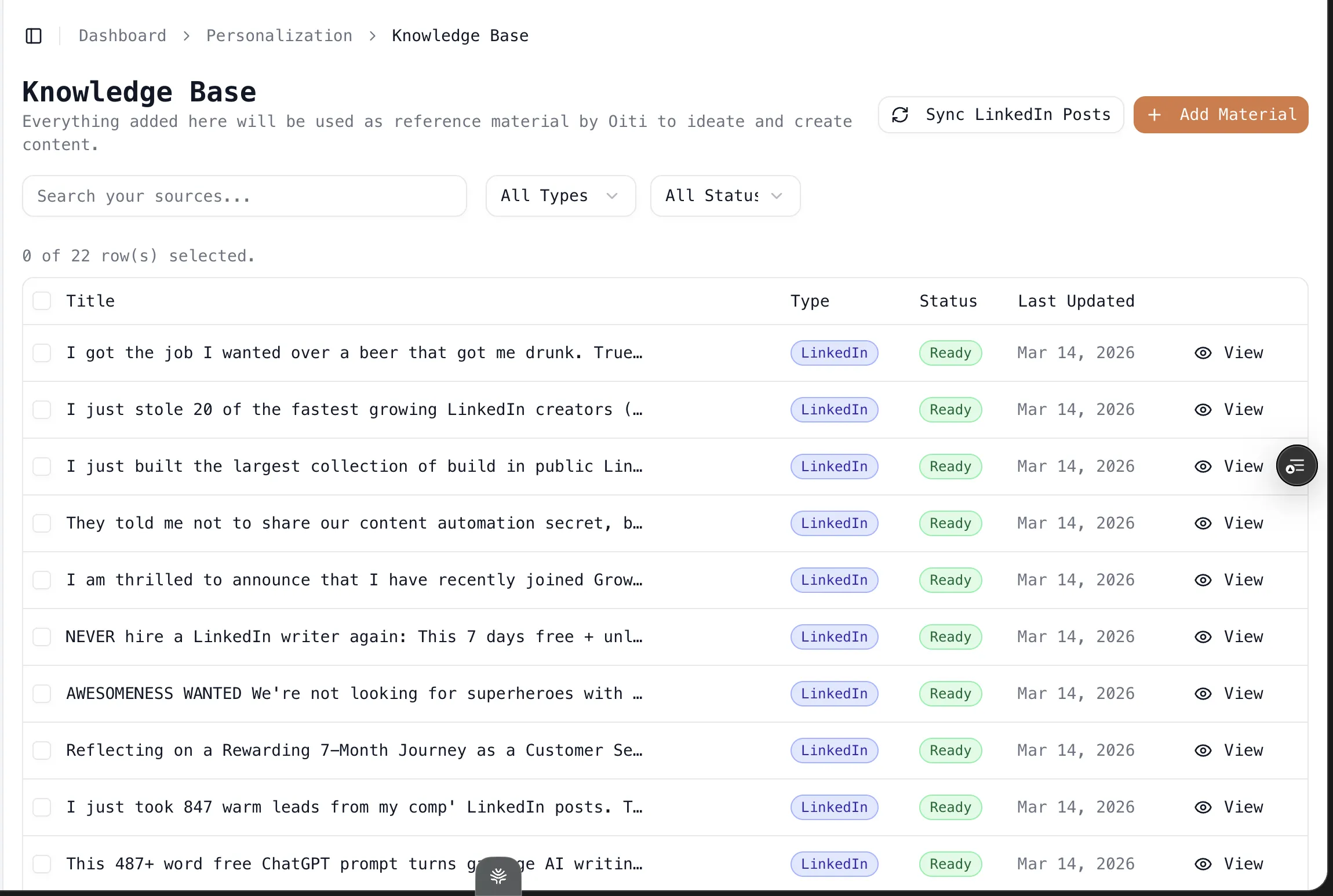
No analytics or deep scheduling → Oiti Pro is $79/mo for three accounts, and $49 for one: and you get deep scheduling + analytics using linkedin's official apis.
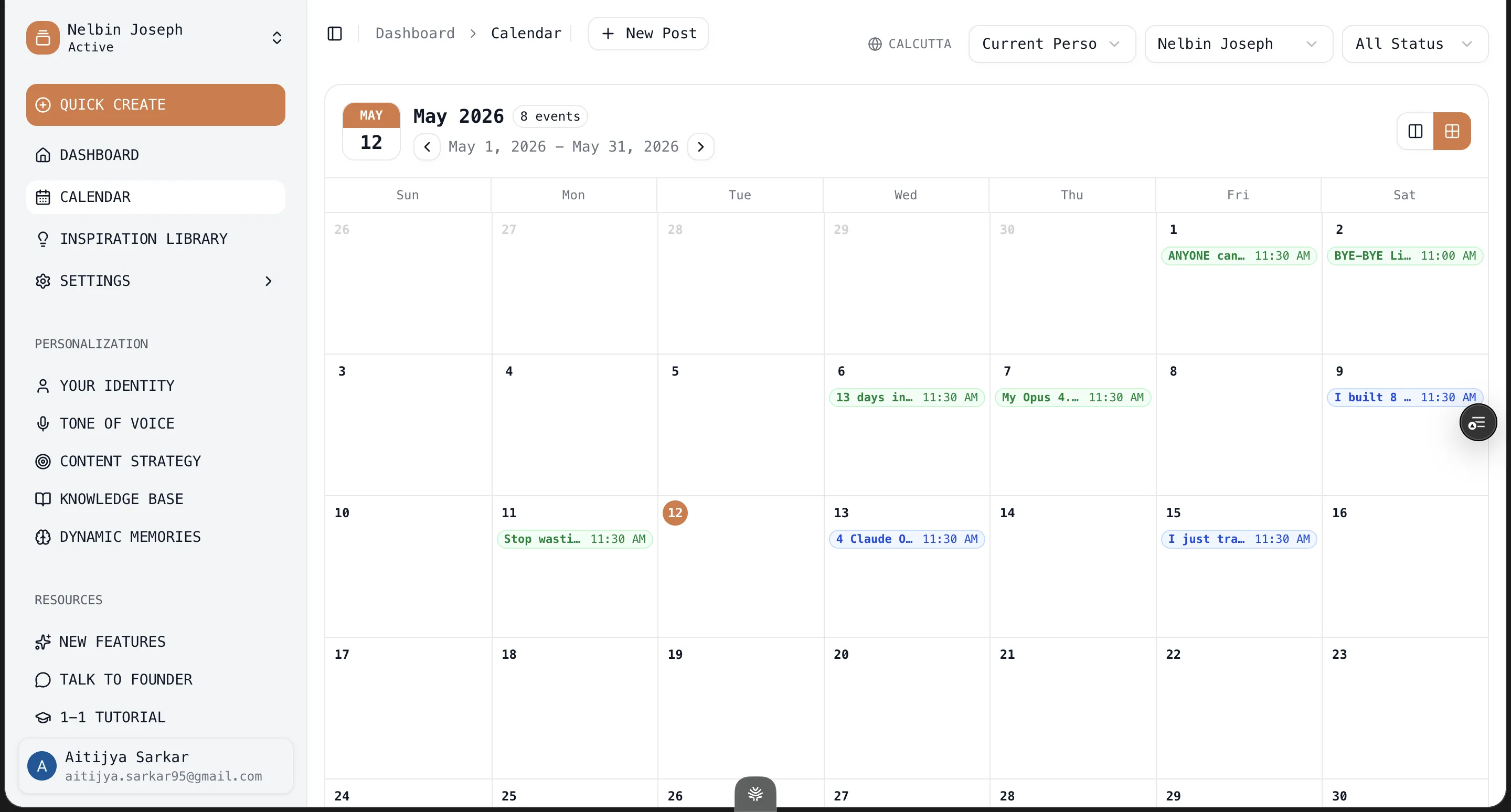
If you want posts that sound like you, Oiti is the one I'd test in parallel — the trial is 7 days and the AI Clone builds in about 30 seconds. Run the same "AI taking away jobs" topic through both and read the two drafts next to each other.
EasyGen vs the best alternatives
How EasyGen stacks up against the tools people usually compare it with:
| Tool | Price (from) | LinkedIn-native | Voice memory | ToS-safe (official APIs) | Best for |
|---|---|---|---|---|---|
| Oiti | $49/mo | Yes | Yes (long-term memory + KB) | Yes | Founders/coaches/consultants who want posts that sound like them |
| EasyGen | $59.99/mo | Yes | No (one-shot form) | Yes (plain web tool) | Fast viral-format skeletons you'll rewrite yourself |
| Supergrow | ~$19/mo | Yes | Limited | Yes | Budget content scheduling |
| Kleo | $99/mo | Yes | Limited (static profile) | Yes | Fast viral-format content on a single account |
| Taplio | $39/mo | Yes | No | No (Chrome extension) | All-in-one content + outbound, if you accept the account risk |
For the full field, see the best EasyGen alternatives, which I tested hands-on, and the best LinkedIn AI tools in 2026 for the whole category. Down to two tools? I also compared EasyGen vs Taplio, EasyGen vs Supergrow, EasyGen vs Scripe and AuthoredUp vs EasyGen head to head.
Frequently asked questions
Is EasyGen worth it in 2026?
How much does EasyGen cost?
Does EasyGen have a free trial?
Does EasyGen's AI actually sound like me?
What is EasyGen and who is it for?
Is EasyGen safe to use with LinkedIn?
How does Oiti compare to EasyGen?
The verdict
EasyGen scored ≈2.1/5 on the axes that decide whether a LinkedIn AI tool writes like you, remembers you, and keeps your account safe. It's a fast, LinkedIn-focused, genuinely low-risk web tool, and the Track Creators feed is a genuinely good idea. But the thing it's built to do — write your posts — it does with expired 2020 broetry, out of a one-shot form that forgets you the moment you close it. For the heavy editor who just wants a viral-format skeleton to react to and rewrite, it's a defensible buy, and the 7-day free trial means you can confirm that for yourself at no cost. For everyone else — and especially for the solo founder, coach, or consultant whose edge is writing that sounds like a specific human — the output works against you, there's no memory that learns your voice, and even ChatGPT gives you more by letting you go back and forth. If you want to see what “sounds like you” looks like in practice, try Oiti free for 7 days — the AI Clone builds in about 30 seconds, and you can run the same topic through both tools before you decide.
7 days free · No usage limits